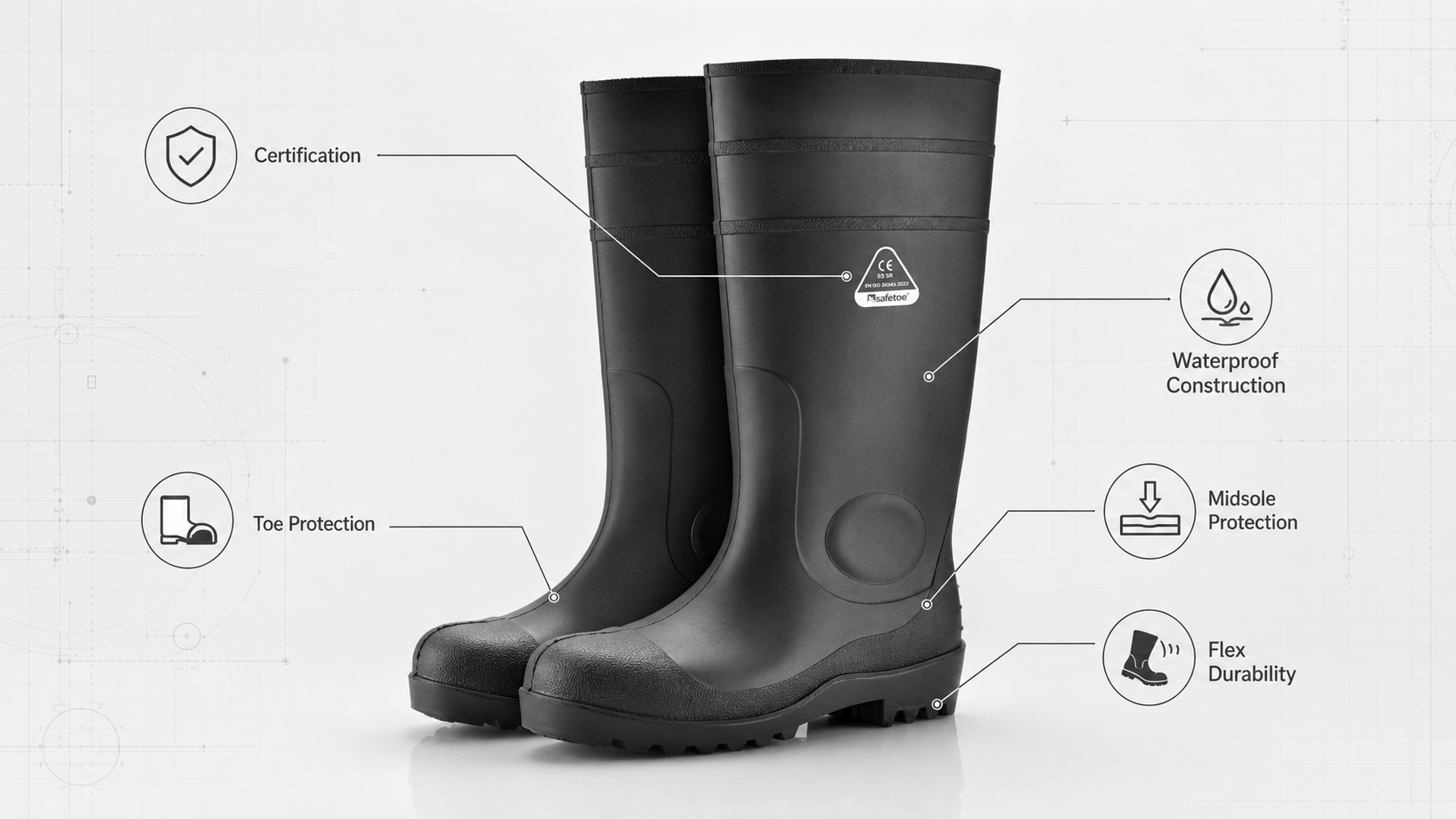
PVC Wellington boots may look similar, but they can meet very different standards and protection levels. For professional PPE purchasing, terms such as waterproof, steel toe, PVC, and slip resistant are not enough to judge whether a boot is suitable for a specific workplace.
Buyers should also confirm four key points: Which standard does it meet? What protection level does it provide? What test or certification evidence supports the claim? And which technologies improve its performance?
This guide explains the differences between EN ISO 20345 and EN ISO 20347, along with S5 protection, certification checks, waterproof construction, and flex durability.
EN ISO 20345 applies to safety footwear with certified toe protection, while EN ISO 20347 covers occupational footwear. For Wellington boot procurement, buyers should verify the applicable standard, protection classification, product marking, certification evidence and actual workplace risks.
Learn more about Wellington Boots Certification.
1. EN ISO 20345 vs EN ISO 20347: What’s the Difference?
EN ISO 20345 and EN ISO 20347 are both widely used footwear standards, but they apply to different product categories. For PPE buyers, the key distinction is whether the footwear is intended to provide certified toe-impact protection.
EN ISO 20345 applies to safety footwear. Products under this standard are designed for workplaces where impact and compression hazards may be present, and the standard requires a protective toe cap. Depending on the classification, additional requirements may also cover features such as penetration resistance, water resistance and slip performance.
EN ISO 20347 applies to occupational footwear. It is intended for professional work environments where a certified safety toe is not the defining requirement. These products may still provide useful workplace performance such as water resistance, slip resistance and durability, but they should not replace EN ISO 20345 safety footwear where toe-impact protection is required.
| EN ISO 20345 | EN ISO 20347 |
| Footwear Type | Safety Footwear | Occupational Footwear |
| Safety Toe | Required by the standard | Not the defining requirement |
| Main Purpose | Protection against workplace hazards | Occupational workplace performance |
| Typical Selection | Higher-risk workplaces | Lower-risk wet-work environments |
| Safetoe Range | Certified Safety Wellington Boots | Occupational Wellington Boots |
For procurement, the correct choice should be based on the actual workplace risk assessment, together with the required standard, protection classification, product marking and supporting certification.
2. What Does S5 Mean for Safety Wellington Boots?
S5 is a Class II safety footwear classification under EN ISO 20345:2022. This is more meaningful than looking only at individual product claims such as steel toe, waterproof, or slip resistant.
For procurement teams, S5 should be treated as a protection classification, not as a description of one specific boot design. It indicates that the footwear has been assessed against the requirements applicable to that classification, helping buyers understand the level of protection the product is intended to provide.
It is also important to separate the standard requirement from the configuration of an individual Safetoe model.
For example,W-6037 is listed as EN ISO 20345:2022 S5 SR and is equipped with a steel toecap and steel midsole plate. These steel components are part of the W-6037 product configuration and should not be interpreted as a requirement that every S5 Wellington boot must use the same materials.
Similarly,W-6055 is listed as CE EN ISO 20345:2022 S5 SR.
For buyers, the key is to check both the certified classification and the actual product specification before purchasing.
3. How Buyers Should Verify Wellington Boot Certification
A supplier may state that a Wellington boot is "CE certified" or "EN ISO 20345 compliant", but buyers should verify that the certification actually applies to the product being purchased. A certificate alone is not enough if the model, classification or product identification cannot be matched.
A practical verification process should include five checks:
1. Check the product marking
Look for the applicable standard and protection classification marked on the footwear. These details should be consistent with the supplier’s product specification.
2. Check the product label
Confirm key identification information such as the model, size, standard and protection level. The label should allow the product to be clearly identified.
3. Check the certificate
Verify that the certificate covers the actual model or product family being purchased. Buyers should also check the issuing body, referenced standard and certification details rather than relying only on a supplier statement.
4. Check supporting test documentation
Where additional performance claims are important to the project, request relevant test reports or supporting documentation. This is especially useful when evaluating specific protection features beyond the basic product description.
5. Check product traceability
Model numbers, production information, batch or other identification should be traceable where applicable.
4. Waterproof Construction: More Than a Marketing Claim
For Wellington boot buyers, "waterproof" should mean more than a marketing claim. PVC material alone does not guarantee reliable protection against water ingress in real working conditions.
Buyers should evaluate the complete boot construction, including the molded PVC structure, critical connection areas, resistance to water ingress, and suitability for the intended wet-work environment. A boot used for light cleaning may face very different conditions from one used daily in mining, agriculture, construction, or industrial wash-down areas.
This is where Endravax™ Waterproof Protection becomes relevant. It represents Safetoe's approach to improving waterproof performance in selected Wellington boots designed for wet working environments.
For procurement teams, the correct logic is simple: define the wet-work requirement first, evaluate the waterproof construction second, and then confirm whether the technology matches the application.
5. Why Flex Durability Matters in PVC Wellington Boots
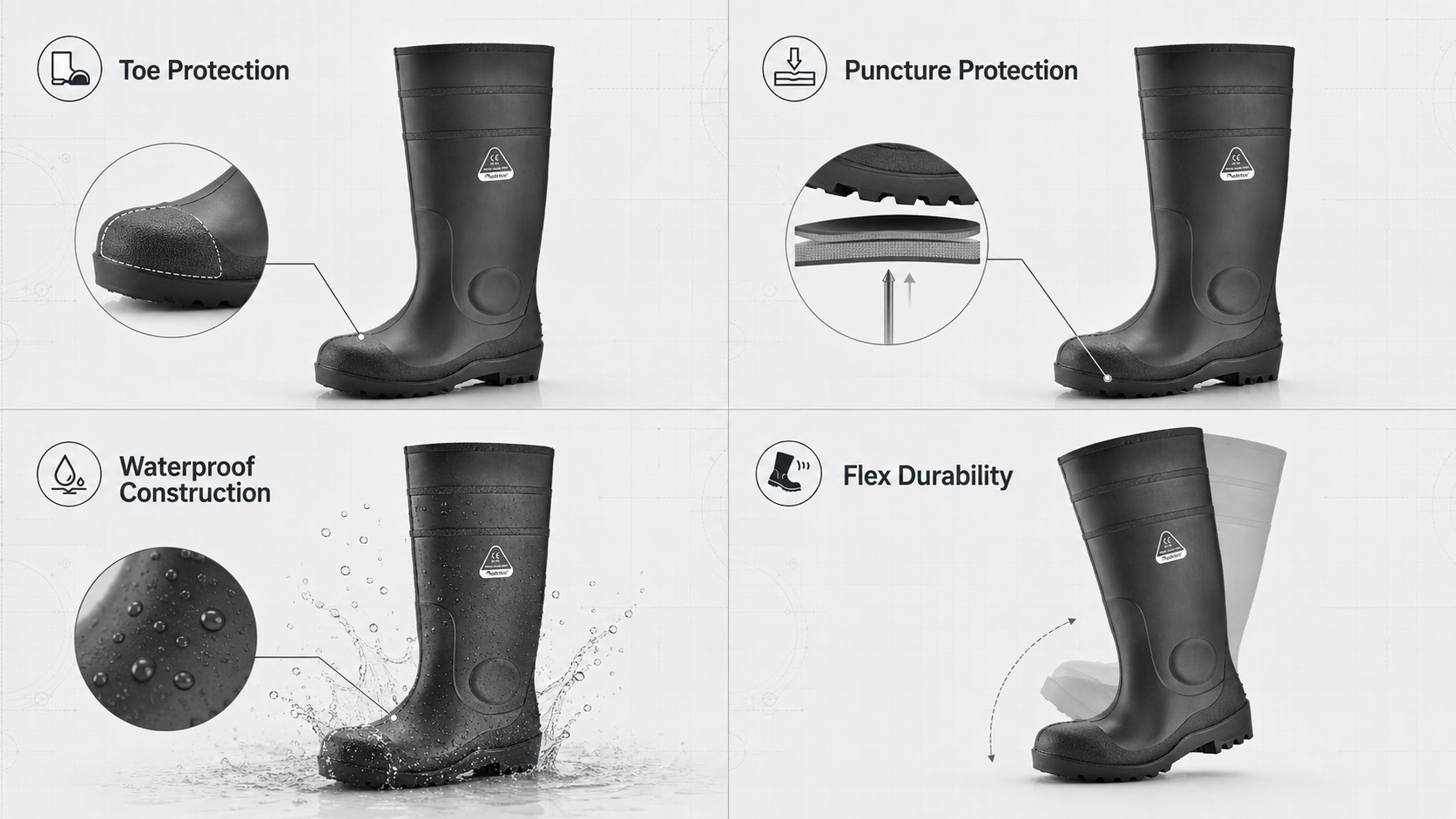
PVC Wellington boots are exposed to repeated movement throughout the working day. Walking, bending, squatting, uneven terrain, and continuous flexing place repeated stress on key flex zones, especially around the forefoot.
Over time, insufficient flex durability can lead to surface cracking, material fatigue, or reduced service life. For buyers, this means flexibility should not be evaluated only by how soft a boot feels when new. The more important question is how well the material and construction withstand repeated movement during long-term use.
Korvanta™ Flex Durability Technology represents Safetoe’s approach to improving resistance to repeated flexing in selected PVC Wellington boots.
For procurement teams, better flex durability can help support longer-lasting performance and more reliable use in demanding workplaces.
6. Protection Features Should Match the Workplace Risk
The right Wellington boot should be selected according to the actual hazards of the workplace, rather than by choosing the highest protection level available.
In Construction ,workers may face falling objects, sharp debris, wet surfaces, and slippery ground. Key protection priorities therefore include impact protection, puncture resistance, waterproofing, and slip resistance.
In Mining , boots are often exposed to rough terrain, standing water, sharp materials, and demanding daily use. Buyers should focus on puncture protection, waterproof performance, grip, and long-term durability.
For Agriculture , waterproofing and reliable grip are especially important in mud, rain, and wet working areas. Depending on the actual workplace risk, buyers may choose either safety footwear or occupational footwear.
The key principle is simple: match the protection features to the hazard assessment and working environment.
7. A Buyer's Checklist for Safety Wellington Boots
Before placing an order, buyers should verify that the Wellington boot matches the actual workplace risk, required standard, and intended working conditions. The following checklist provides a practical way to compare products and supplier documentation.
| Check | What the Buyer Should Verify |
| Intended application | Construction, mining, agriculture, cleaning, etc. |
| Footwear standard | EN ISO 20345 or EN ISO 20347 |
| Protection class | Appropriate classification for the workplace |
| Toe protection | Required where impact hazards exist |
| Puncture protection | Required where penetration hazards exist |
| Waterproof construction | Appropriate for wet conditions |
| Slip performance | Suitable for the working surface |
| Flex durability | Suitable for repeated movement |
| Product identification | Model, size, marking and label |
| Certification evidence | Certificate and test documentation where applicable |
A reliable purchasing decision should connect workplace hazards, product specifications, certification evidence, and traceability. Buyers should not rely on a single feature or marketing claim when selecting safety Wellington boots.
Frequently Asked Questions
Q: What is the difference between EN ISO 20345 and EN ISO 20347?
A: EN ISO 20345 covers safety footwear with protective toe caps for workplace hazards. EN ISO 20347 covers occupational footwear where toe-impact protection is not the defining requirement. Buyers should select the standard according to the actual workplace risk and required protection.
Q: What does S5 mean on Wellington boots?
A: S5 is a protection classification under EN ISO 20345 for Class II safety footwear. Buyers should also check the specific product configuration, marking, and certification documents.
Q: Are EN ISO 20347 Wellington boots safety footwear?
A: No. EN ISO 20347 Wellington boots are occupational footwear, not EN ISO 20345 safety footwear. They may offer waterproofing and slip resistance but are not defined by protective toe caps.
Q: How can buyers verify Wellington boot certification?
A: Check the product marking, label, model number, protection classification, and certificate. These details should match the actual product, with supporting test documentation reviewed where necessary.
Q: Are all waterproof Wellington boots safety boots?
A: No. Waterproof does not automatically mean safety footwear. Buyers should verify the applicable standard, protection classification, toe protection, puncture protection, and certification before purchasing.
Conclusion
Choosing the right Safety Wellington Boot means matching the product to the actual workplace risks, required standard, and protection level. Buyers should understand the differences between EN ISO 20345, EN ISO 20347, and S5, while also checking certification evidence and product specifications.
Key features such as waterproofing, toe protection, puncture resistance, slip performance, and flex durability should match the intended application. Combining standards, risk assessment, certification, and product technology helps buyers make safer and more reliable purchasing decisions.
Article Summary
Safety Wellington boots can look similar while meeting very different protection requirements. This guide explains EN ISO 20345 and EN ISO 20347, S5 protection, certification verification, waterproof construction and flex durability to help PPE buyers select the right Wellington boots for their workplace.
Author: Jay Yuan
Technical Marketing Director, Safetoe
Focused on safety footwear, PPE standards and industrial protection applications
Source: Safetoe

 English


