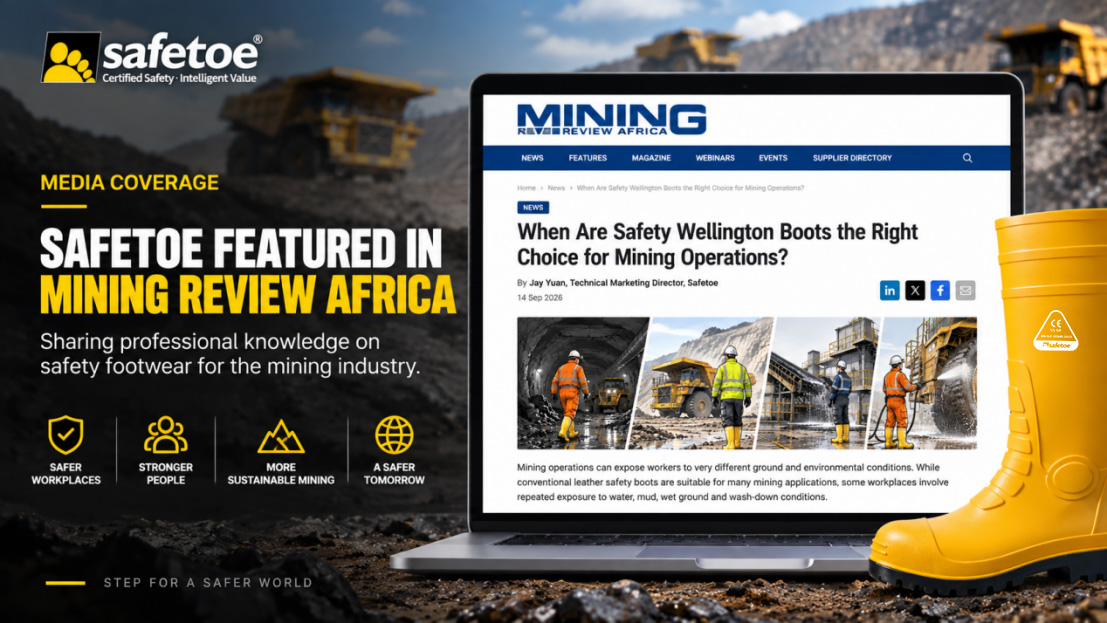
Safetoe has contributed a new technical article to Mining Review Africa, exploring an important question for mining safety managers and procurement teams:
When are safety Wellington boots the right choice for mining operations?
The article focuses on mining environments where workers may face repeated exposure to water, mud, slurry, wet ground and frequent wash-down. In these conditions, footwear selection involves more than simply keeping workers' feet dry. Traction, protective performance, durability and footwear construction all need to be considered against the actual worksite hazards.
This contribution reflects Safetoe's ongoing focus on sharing practical safety footwear knowledge for demanding mining environments.
Wet Mining Environments Require Different Footwear Considerations
Mining conditions can vary significantly between worksites and even between different areas of the same operation.
Underground workings may involve standing water and persistently damp ground. Surface mines can become muddy during heavy rainfall, while mineral processing and maintenance areas may expose workers to slurry, water and frequent equipment wash-down.
Where water exposure is occasional, conventional leather safety footwear with suitable water-resistant or waterproof construction may remain appropriate.Where deeper mud, standing water or frequent cleaning are regular parts of the job, however, a higher-shaft moulded Wellington construction can offer practical advantages.
The key point is that footwear should be selected according to the frequency and severity of the exposure, rather than by boot type alone.
Waterproofing Is Only Part of the Protection
A waterproof Wellington boot is not automatically a safety boot.
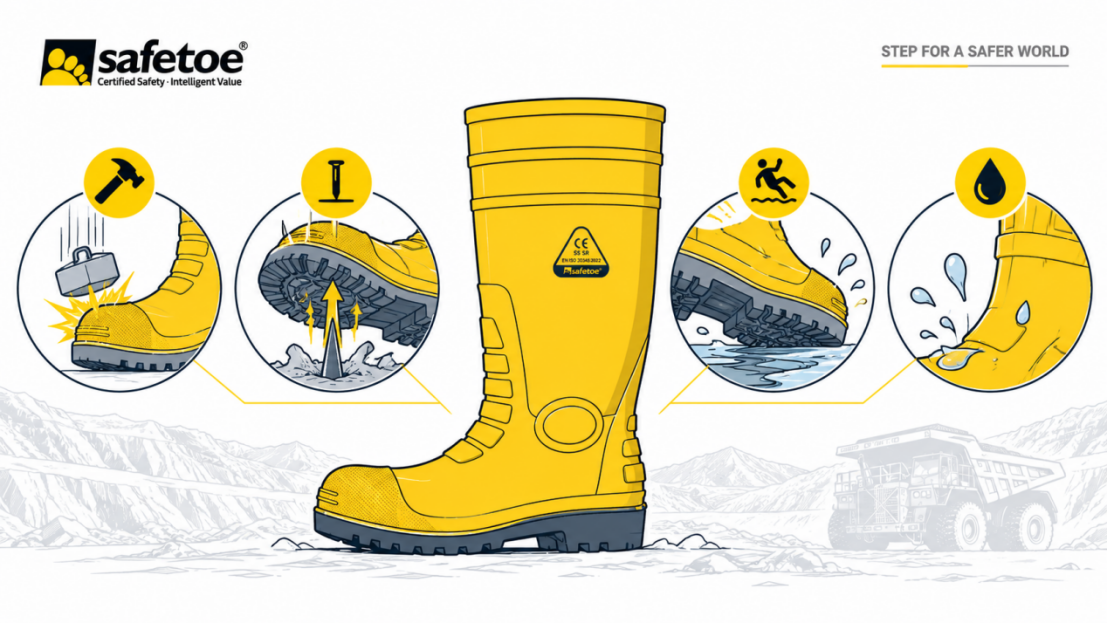
For higher-risk mining environments, footwear may also need to address hazards from falling objects, sharp materials underfoot and slippery or changing ground conditions.
Depending on the worksite risk assessment, four areas may require particular attention:
Buyers should also verify the applicable safety standard, footwear classification and supporting certification against local regulations and individual project requirements.
Match the Footwear to the Mining Environment
Safety Wellington boots are not a universal replacement for conventional leather mining boots.
Leather safety footwear may remain better suited to many dry, rugged or highly mobile applications, while moulded Wellington construction can provide practical benefits where water, mud and wash-down are persistent workplace conditions.
The underlying selection principle remains simple:
Identify the hazard first, then match the footwear construction, protection and certification to the actual work.
The right mining boot is therefore not simply the most waterproof or the most heavily protected option. It is the footwear whose performance best matches the environment workers actually face.
Safetoe develops professional safety footwear and PPE for demanding industrial environments, including mining, oil & gas, construction, manufacturing and energy.Our approach combines workplace hazard assessment, internationally recognized standards, protective technologies and application-specific footwear design.

 English