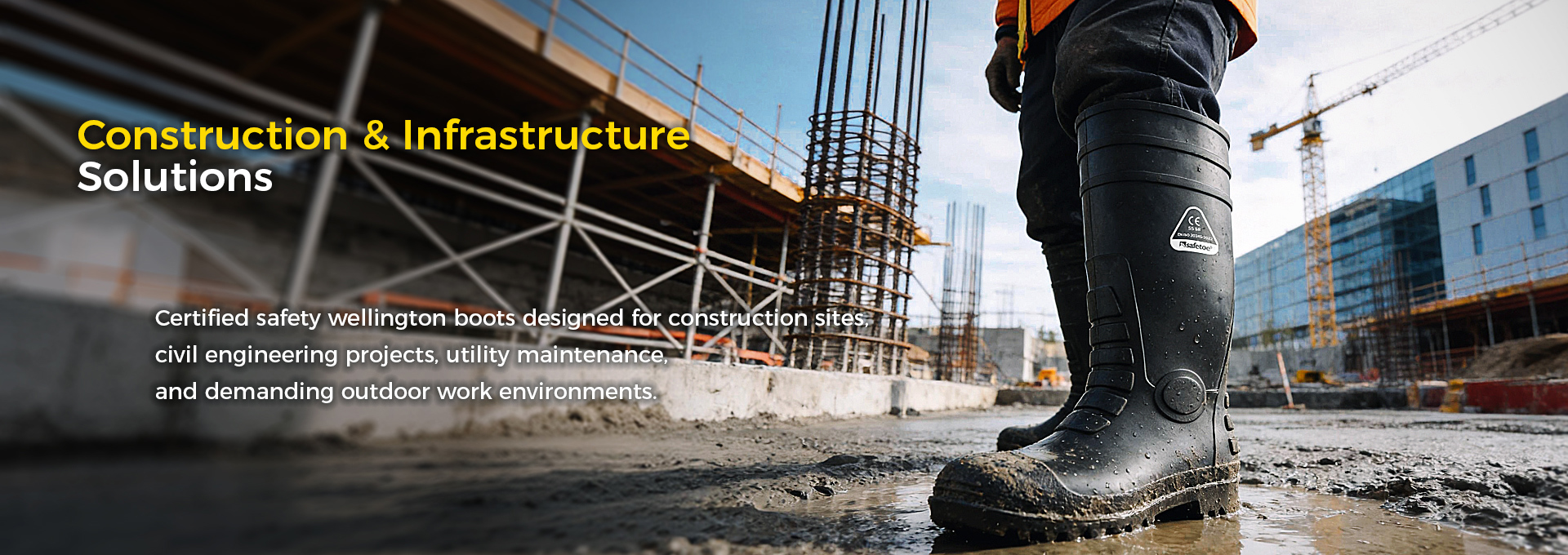
Construction sites expose workers to water, mud, falling materials, sharp debris and slippery surfaces. Choosing safety Wellington boots for construction therefore involves more than waterproofing. Buyers should consider protection level, slip resistance, durability and the actual conditions of the jobsite.
For wet and muddy construction sites, safety Wellington boots should be selected according to jobsite hazards, with particular attention to toe protection, puncture resistance, waterproof construction, slip resistance, durability and applicable safety standards.
Explore the Safetoe Construction Wellington Boots Solution for construction-specific hazards, technologies and certified footwear options.
1. Start with the Hazards on Your Construction Site
Before choosing construction Wellington boots, identify the main risks workers face:
Different construction activities create different footwear requirements. Excavation and concrete work, for example, may involve prolonged exposure to mud and water, while active building sites can add impact and puncture hazards.
The goal is not simply to choose a waterproof boot, but to match the footwear protection to the actual jobsite.
2. Choose the Right Level of Toe and Puncture Protection
Construction workers may face impact hazards from falling tools, bricks or materials. Where these risks exist, certified safety toe protection is essential. VortiGard™ Toe Protection is designed to help protect against impact and compression hazards.
Sharp objects underfoot are another concern. Nails, exposed rebar and metal debris can penetrate ordinary footwear, making certified puncture protection important. Safetoe footwear uses different puncture-resistant constructions depending on the model and application, including FlexBarrier™ flexible puncture protection in selected footwear.
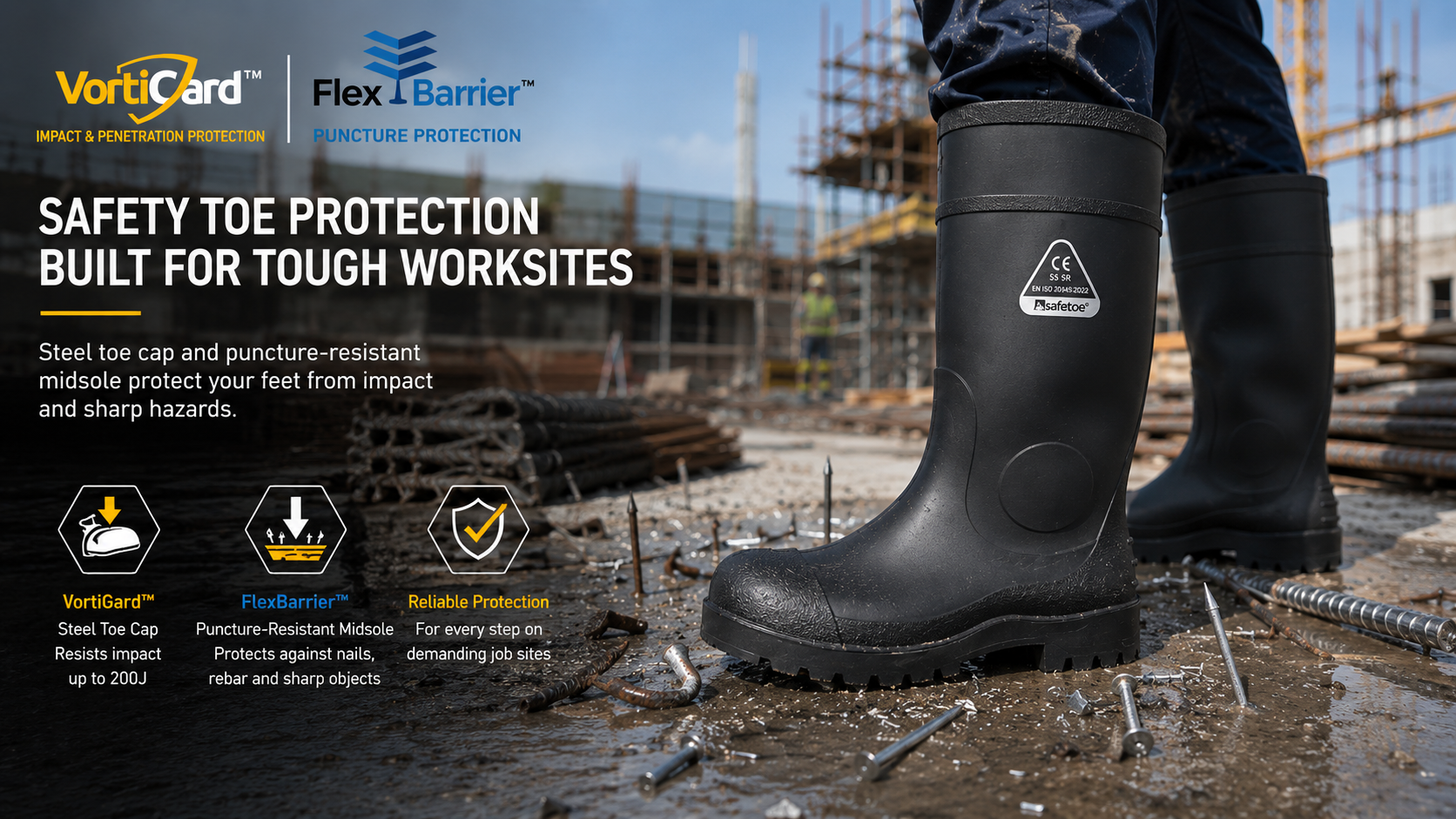
For wet construction sites requiring toe protection, puncture resistance and waterproofing, EN ISO 20345 S5 Wellington boots are a practical choice.
Review the Wellington Boots Certification requirements, or explore Safetoe W-6038 and W-6037 S5 Safety Wellington Boots for construction applications.
3. Waterproof Construction Matters in Wet and Muddy Conditions
Rain, standing water, wet concrete, mud and washdown can expose construction workers to moisture throughout the working day.
This makes one distinction important:
Waterproof ≠ Water-resistant.
For consistently wet jobsites, buyers should look for footwear designed with a genuinely waterproof structure rather than relying only on surface water resistance.
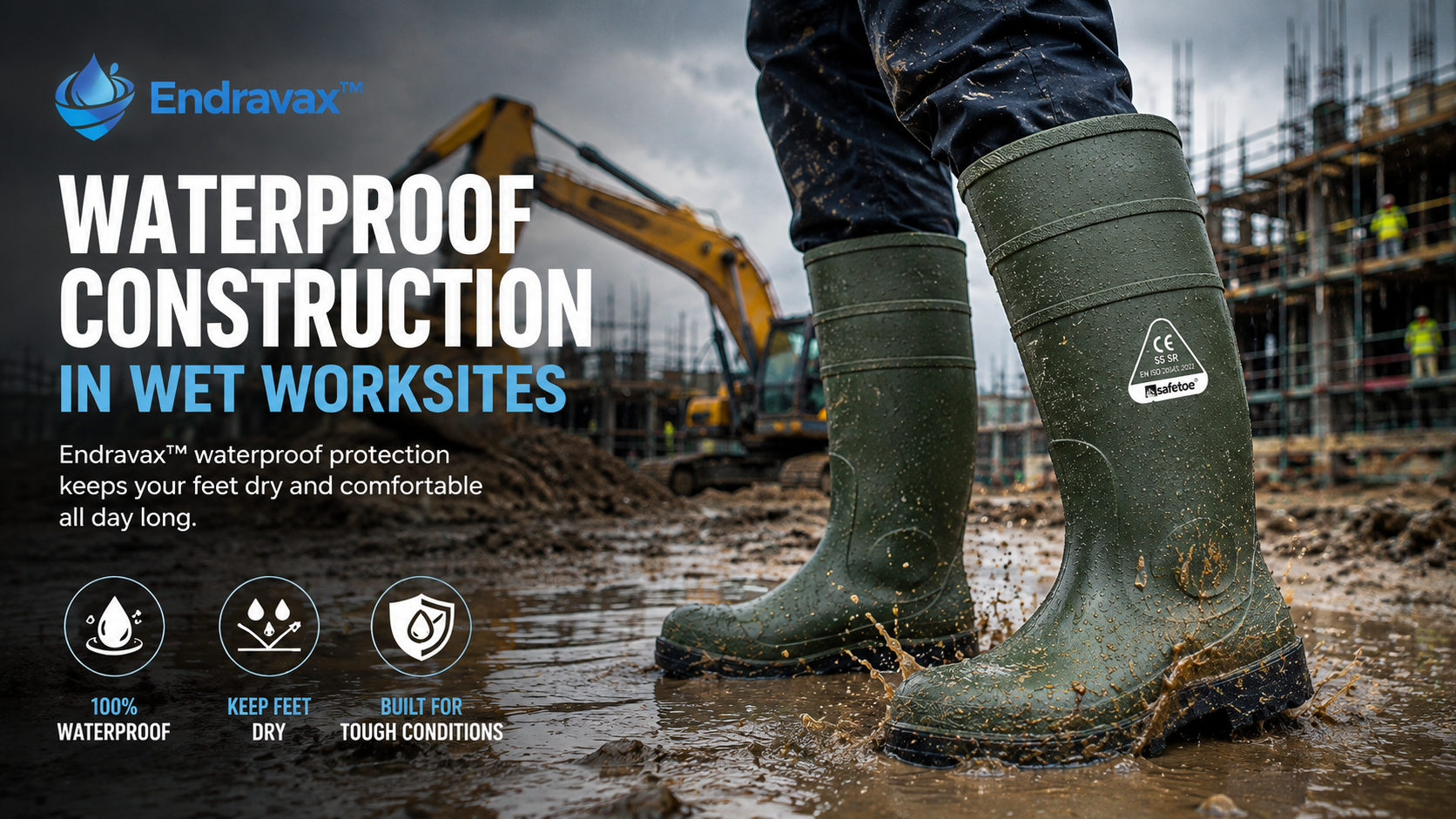
Safetoe's Endravax™ Waterproof Protection is designed for Wellington boots used in demanding wet environments, helping maintain waterproof performance during regular site use.
4. Check Slip Resistance and Outsole Performance
Wet concrete, mud, uneven ground, ladders and work platforms can all increase slip risks.
When comparing construction Wellington boots, check both the tested slip-resistance performance and the outsole design. The objective is not simply to choose the deepest-looking tread, but to select footwear designed for the surfaces workers actually encounter.
For example, the Safetoe W-6038 combines waterproof construction with SR-rated slip resistance, making traction part of the overall protection system rather than an afterthought.
5. Don't Ignore Flexibility and Durability
Construction workers repeatedly walk, squat, climb and kneel. These movements continuously flex the forefoot area of a Wellington boot.
This means durability should not be judged simply by asking:
“How thick is the PVC?”
Repeated flex performance also matters.
Korvanta™ Flex Durability focuses on durability under repeated bending and movement, helping Wellington boots withstand demanding daily use while maintaining flexibility.
For contractors and PPE buyers, better flex durability can also help reduce premature replacement and long-term footwear costs.
6. How to Compare Construction Wellington Boots Before Buying
For B2B procurement, don't compare Wellington boots only by price, weight or color.
Instead, compare:
| What to Check | Why It Matters |
| Safety standard | Confirms protection level |
| Toe protection | Protection from impact hazards |
| Puncture resistance | Protection around nails and debris |
| Waterproof construction | Essential for wet jobsites |
| Slip resistance | Traction on wet surfaces |
| Flex durability | Performance during repeated movement |
| Fit & comfort | Important for long shifts |
A better purchasing formula is:
Certification + Protection + Construction + Durability + Application
For a complete construction-focused comparison, visit the Safetoe Construction Wellington Boots Solution.
Recommended Safetoe Wellington Boots for Construction
W-6038
S5 safety Wellington boot for demanding construction environments.
View W-6038 →
W-6037
Safety Wellington boot for construction and industrial wet environments.
View W-6037 →
Frequently Asked Questions
Q:Are Wellington boots suitable for construction work?
A: Yes, if their protection matches the jobsite hazards. Construction applications may require waterproofing, safety toe protection, puncture resistance and slip resistance.
Q:Do construction Wellington boots need a safety toe?
A:Where falling tools, materials or other impact hazards are present, safety toe protection should be considered according to the site's risk assessment.
Q:What safety standard should construction Wellington boots meet?
A:EN ISO 20345 is widely used for safety footwear. S5 Wellington boots are commonly used in wet environments requiring toe and puncture protection.
Q:What is the difference between safety Wellington boots and ordinary rain boots?
A:Ordinary rain boots mainly provide water protection. Safety Wellington boots can additionally provide certified toe protection, puncture resistance and tested slip resistance.
Find the Right Wellington Boots for Your Construction Project
The right construction Wellington boots should match the hazards, working conditions and required safety standards of the project.
Explore the Safetoe Construction Wellington Boots Solution or contact Safetoe for product recommendations, samples and bulk purchasing support.

 English


