Why Forestry Helmets Need Integrated Protection
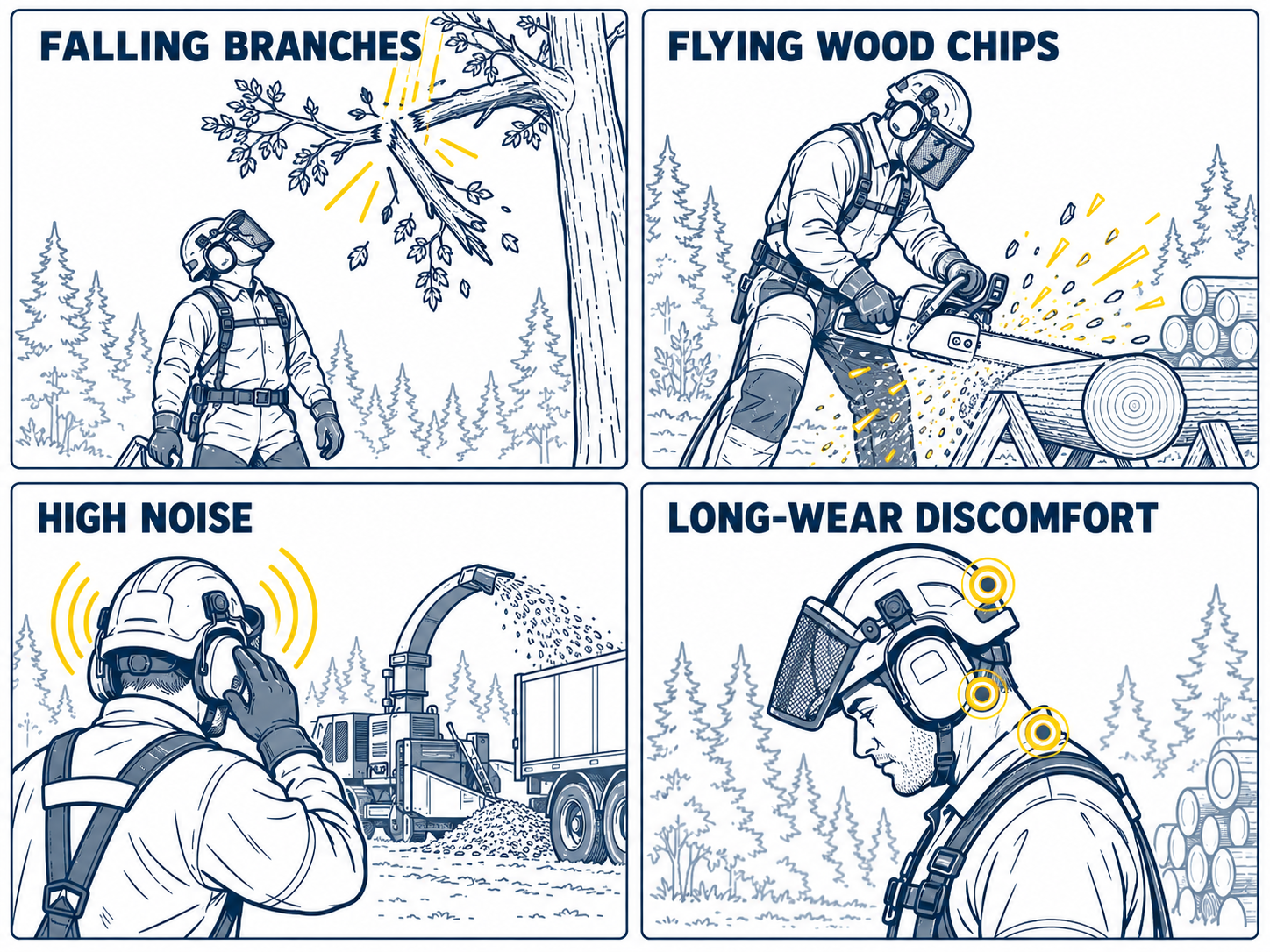
Forestry and tree-care work can expose workers to several hazards at the same time. Falling branches and overhead objects threaten the head, while wood chips, sawdust and flying debris can reach the face. Chainsaws, wood chippers and other forestry machinery may also create hazardous noise.
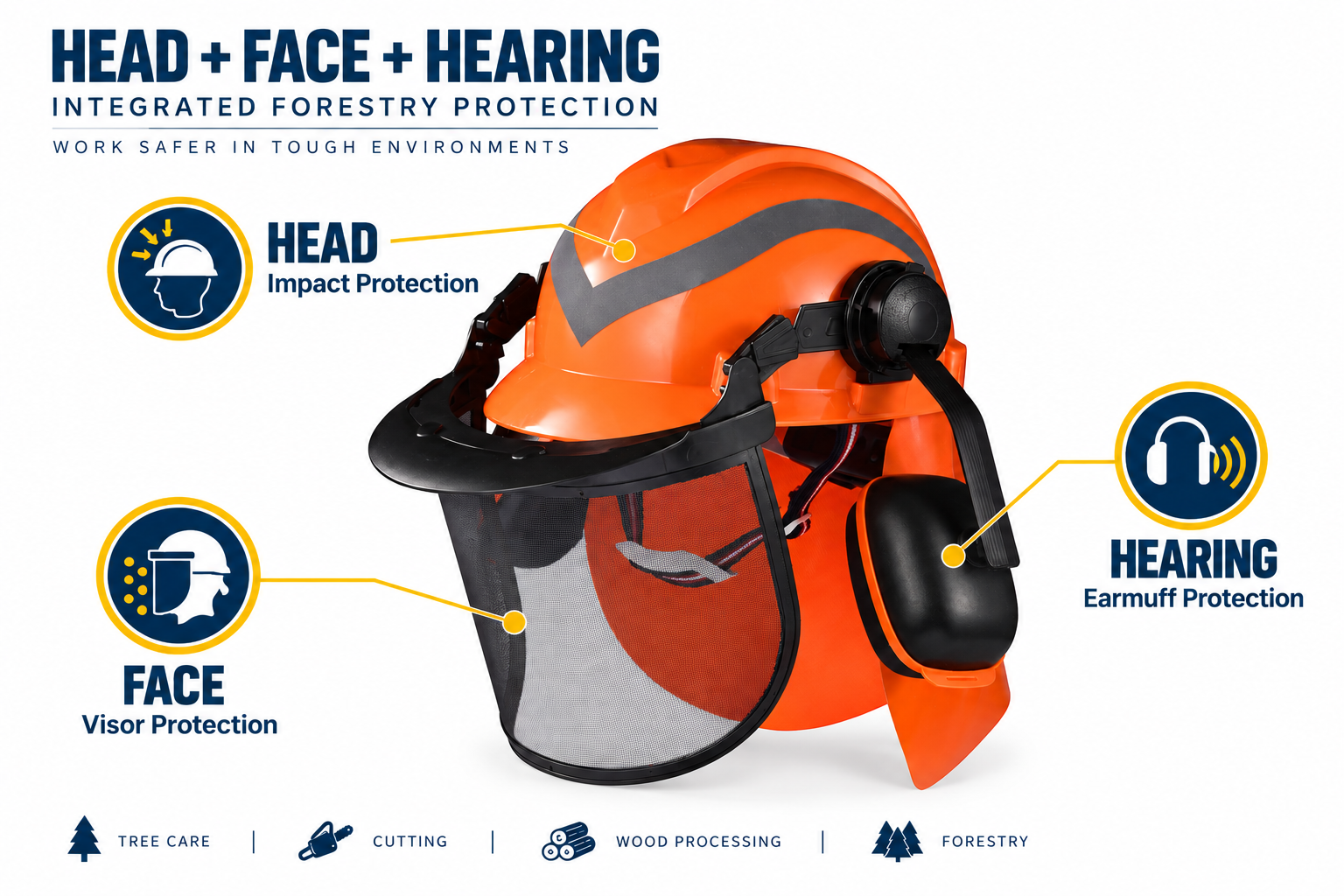
For this reason, selecting a forestry helmet is often about more than choosing a protective shell. Buyers should consider whether the job requires an integrated protection system combining head, face and hearing protection.
The basic selection logic is:
Head Protection + Face Protection + Hearing Protection
The correct configuration should reflect the actual cutting task, debris exposure, noise level, outdoor conditions and workplace risk assessment.
Explore Forestry & Integrated Protection Helmets for worksite-specific helmet solutions.
1. Start with the Hazards of Forestry Work
Before comparing helmet models or accessories, identify the hazards workers are likely to face.
| Forestry Hazard | Protection to Consider |
| Falling branches | Head protection |
| Wood chips & debris | Face protection |
| Sawdust & particles | Face / eye protection |
| Chainsaws & machinery noise | Hearing protection |
| Long outdoor shifts | Comfort & fit |
| Active movement | Secure retention |
Tree cutting, pruning, wood processing and general forestry work can create different combinations of hazards. A helmet system suitable for occasional tree maintenance may not be the best configuration for continuous cutting or wood-processing operations.
This is why procurement should begin with the worksite hazard profile, not simply with the number of accessories attached to the helmet.
2. Start with Certified Head Protection
An integrated forestry helmet may include a visor and earmuffs, but those accessories do not replace the helmet's primary purpose: protecting the head.
Forestry workers may encounter falling branches, overhead objects and accidental contact while cutting, trimming or moving through wooded environments. Buyers should therefore first confirm that the helmet itself is suitable for the intended industrial application and required protection level.
For projects using European industrial helmet requirements, review the applicable EN 397 Certification and verify that the certification applies to the actual model being purchased.
The selection sequence should be:
Certified Helmet → Required Accessories → Complete Protection System
For a broader explanation of industrial helmet standards, see EN 397 vs ANSI Z89.1: How to Choose the Right Industrial Safety Helmet.
3. Choose the Right Face Protection
Face protection is one of the most important differences between a basic industrial helmet and an integrated forestry helmet.
The appropriate visor depends on the type of debris, visibility requirement, airflow needs and working environment.
Clear Polycarbonate Visor
A clear polycarbonate visor provides transparent face coverage while allowing workers to maintain a clear view of the cutting area.
It can be suitable for applications such as:
tree care;
cutting;
wood processing;
grinding;
mixed industrial work.
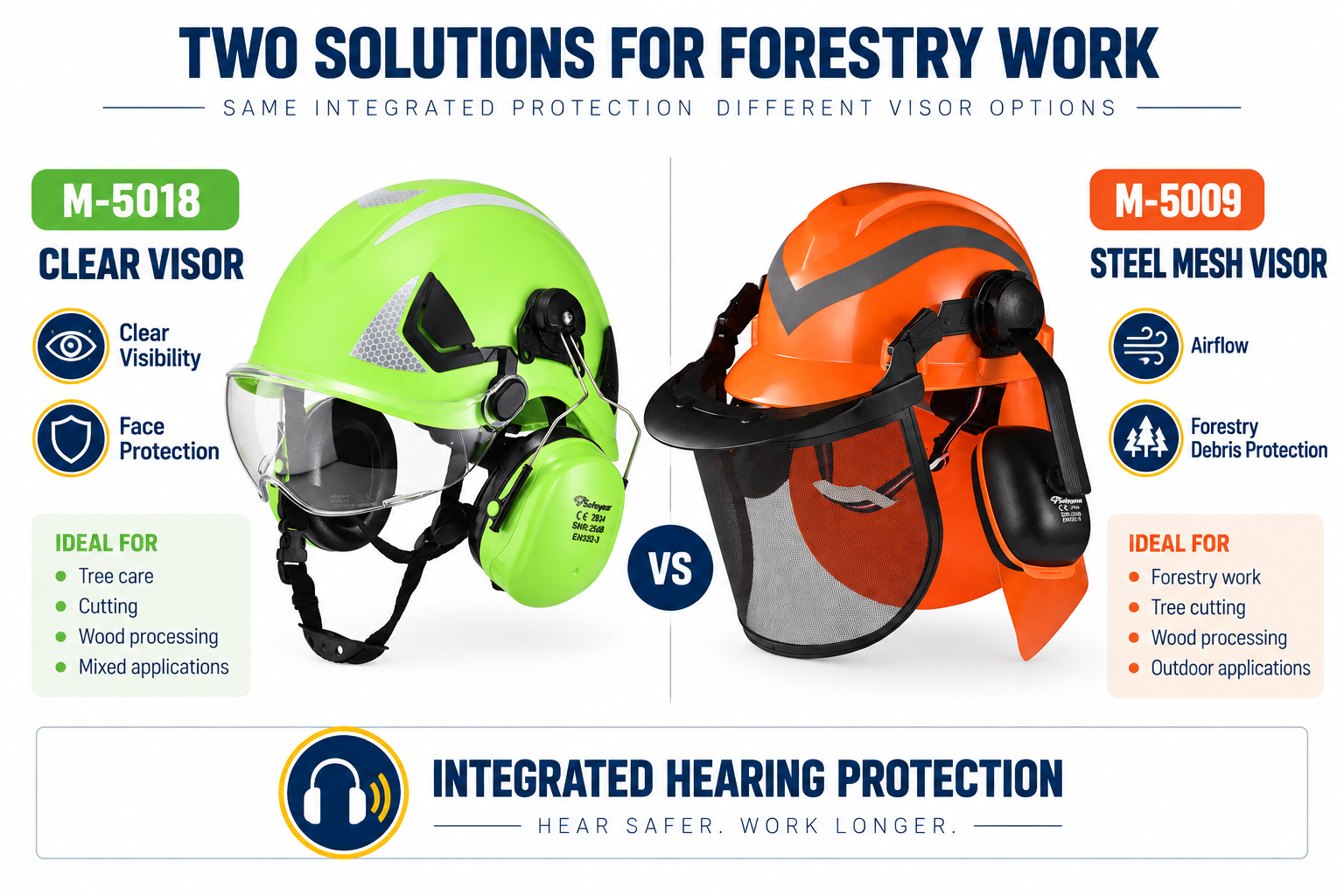
Safeyear M-5018 uses a clear visor together with hearing protection, making it suitable where clear visibility and broad face coverage are important.
Safeyear's CrystalShield™ Face Protection explains the role of face-protection design within an integrated helmet system.
Steel Mesh Visor
A steel mesh visor provides a different type of protection. Its open construction can offer:
greater airflow;
reduced enclosed-face feeling;
protection against coarse wood chips and forestry debris;
practical performance during outdoor forestry work.
Safeyear M-5009 combines a steel mesh visor with helmet-mounted hearing protection and a protective neck cover.
Clear Visor or Mesh Visor: Which Is Better for Forestry?
There is no single answer for every forestry task.
A clear visor provides transparent face coverage, while a mesh visor can provide greater airflow and protection against coarse forestry debris. The appropriate choice depends on the hazard, intended application and applicable visor certification.
This distinction is important when comparing M-5018 and M-5009. They are not simply two helmet styles with different colors; they provide different face-protection formats for different work conditions.
4. Don't Ignore Hearing Protection
A forestry helmet protects the head, but it does not automatically protect hearing.
Common forestry noise sources include:
chainsaws;
wood chippers;
cutting equipment;
forestry machinery.
Where workplace noise reaches hazardous levels, suitable hearing protection should be selected according to the site's noise assessment and applicable requirements.
Helmet-mounted earmuffs can be practical because they allow head, face and hearing protection to function as one integrated PPE system. However, buyers should still verify the actual hearing-protection specification of the earmuff rather than assuming every helmet-mounted accessory provides the same level of protection.
For products carrying EN 352-3 or SNR information, those values should be checked on the relevant product documentation before procurement.
5. Comfort and Secure Fit Matter During Long Shifts
Forestry workers frequently bend, look upward, walk across uneven terrain and remain active for long periods.
Once a visor and earmuffs are added, the complete helmet system may also become heavier than a basic helmet. This makes weight distribution, pressure management and stable fit especially important.
A good integrated system should remain secure when the worker moves, turns or changes posture. Poor balance or excessive pressure can make long-duration wear uncomfortable.
Safeyear's ErgoComfort™ Comfort System focuses on suspension and pressure distribution, while the SecureHold™ Retention System supports a more stable helmet fit during active movement.
For forestry PPE, comfort should therefore not mean simply "soft." The more useful question is:
Can the complete helmet, visor and earmuff system remain stable and wearable throughout the working shift?
6. M-5018 vs M-5009: Which Forestry Helmet Should You Choose?
M-5018 and M-5009 both provide integrated forestry protection, but their visor configurations make them suitable for different priorities.
M-5018
Integrated Forestry Helmet with Clear Face Shield & Earmuffs
Core configuration:
Clear PC Visor + Hearing Protection
M-5018 is the stronger option when the application emphasizes:
clear visibility;
broad face coverage;
tree care;
industrial cutting;
grinding;
wood processing.
Its transparent visor allows the wearer to maintain direct visual contact with the working area.
M-5009
Forestry Helmet with Steel Mesh Visor & Earmuffs
Core configuration:
Steel Mesh Visor + Hearing Protection + Neck Cover
M-5009 is more strongly oriented toward:
forestry;
tree cutting;
wood processing;
outdoor work.
Its key differentiation is the combination of a mesh visor and protective neck cover.
The choice can therefore be simplified as:
M-5018 → Clear Visibility + Clear Face Protection
M-5009 → Airflow + Forestry Debris Protection + Neck Coverage
Neither configuration is automatically "better." The correct choice depends on the hazards workers actually face.
7. Quick Forestry Helmet Selection Guide
| Work Requirement | What to Consider | Safeyear Example |
| General forestry | Head + face + hearing protection | M-5018 / M-5009 |
| Clear visibility | Clear polycarbonate visor | M-5018 |
| Wood chips & airflow | Steel mesh visor | M-5009 |
| High-noise work | Helmet-mounted earmuffs | M-5018 / M-5009 |
| Outdoor neck coverage | Protective neck cover | M-5009 |
| Long-duration work | Fit & pressure distribution | Appropriate suspension system |
This table is a selection framework rather than a universal PPE specification. Final requirements should reflect the actual forestry task, worksite hazards, employer requirements and applicable safety standards.
FAQ
1.What protection should a forestry helmet provide?
A forestry helmet should match the actual work hazards. Many forestry applications require a combination of head, face and hearing protection, rather than relying only on a protective helmet shell.
2.Is a clear visor or mesh visor better for forestry work?
It depends on the hazard. A clear visor provides transparent face coverage, while a mesh visor can offer greater airflow and protection from coarse forestry debris. Always consider the intended use and applicable certification.
3.Do forestry helmets need hearing protection?
Where chainsaws, wood-processing equipment or other machinery create hazardous noise levels, appropriate hearing protection should be selected according to the workplace noise assessment and applicable requirements.
Conclusion
Choosing the right forestry helmet means looking beyond the helmet shell. Tree-care and forestry work can combine head impact, flying debris, sawdust, high noise and long periods of active outdoor movement.
For many applications, an integrated system combining head, face and hearing protection offers a more practical approach. Buyers should identify the hazards first, then select the appropriate helmet, visor type, hearing protection and fit system.
For more information, explore Forestry & Integrated Protection Helmets.
For a broader PPE comparison, see Bump Cap vs Safety Helmet vs Face Shield: What Protection Do You Need?

 English


