Construction workers may face falling tools, overhead structures, lateral impacts, heat, flying debris and high-noise environments. Choosing the right safety helmet therefore requires more than checking whether a helmet meets a safety standard.
Quick Answer: How to Choose a Construction Safety Helmet
Choose a construction safety helmet by checking five things:
Jobsite impact hazards
Type I or Type II protection
Vented or non-vented design
Fit, retention and accessory compatibility
Applicable EN 397 or ANSI/ISEA Z89.1 certification
The correct helmet should be selected according to the actual hazard assessment rather than job title, colour or appearance.
A practical selection should consider the jobsite hazards, required protection configuration, fit, comfort and working environment together.
The key principle is simple:
The right construction helmet should match the hazards of the jobsite—not simply the job title.
1. Start with the Head Hazards on the Jobsite
Before choosing a helmet model, identify the hazards workers are actually exposed to.
Different construction tasks may require different levels of head, face or hearing protection.
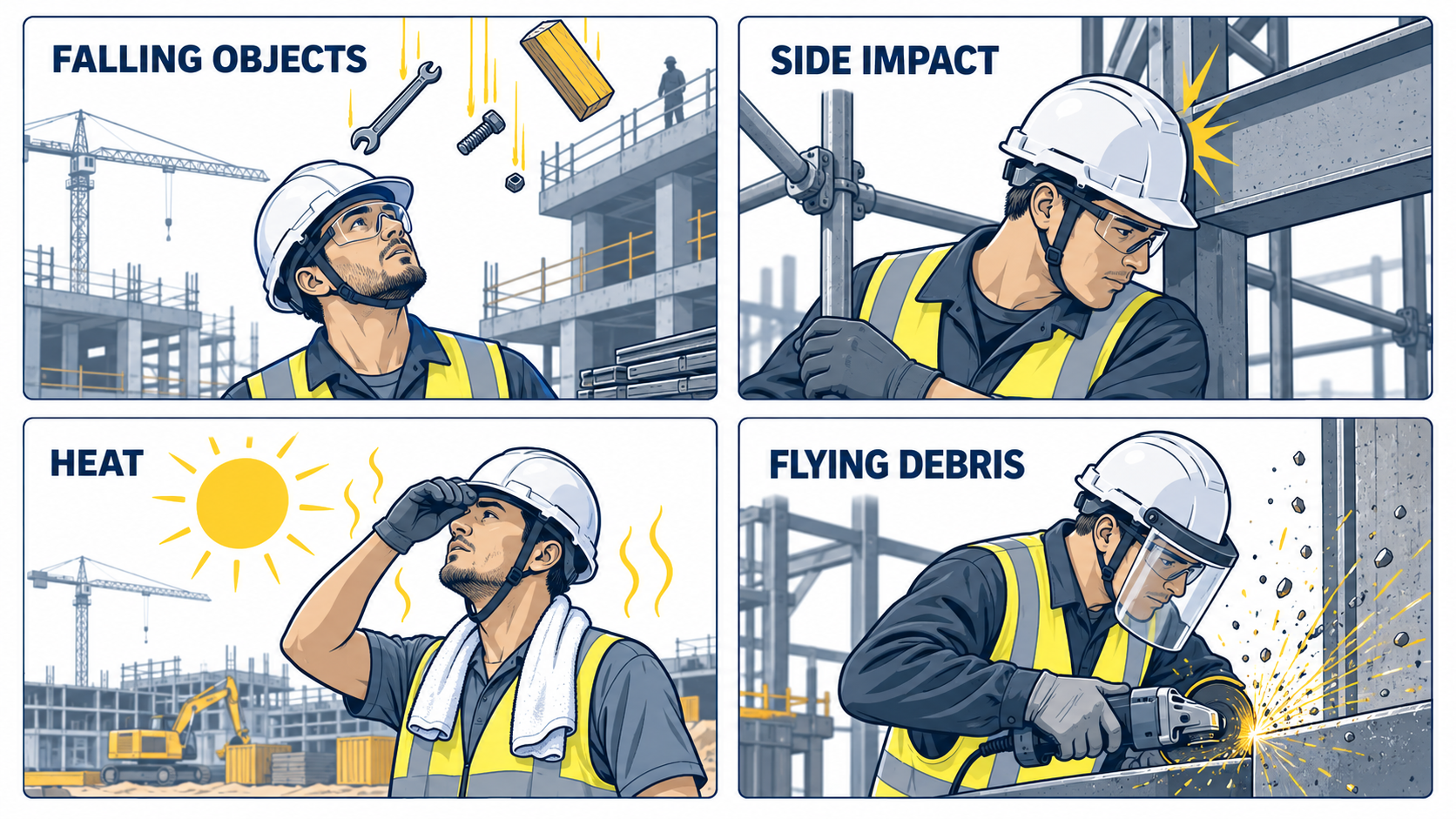
Construction Hazard | What to Consider |
Falling tools & materials | Top-impact and penetration protection |
Beams & structures | Lateral / multi-directional impact |
Hot outdoor work | Secure retention / chin strap |
Grinding & cutting debris | Face protection |
Machinery & equipment noise | Hearing protection |
Climbing / movement | Secure retention |
This hazard-first approach helps buyers avoid selecting one helmet configuration for every worker.
For a broader overview of head protection for construction environments, explore our Construction Safety Helmet Solutions.
2. Choose the Right Level of Impact Protection
Impact protection is the starting point for most construction safety helmets.
For general construction activities, protection against falling tools, materials and overhead hazards is usually a primary concern. However, some jobsites also expose workers to impacts from the front, rear or sides.
Workers may require additional lateral impact protection when working around:
For standard construction applications, the W-018 General Construction Safety Helmet can be considered as a practical option.
Where additional top and lateral impact protection is required, a helmet such as the W-6000 ANSI Type II Safety Helmet may be more appropriate.
PPE buyers should therefore distinguish between helmets designed primarily for top impact and helmets certified for additional lateral impact protection.
Safeyear ForceBarrier™ Side Impact Protection is designed for applications where protection against impacts from multiple directions needs to be considered.
Not sure about EN 397, ANSI Type I or Type II? Read our EN 397 vs ANSI Z89.1 Safety Helmet Guide.
3. Vented or Non-Vented Safety Helmet?
Ventilation is an important consideration for construction workers who spend long periods outdoors.
In hot environments, heat can lead to:
Heat → Sweat → Discomfort → Frequent Helmet Adjustment
Frequent adjustment can affect fit and worker compliance.
For this reason, vented safety helmets are generally better suited to hot construction environments where airflow and heat management are priorities.
Safeyear VentStream™ Ventilation Technology is designed to improve airflow through the helmet and support comfort during extended outdoor use.
The W-018 Vented Construction Safety Helmet is a practical option for general construction environments where ventilation is important.
However, ventilation is not appropriate for every job.
Non-vented helmets may be required where specific electrical hazards are present.
Electrical work requires additional considerations beyond ventilation, including the applicable electrical classification and project requirements.
For electrical applications, see our guide on How to Choose an Electrical Safety Helmet for Utility Work.
4. Consider Fit, Retention and Long-Wear Comfort
Construction workers rarely remain in one position throughout a shift.
They may need to:
A construction safety helmet should therefore do more than simply fit the worker's head.
It should also:
Stay securely positioned
Distribute pressure comfortably
A secure retention system helps reduce unwanted helmet movement when workers climb, bend or change position.
Safeyear SecureHold™ Retention System uses adjustable retention to support more stable positioning.
Long-wear comfort is equally important. Pressure points can become noticeable during extended shifts and may encourage workers to repeatedly adjust or remove PPE.
Safeyear ErgoComfort™ Suspension & Comfort System is designed to improve pressure distribution and support more comfortable long-term wear.
For PPE buyers, fit and comfort should therefore be considered alongside impact performance.
5. Do You Need Face or Hearing Protection?
Not every worker on the same construction site faces the same hazards.
This is why one basic helmet configuration may not be suitable for all jobs.
Flying Debris / Grinding
Workers involved in cutting, grinding or other tasks that generate flying debris may require additional face protection.
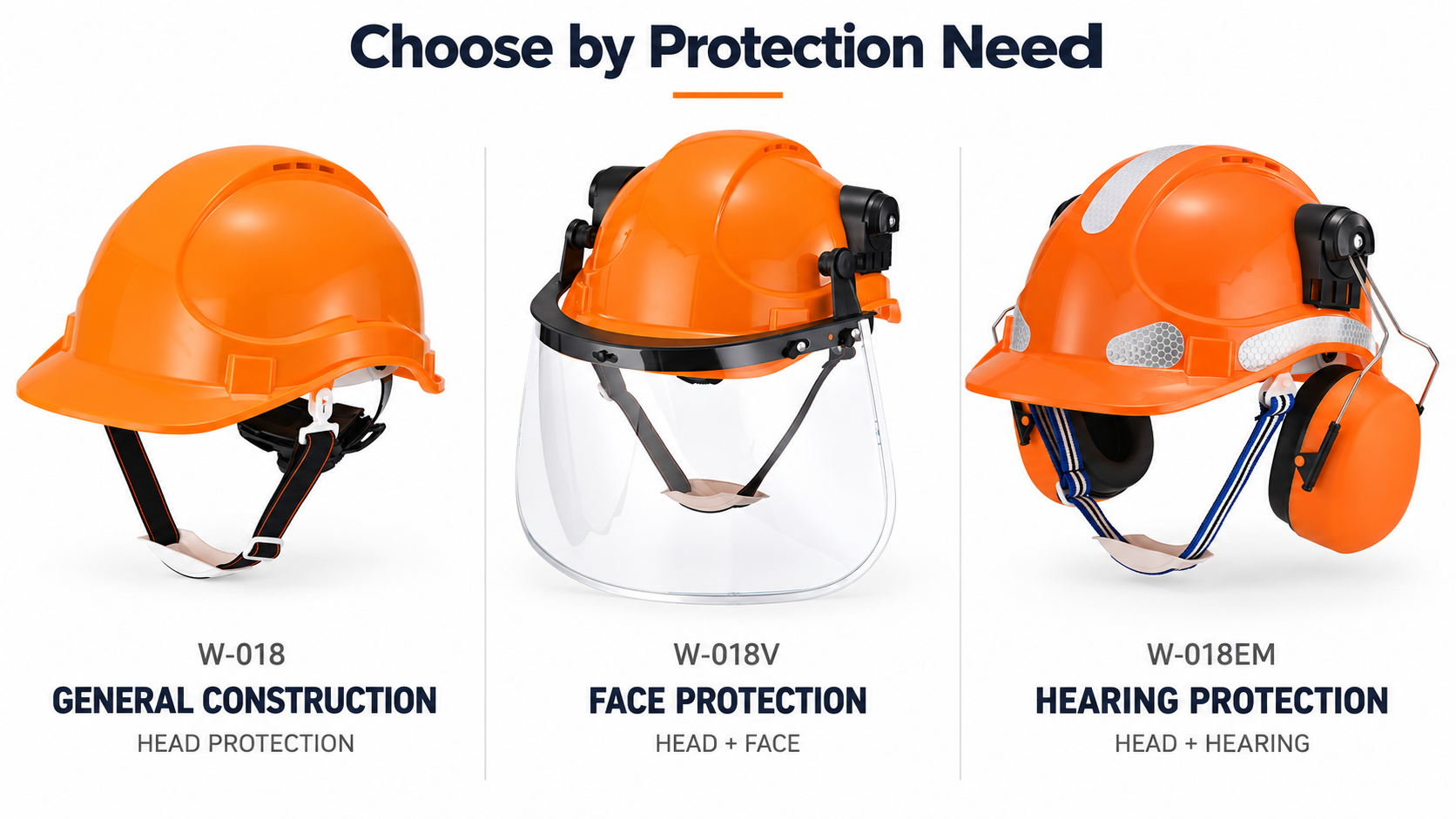
A configuration such as the W-018V Safety Helmet with Face Shield can provide integrated head and face protection.
Safeyear CrystalShield™ Face Protection can be used where workers require additional facial coverage against flying particles and debris.
High-Noise Construction Areas
Workers operating near heavy machinery, demolition equipment or other high-noise sources may require hearing protection in addition to head protection.
The W-018E / W-018EM Safety Helmet with Earmuffs provides an integrated configuration for this type of work.
Standard Construction Work
Where the primary requirement is head protection without additional face or hearing accessories, the W-018 Safety Helmet may be the more suitable configuration.
The selection logic is straightforward:
Same worksite. Different hazards. Different protection configurations.
6. Check the Safety Standard Before You Buy
Choosing the correct helmet configuration is only part of the selection process.
PPE buyers should also confirm which safety standard applies to the target market, employer or project.
EN 397
EN 397 is commonly specified for industrial protective helmets in European and many international markets.
ANSI/ISEA Z89.1
ANSI/ISEA Z89.1 is commonly specified for industrial head protection in the United States.
Requirements such as impact classification, electrical performance or Type I / Type II protection should be confirmed against the applicable standard and worksite risk assessment.
For more detailed information, see:
EN 397 vs ANSI Z89.1: How to Choose the Right Industrial Safety Helmet
You can also review our certification pages for:
7. Quick Construction Helmet Selection Guide
The table below provides a simple starting point for construction PPE buyers.
Worksite Need | Recommended Direction | Example Safeyear Configuration |
General construction | Vented safety helmet | W-018 |
Face & debris protection | Helmet + face shield | W-018V |
High-noise construction | Helmet + earmuffs | W-018EM |
Electrical exposure | Non-vented / appropriate electrical class | W-003 |
Multi-directional impact | Type II protection | W-6000 |
*Electrical protection should always be selected according to the applicable standard, hazard assessment and certified helmet classification.
FAQ
What type of safety helmet is best for construction work?
The right helmet depends on the jobsite hazards. General construction may require top-impact protection, while sites with lateral impact, electrical, flying-debris or high-noise risks may require additional protection or accessories.
Should I choose a vented or non-vented construction helmet?
Vented helmets can improve airflow in hot working environments. Where electrical hazards exist, helmet ventilation and electrical classification require additional consideration.
When should construction workers use a Type II helmet?
A Type II helmet should be considered where workers face potential impacts from the front, rear or sides in addition to top impacts. Always follow the applicable workplace risk assessment and safety requirements.
Choosing the Right Construction Safety Helmet
The best construction safety helmet is not determined by a single feature.
Buyers should consider:
Jobsite Hazard → Impact Requirement → Ventilation → Fit & Retention → Face/Hearing Protection → Applicable Standard
For general construction, a vented helmet may provide a practical balance of protection and comfort.
Where workers face flying debris, high noise, electrical exposure or multi-directional impacts, additional protection configurations may be required.
Selecting helmets according to the actual jobsite hazards helps contractors and PPE buyers provide more appropriate head protection for different workers and tasks.
Explore Construction Safety Helmet Solutions
View Construction Safety Helmets

 English


