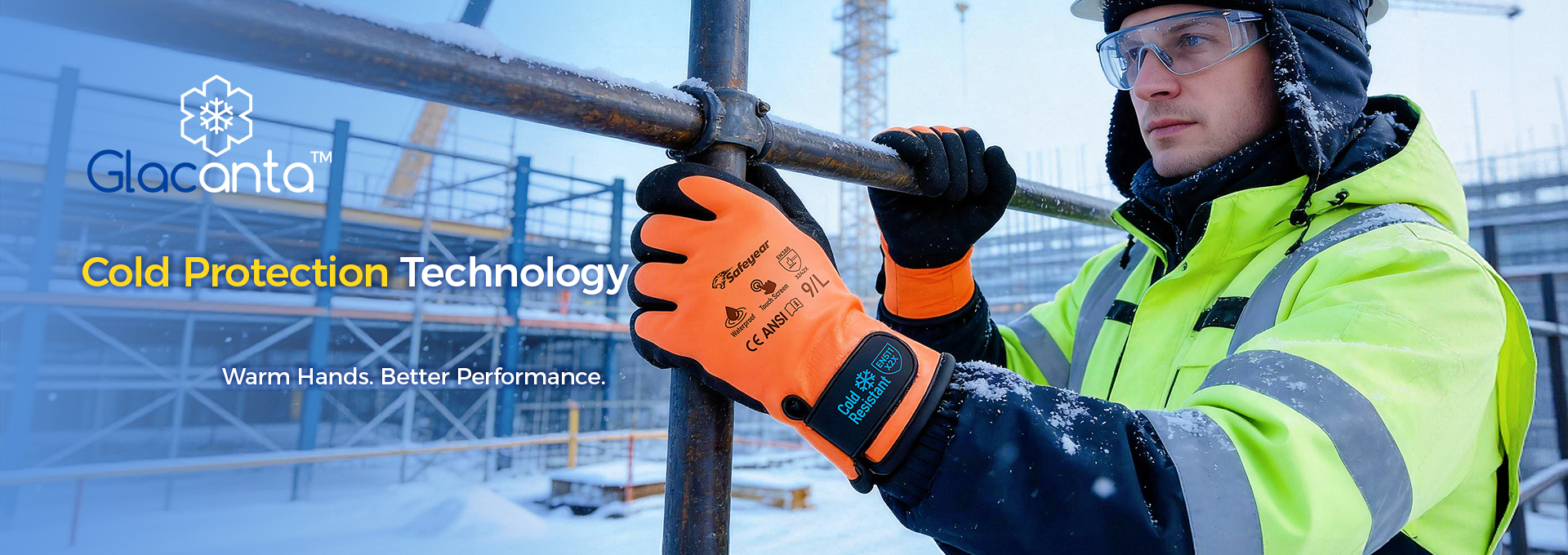
Cold storage, refrigerated warehouses and outdoor winter jobs challenge hand warmth, grip and finger movement. Workers may handle cold packaging, tools or rough materials throughout a shift. Selecting cold weather work gloves therefore requires more than choosing the thickest pair. Thermal insulation must be balanced with dexterity and the mechanical protection required for the task. This guide explains how to compare environments, interpret EN 511 ratings and assess glove construction. Explore our Cold Weather Work Gloves Worksite Solutionfor application considerations.
What Hand Protection Challenges Do Workers Face in Cold Environments?
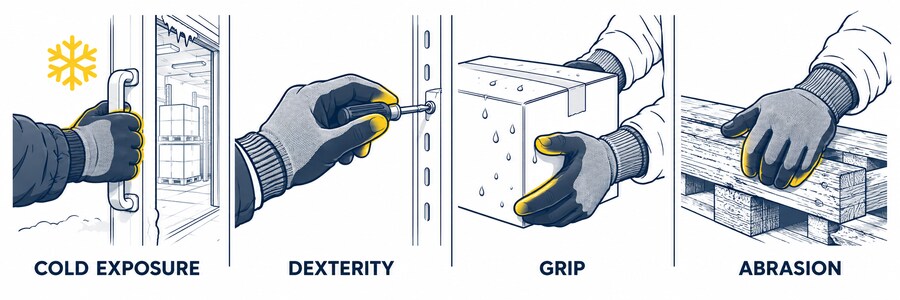
Cold Exposure
Consider cold air, contact with chilled objects and repeated movement between warm and cold areas. Temperature, exposure duration, wind and moisture affect the protection needed.
Reduced Dexterity
Cold hands and bulky gloves can make picking, fastening and tool use harder. Check whether workers can perform the required movements while keeping their gloves on.
Reduced Grip
Cold packaging, condensation and damp equipment can change handling conditions. Evaluate palm texture and grip on the actual materials, rather than assuming one coating suits every surface.
Abrasion and Repetitive Handling
Cartons, pallets and building materials still create mechanical demands in cold environments. Thermal lining does not establish abrasion, cut or puncture resistance; check those properties separately.
Cold exposure, dexterity, grip and abrasion must be considered together.
How to Choose Cold Weather Gloves by Work Environment
Start with the environment, then identify what workers touch and how precisely they must handle it. Indoor refrigeration and outdoor winter work can require different combinations of protection.
| Work environment | Main needs | What to look for |
| Cold storage | Thermal protection and dexterity | Insulation with suitable flexibility |
| Refrigerated warehouse | Warmth and handling grip | Thermal lining and an appropriate palm surface |
| Outdoor winter work | Cold and mechanical protection | Insulation plus task-appropriate protection |
| Cold material handling | Grip and abrasion resistance | Durable palm construction and verified mechanical ratings |
| Precision work in cold areas | Finger control and warmth | Flexible construction with an appropriate fit |
Where wet exposure is expected, also verify the documented water-penetration performance. A coated appearance alone does not establish waterproof protection.
Match the environment and handling needs to the glove construction.
What Does EN 511 Mean for Cold Protection Gloves?
EN 511 evaluates gloves against cold. Its three marking positions refer, from left to right, to convective cold, contact cold and water penetration. Convective and contact cold use numerical performance levels; water penetration uses a separate result. Read each position rather than treating the code as one overall score.
For example, EN 511 X2X records Contact Cold Level 2 in the middle position. The two X positions do not state rated convective-cold or water-penetration performance. Therefore, X2X alone does not support a waterproof claim. EN 511:2006
EN 511 levels are not guaranteed working temperatures. Contact Cold Level 2 cannot simply be converted into a minimum ambient temperature. Assess the manufacturer’s use instructions alongside exposure duration, activity, moisture and fit. Review mechanical performance separately through EN 388 glove ratings.
Warmth or Dexterity: How Should Workers Balance Both?
More insulation is not always better for every task. Prolonged or less active work may place greater emphasis on warmth, while picking, packing and equipment operation also require finger control. Compare gloves during representative tasks in the expected conditions.
Check fingertip reach, grip around tool handles and whether cuffs work with other clothing. Excess material can obstruct movement, while an overly tight fit can cause discomfort. Evaluate exposure duration and activity together with environmental conditions. Gloves form part of the site’s cold-work arrangements, including suitable clothing and opportunities to warm up. Follow the workplace procedure if cold or discomfort affects safe handling.
How Important Are Grip and Durability in Cold Work?
Winter work still involves cartons, pallets, tools and equipment. A warm glove that cannot maintain handling control may be unsuitable for the task. Compare coating condition and grip on representative dry or damp surfaces.
GripVanta™ Grip Technologyand DuralVanta™ Durability Technologyprovide supporting information on handling and wear considerations. These technology names do not replace model-specific ratings. Performance varies with glove construction, surface conditions and use. Inspect gloves regularly and follow replacement instructions.
Recommended Safeyear Gloves for Cold Weather Work
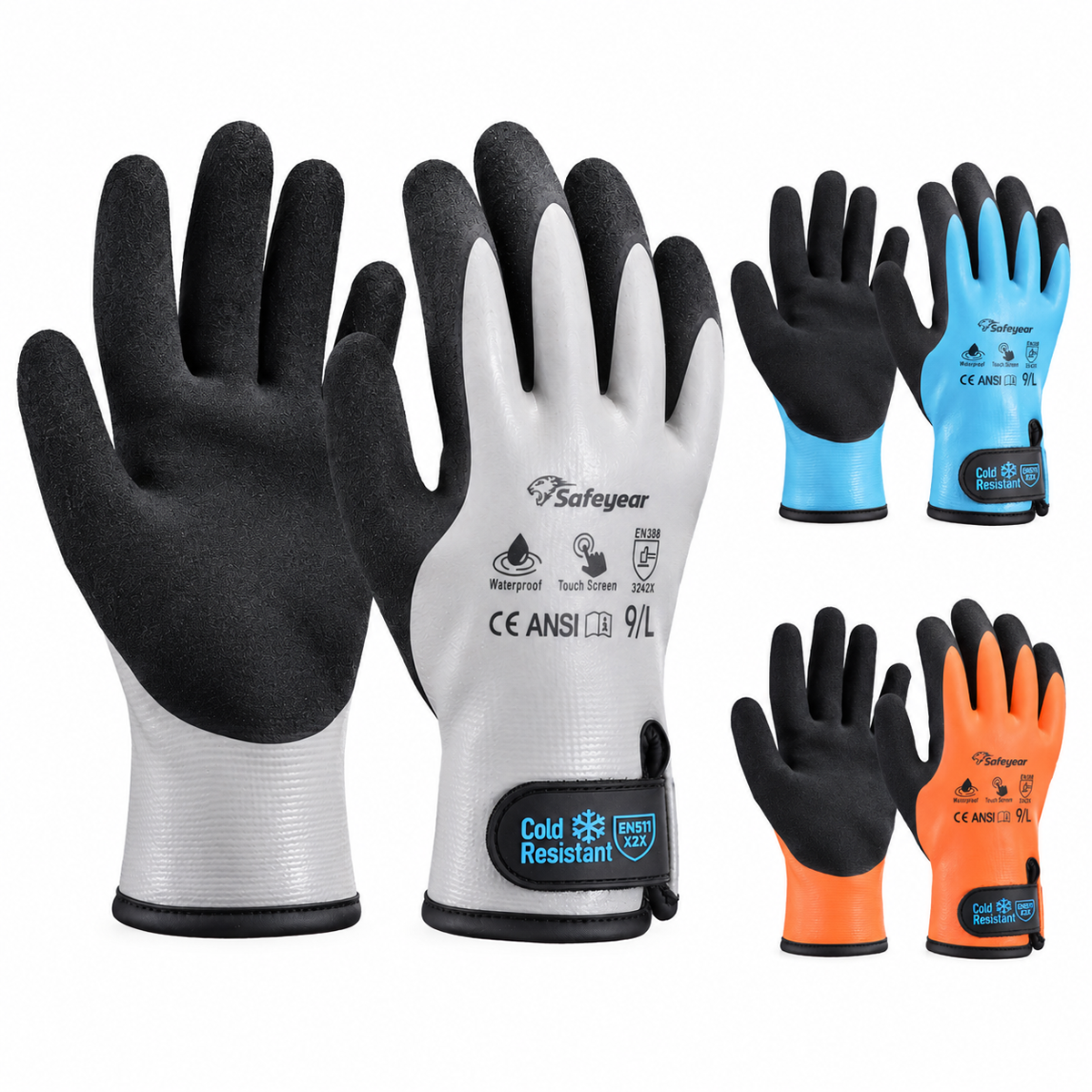
FL-9002 — An Option to Evaluate for Winter and Cold Storage
FL-9002 Cold Weather Work Gloves combine an acrylic terry thermal liner, full latex coating and sandy latex palm and thumb. Safeyear identifies Glacanta™ Cold Protection Technology as the model’s thermal-protection approach.
These features make FL-9002 a candidate to assess for cold-storage handling, refrigerated logistics and outdoor winter tasks. Confirm that its documented performance matches the actual exposure and mechanical hazards. Verify the exact supplied model, markings, instructions and supporting documents before purchase. A thermal liner or full coating does not by itself establish a safe exposure duration, waterproof performance or suitability for every cold environment.
Cold Weather Work Glove Selection Checklist
☐ What is the working environment?
☐ How long will workers be exposed to cold?
☐ How much dexterity is required?
☐ Are wet or slippery materials handled?
☐ What mechanical hazards are present?
☐ What EN 511 performance is documented?
☐ Does the glove fit and function during the task?
Cold Weather Work Gloves FAQ
What are the best gloves for cold storage work?
Choose according to the task, cold exposure, grip and finger-control requirements. Compare documented cold and mechanical performance, then assess the fit during representative work. No single glove is best for every cold-storage job.
What does EN 511 mean on work gloves?
EN 511 addresses convective cold, contact cold and water penetration. Check each marking position against the product instructions. An X does not state a rated performance level for that position.
Does EN 511 tell me the lowest temperature a glove can be used at?
No. A performance level is not a universal temperature limit. Suitability also depends on exposure duration, activity, wind, moisture, fit and the manufacturer’s instructions.
Are thicker insulated gloves always better for cold work?
No. Extra bulk may interfere with handling tools or small items. Choose sufficient thermal protection while retaining the grip and dexterity required for the task.
Summary
Choose cold weather work gloves by matching the environment, exposure and handling requirements to documented product performance. Balance warmth with dexterity, grip and mechanical protection. EN 511 supports comparison, but it does not establish a guaranteed working temperature. Assess the complete glove on the wearer before specifying it for a job.
About the Author
By Jay Yuan, Technical Marketing Director, Safeyear.
Jay writes about industrial PPE, performance standards and worksite product selection for global buyers.
Explore Glacanta™ Cold Protection Technology, view our Cold Weather Work Gloves Solutions, or contact Safetoe to discuss your application and request model-specific documents.

 English


