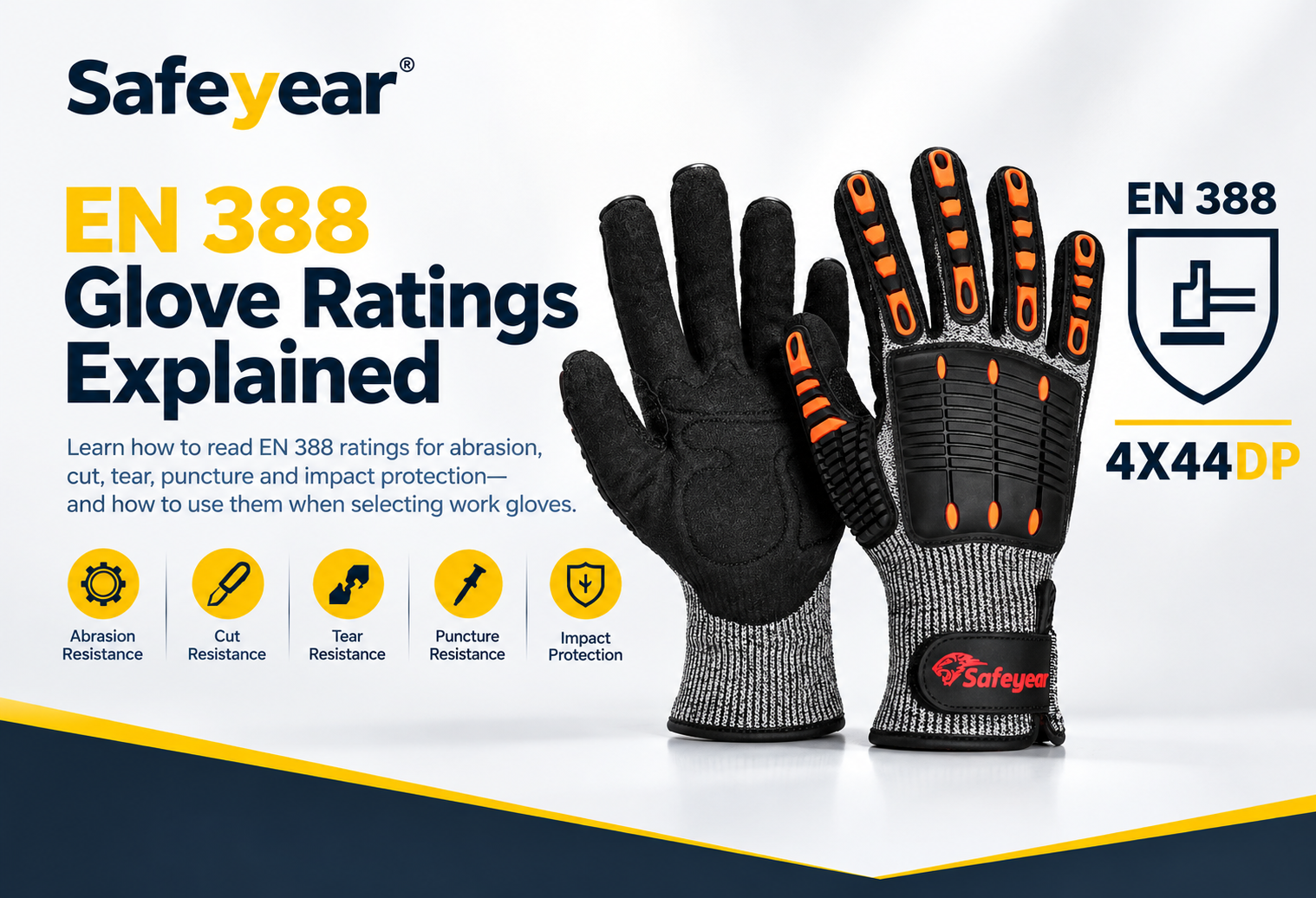
What does 4X44DP mean on a safety glove? Each character represents a different aspect of mechanical protection under EN 388. Understanding these ratings helps buyers compare gloves and select the right protection for specific workplace hazards.
EN 388 ratings cover abrasion, blade cut, tear, puncture, ISO 13997 cut resistance and optional impact protection. However, a higher rating does not automatically mean a better glove for every task.
What Is EN 388?
EN 388:2016+A1:2018 is a European standard for protective gloves against mechanical risks. It helps buyers evaluate glove performance through standardized tests.
For more information about the standard and its testing framework, visit our EN 388 Mechanical Protection Guide.
How Do You Read an EN 388 Glove Rating?
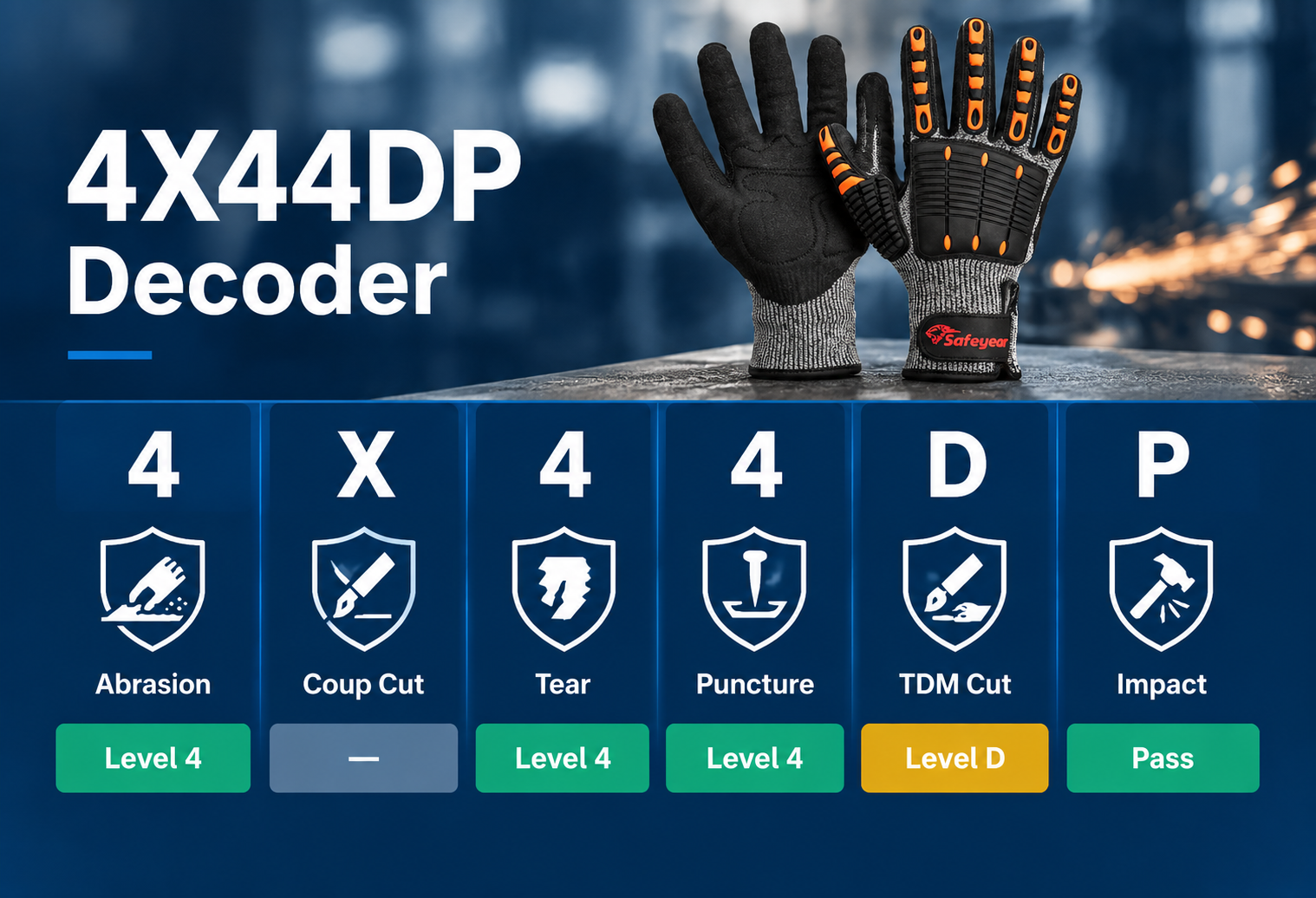
The code 4X44DP contains six positions, each representing a different test result.
| Position | Protection Test | Rating |
| 1 | Abrasion | 0–4 |
| 2 | Blade Cut — Coup Test | 0–5 / X |
| 3 | Tear | 0–4 |
| 4 | Puncture | 0–4 |
| 5 | ISO 13997 TDM Cut | A–F / X |
| 6 | Impact | P / no marking |
Each position should be read separately. EN 388 is not a single overall protection score.
What Do EN 388 Cut Levels A–F Mean?
The ISO 13997 test measures the force required to cut through glove material. Higher letters indicate greater cut resistance under this test.
| Level | Force Threshold |
| A | ≥2 N |
| B | ≥5 N |
| C | ≥10 N |
| D | ≥15 N |
| E | ≥22 N |
| F | ≥30 N |
Higher cut resistance is not automatically better for every task. Dexterity, grip, comfort and cost also matter.
For more detailed selection guidance, see our upcoming guide: How to Choose the Right Cut-Resistant Gloves: EN 388 Cut Levels A–F Explained.
Coup Test vs. ISO 13997 TDM
The Coup Test uses a rotating circular blade to assess cut resistance. ISO 13997, also known as the TDM test, uses a straight blade under increasing force.
These methods assess cut resistance differently. Depending on the glove material and test results, the Coup Test position may display an X rather than a numerical level, while the ISO 13997 position can provide a letter rating.
When both positions appear on the marking, review the complete EN 388 code. Do not rely on only one cut result when evaluating a glove for a specific workplace hazard.
What Do “X” and “P” Mean?
X does not automatically mean failure. It indicates that a performance level is not reported for that test position.
P indicates a pass in the optional EN 388 impact protection test. However, TPR impact structures alone do not prove that a glove has achieved the P marking. Always check the documentation for the exact glove model.
How Should You Choose Gloves Using EN 388?
Start with the workplace hazard, then identify the relevant test results.
| Workplace Hazard | Performance to Review |
| Rough material handling | Abrasion |
| Sharp edges | Cut |
| Tearing or snagging | Tear |
| Sharp pointed objects | Puncture |
| Impact hazards | Impact |
| Multiple hazards | Complete rating |
Grip, dexterity, fit and comfort also matter. EN 388 ratings are important evidence, but they do not determine every aspect of glove suitability.
EN 388 Rating Example: Safeyear TPR9004
The Safeyear TPR9004, with the stated marking 4X44DP, illustrates how to interpret a glove rating:
These results can help buyers evaluate the glove for applications involving cut, abrasion, puncture and impact hazards. Confirm the marking and supporting test documentation before purchasing.
Explore Safeyear work gloves for more information about mechanical protection options.
Does a Higher EN 388 Rating Always Mean a Better Glove?
No. Different jobs require different protection priorities. Precision assembly may emphasize grip and dexterity, while heavy industrial work may require greater attention to cut, abrasion and impact hazards.
The best glove is the one whose tested performance matches the actual task and risk profile.
EN 388 Glove Selection Checklist
Before selecting a glove, ask:
What mechanical hazards are present?
Which EN 388 ratings matter most?
Is cut or puncture resistance required?
Is impact protection necessary?
Does the rating apply to the exact model?
Are grip, dexterity and comfort suitable?
Is supporting test or certification documentation available?
What Should Buyers Check When Comparing Safety Earmuffs?
When evaluating industrial safety earmuffs, buyers should check:
Applicable SNR or NRR performance
Relevant hearing protection standard
Ear cup and acoustic design
Cushion condition and sealing
Headband adjustment and fit
Compatibility with safety glasses and other PPE
Expected wearing time and comfort
Product test or certification documentation
For workplace PPE procurement, documented performance should be considered alongside design and fit.
Safeyear Safety Earmuff Options
EM-5002 — Professional Safety Earmuffs
SNR 33 dB | NRR 26 dB
EM-5002 is a professional safety earmuff option for workplaces where documented attenuation performance and a complete hearing protection system are important.
FM-1B — Lightweight Safety Earmuffs
230 g | SNR 31 dB | NRR 26 dB
FM-1B provides a lightweight hearing protection option for workplaces where product weight and long-duration wear are important considerations.
The right choice should be based on workplace noise exposure, required protection, fit and wearing conditions.
FAQ
EN 388 FAQ
1. What does EN 388 cover?
It evaluates glove performance against mechanical risks, including abrasion, cut, tear, puncture and optional impact protection.
2. How do I read 4X44DP?
The six characters represent abrasion, Coup Test cut, tear, puncture, ISO 13997 cut and impact protection.
3. Does X mean the glove failed?
No. X means a performance level is not reported for that test position.
4. What does P mean?
P indicates that the glove passed the optional impact protection test.
5. Does a higher rating always mean better protection?
No. Select gloves according to the hazards, task requirements and supporting test evidence.
Choose Gloves Based on Evidence
Understanding EN 388 ratings helps buyers compare gloves more effectively. Identify workplace hazards, review the relevant test results and verify product documentation before making a decision.
The right glove is not simply the one with the highest numbers, but the one suited to the job.

 English


