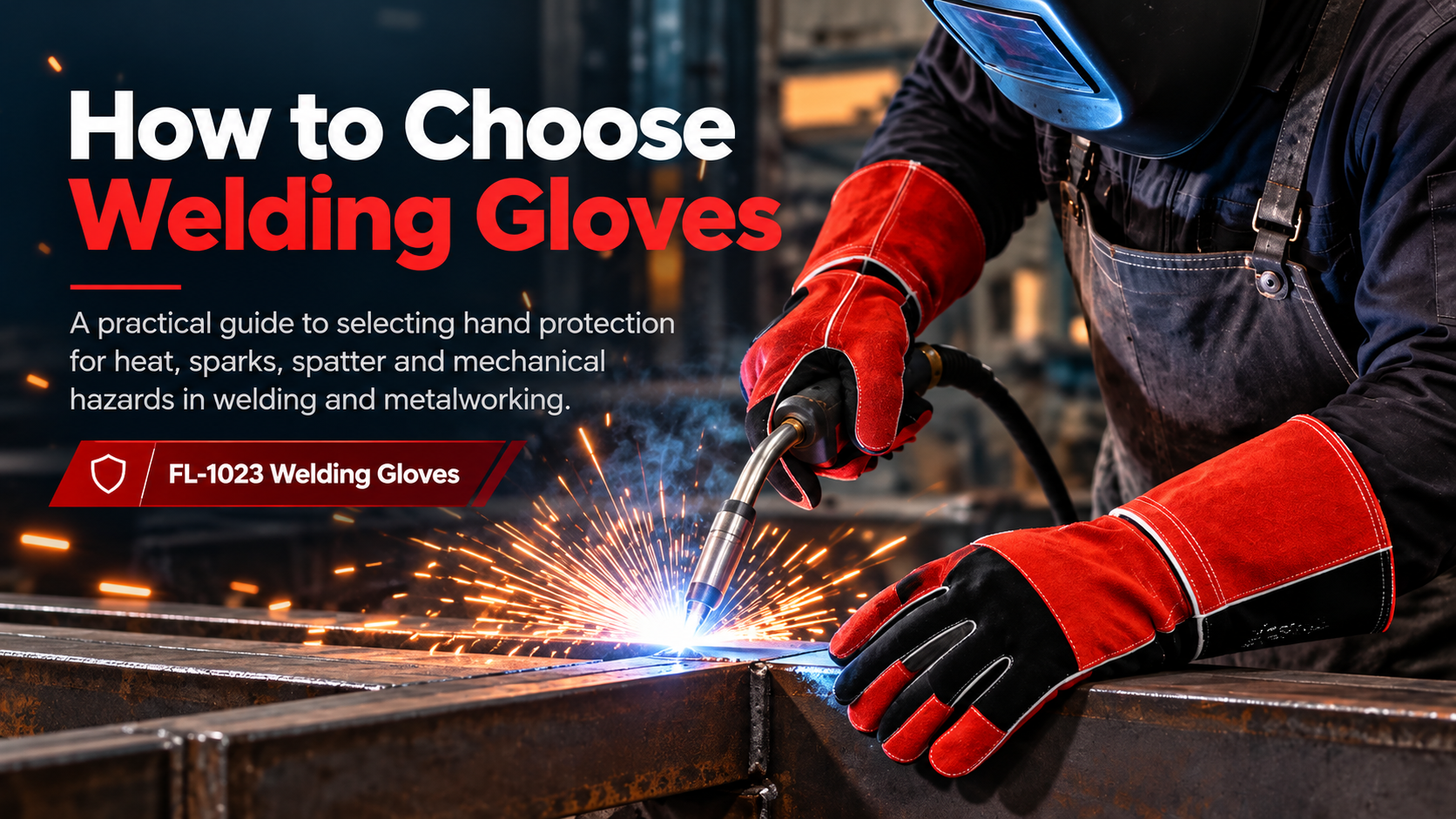
 How to Choose Welding Gloves: A Guide to Heat Protection, EN 407 & EN 12477
Welding exposes workers to heat, sparks, molten metal spatter and rough metal surfaces, while many tasks also require precise hand control. Choosing welding gloves therefore means balancing thermal protection, mechanical protection and dexterity according to the process and task.
Leather construction or thickness alone cannot establish suitability. Buyers need evidence of relevant performance and a fit that supports controlled tool handling. This guide explains how to compare welding processes, use EN 12477 and EN 407 when selecting gloves, and assess the evidence behind specific products. For application guidance, explore the Welding Gloves Worksite Solution.
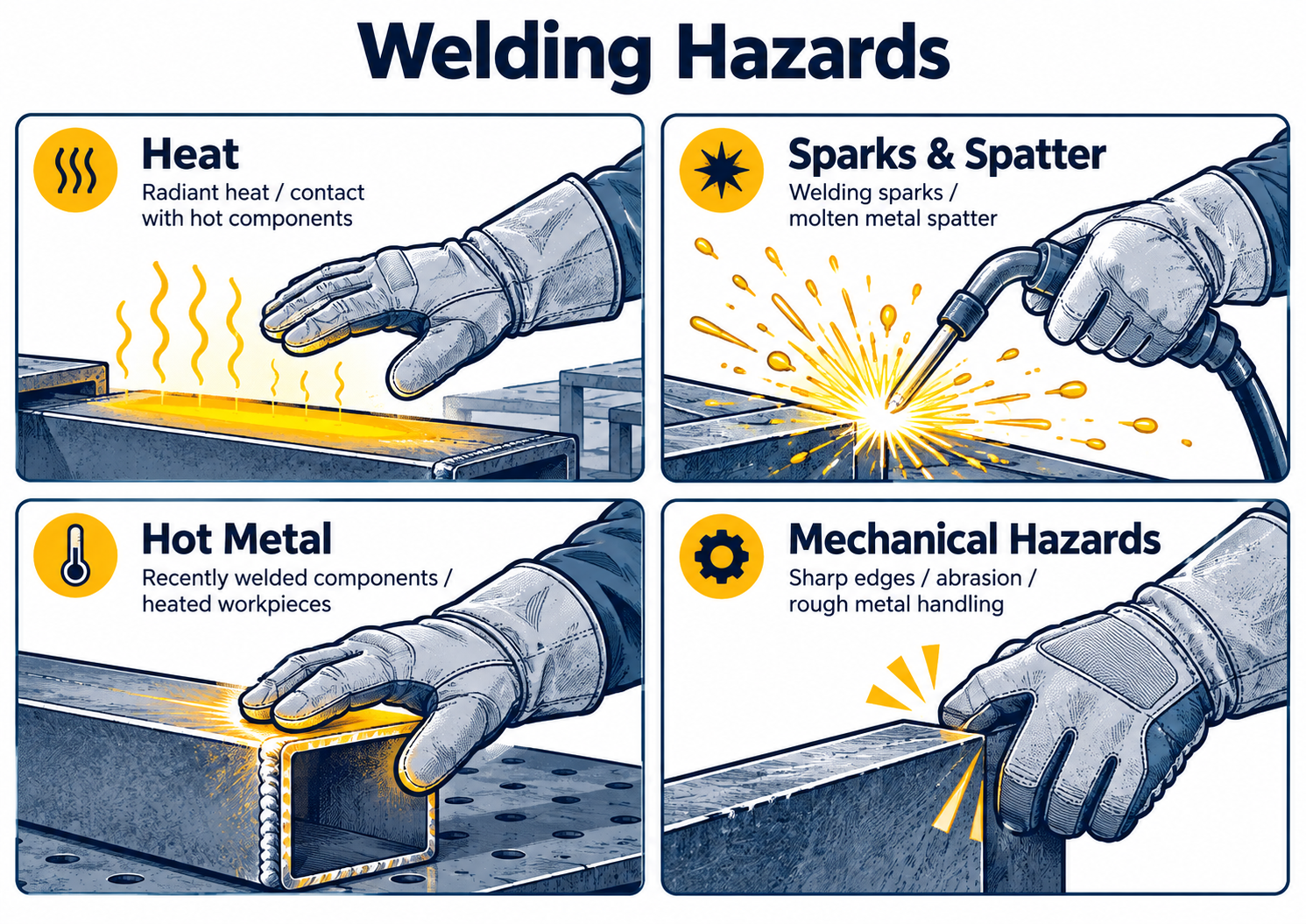
What Hand Hazards Do Welders Face?
Heat Exposure
Radiant and convective heat can affect exposed hands during welding. Identify the actual exposure and check the relevant thermal performance; a contact-heat rating alone does not establish radiant-heat protection.
Sparks & Spatter
Sparks and small molten metal splashes can reach the hand, cuff and wrist. Assess construction, coverage and tested splash performance. Vulatora™ Heat Protection Technology supports the thermal-protection approach used in FL-1023.
Hot Metal Contact
Recently welded components can remain hot after welding stops. Evaluate surface temperature, contact conditions and handling methods, including whether tools can avoid direct contact.
Mechanical Hazards
Rough surfaces, sharp edges and abrasive materials create additional risks during fabrication. Review relevant EN 388 performance alongside thermal requirements; leather appearance does not establish cut resistance.
How to Choose Welding Gloves by Welding Process
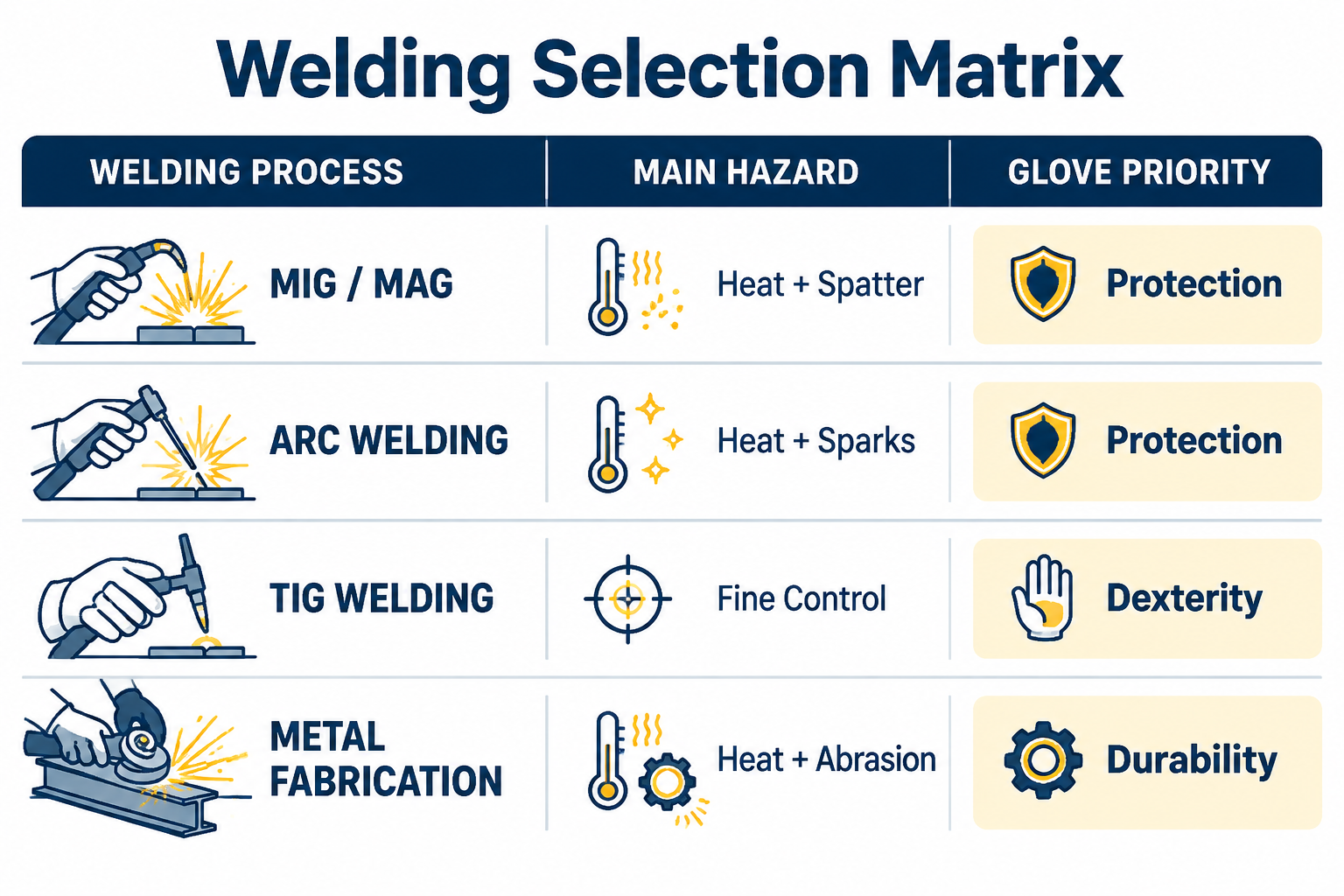
Start with the process, then assess the actual heat, spatter and handling demands.
Welding Process / Task
| Main Need | What to Look For |
MIG / MAG Welding
| Heat + spatter | Thermal protection + durable construction |
| Arc / Stick Welding | Heat + sparks | Strong heat and mechanical protection |
| Heavy Metal Fabrication | Heat + abrasion | Durable leather + mechanical protection |
| TIG Welding | Dexterity + control | Thinner, flexible glove construction |
| Hot Metal Handling | Contact heat | Verified thermal performance |
A glove designed for heavy-duty MIG or arc welding may restrict the fine movements required for TIG work. Thinner construction can support dexterity, but must still meet the task's protection requirements.
What Does EN 12477 Mean for Welding Gloves?
EN 12477 addresses protective gloves for welding and allied processes, combining relevant thermal, mechanical and dexterity requirements.
| Classification | General Emphasis | Selection Implication |
| Type A | Higher minimum requirements for several protective properties; lower minimum dexterity | Consider for more demanding welding and fabrication |
| Type B | Higher minimum dexterity; lower minimum requirements for several protective properties | Consider where fine hand control is important |
These classifications are not automatic process labels. Type A does not simply mean MIG, and Type B does not automatically make a glove suitable for every TIG task. Select according to the actual hazards and documented performance.
What Does EN 407 Tell You About Heat Protection?
EN 407 reports performance for different thermal risks. Check the specific ratings rather than judging heat resistance from glove thickness or leather appearance.
FL-1023 is rated EN 407:2020 — 444X4X, including Contact Heat Level 4. The appropriate description is: Tested at 500°C under the EN 407 contact heat test. Level 4 involves a laboratory contact temperature of 500°C and a threshold time of at least 15 seconds for a specified calorimeter temperature rise. FL-1023's reported threshold times are 21–24 seconds.
These are laboratory results, not safe handling durations or continuous-use temperatures. Actual heat transfer varies with contact pressure, area, materials and glove condition. The X positions do not establish protection for those thermal properties.
Heat Protection or Dexterity: Which Matters More?
Both matter, but their relative priority depends on the process. Heavy welding and hot-component handling can demand substantial protection, while precision welding requires fine finger control. Check whether workers can grip tools, operate controls and position materials without excessive effort. Correct sizing and an appropriate cuff also matter. A thicker glove is not automatically better if it prevents controlled work. Use EN 12477 classification and individual test results together with a task-based fit assessment.
Recommended Safeyear Gloves for Welding & Metalworking
FL-1023 — Certified Welding & Heat Protection
FL-1023 is the primary welding option in this guide, with the following documented performance:
• EN 407:2020 — 444X4X
• Contact Heat Level 4 — tested at 500°C
• EN 12477 — Type A
• EN 388 — 3144X
Its leather construction and Vulatora™ heat-protection system make it an option to evaluate for MIG/MAG, arc welding, heavy fabrication and assessed hot-metal tasks. Confirm the required performance and manufacturer’s use limitations before selection.
FL-1015 — General Leather Handling
FL-1015 has a split-leather palm, breathable cotton back and rubberized safety cuff. Consider it for general material handling, fabrication support, construction or maintenance tasks that match its documented performance.
It is not presented here as an EN 407 or EN 12477 welding glove. Do not substitute it for FL-1023 where verified welding or thermal protection is required.
Welding Glove Selection Checklist
• What welding process will be performed?
• What heat, spark and spatter exposure is expected?
• Is contact with hot metal possible?
• How much dexterity is required?
• What mechanical hazards are present?
• Does the glove have relevant EN 407 performance?
• Is EN 12477 Type A or Type B appropriate for the task?

 English


 How to Choose Welding Gloves: A Guide to Heat Protection, EN 407 & EN 12477
