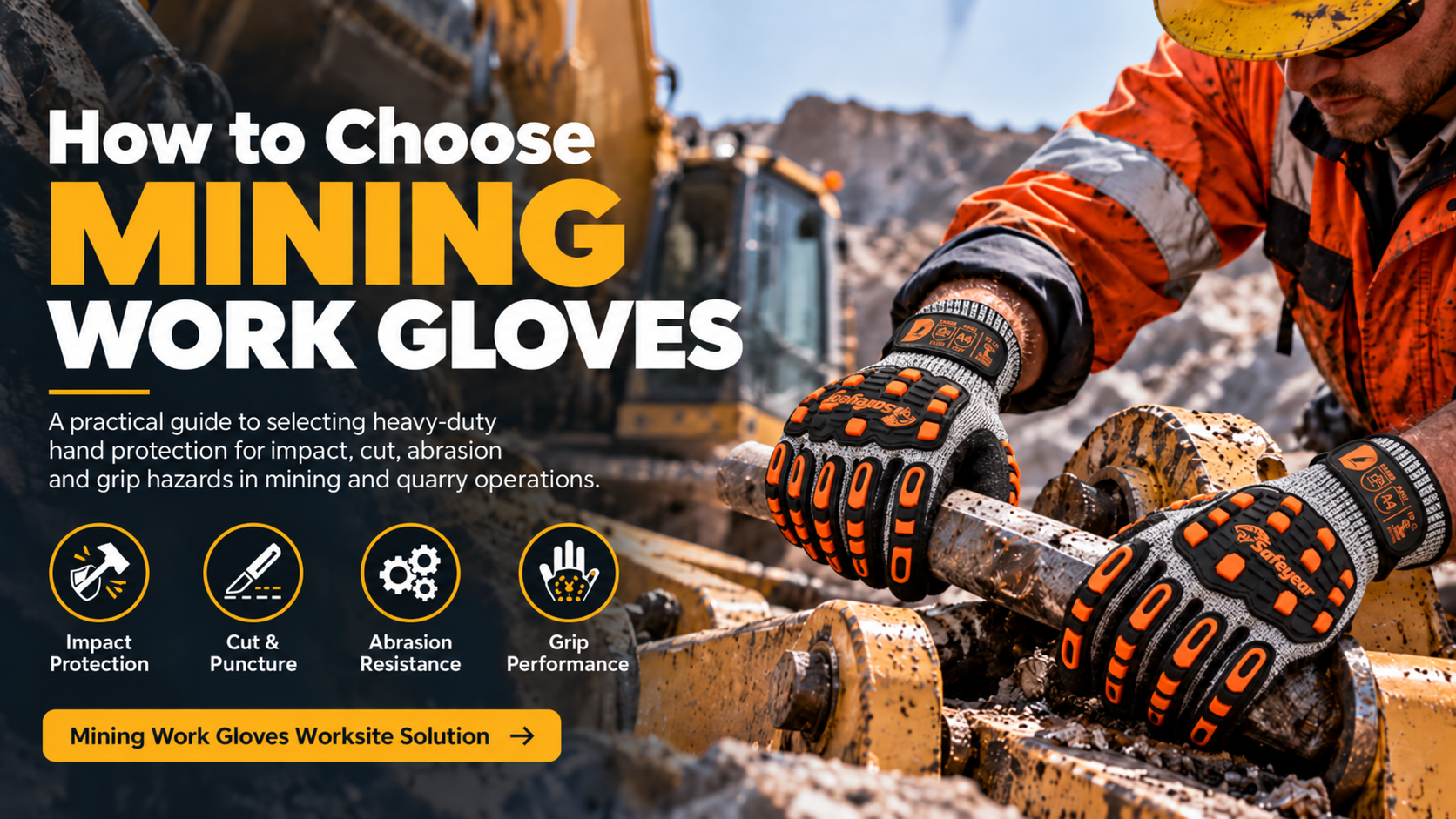
Mining and quarry workers regularly handle heavy equipment, tools, rocks, cables and abrasive materials in demanding working environments. These tasks can expose hands to impact, cuts, punctures, abrasion and reduced grip.2Choosing mining work gloves therefore requires more than selecting the thickest or highest-rated glove available.
The goal is to balance:
Impact Protection + Cut/Puncture Protection + Abrasion Resistance + Grip
while maintaining enough flexibility and handling performance for the task.
This guide explains how to select mining gloves according to the actual hazard profile, work activity and required mechanical protection.
Explore Mining & Heavy Industry Gloves for application-specific Safeyear solutions.
1.What Are the Main Hand Hazards in Mining?
Mining environments can combine several mechanical hazards at the same time.
1.Impact & Crushing Hazards
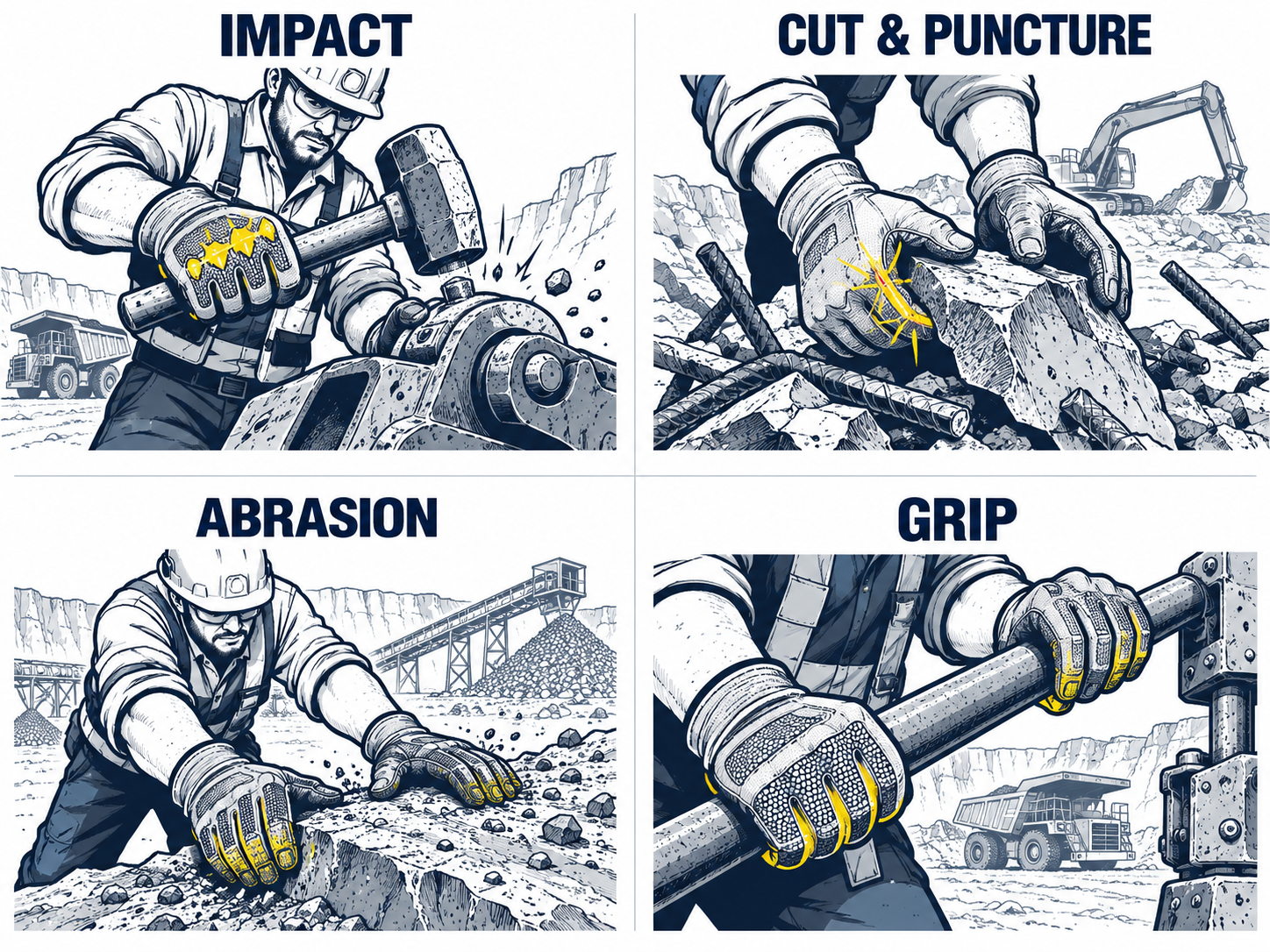
Heavy tools, machinery, rocks and equipment handling can expose the back of the hand and fingers to knocks, blows and impact.This makes impact protection especially important in tasks involving heavy equipment or moving materials.
Learn more about TravMora™ Impact Protection Technology.
2.Cuts & Puncture Hazards
Sharp rocks, metal edges, cables and components may create both cutting and puncture hazards.These should not be treated as the same performance property.Cut resistance and puncture resistance are different EN 388 performance properties.A glove with strong cut performance does not automatically provide equally strong puncture protection.
Learn more about VarioNova™ Cut Protection Technology.
3.Abrasion & Rough Materials
Rocks, cables, machinery surfaces and repeated material handling can place significant wear on a glove.Durability becomes especially important where gloves repeatedly contact rough or abrasive materials.
Learn more about DuralVanta™ Durability Technology.
4.Wet & Slippery Handling
Mining work may also involve wet tools, muddy surfaces, cables and damp materials.Grip performance can affect how securely workers handle equipment under these conditions.
Learn more about GripVanta™ Grip Technology.
2.How to Choose Mining Gloves by Task
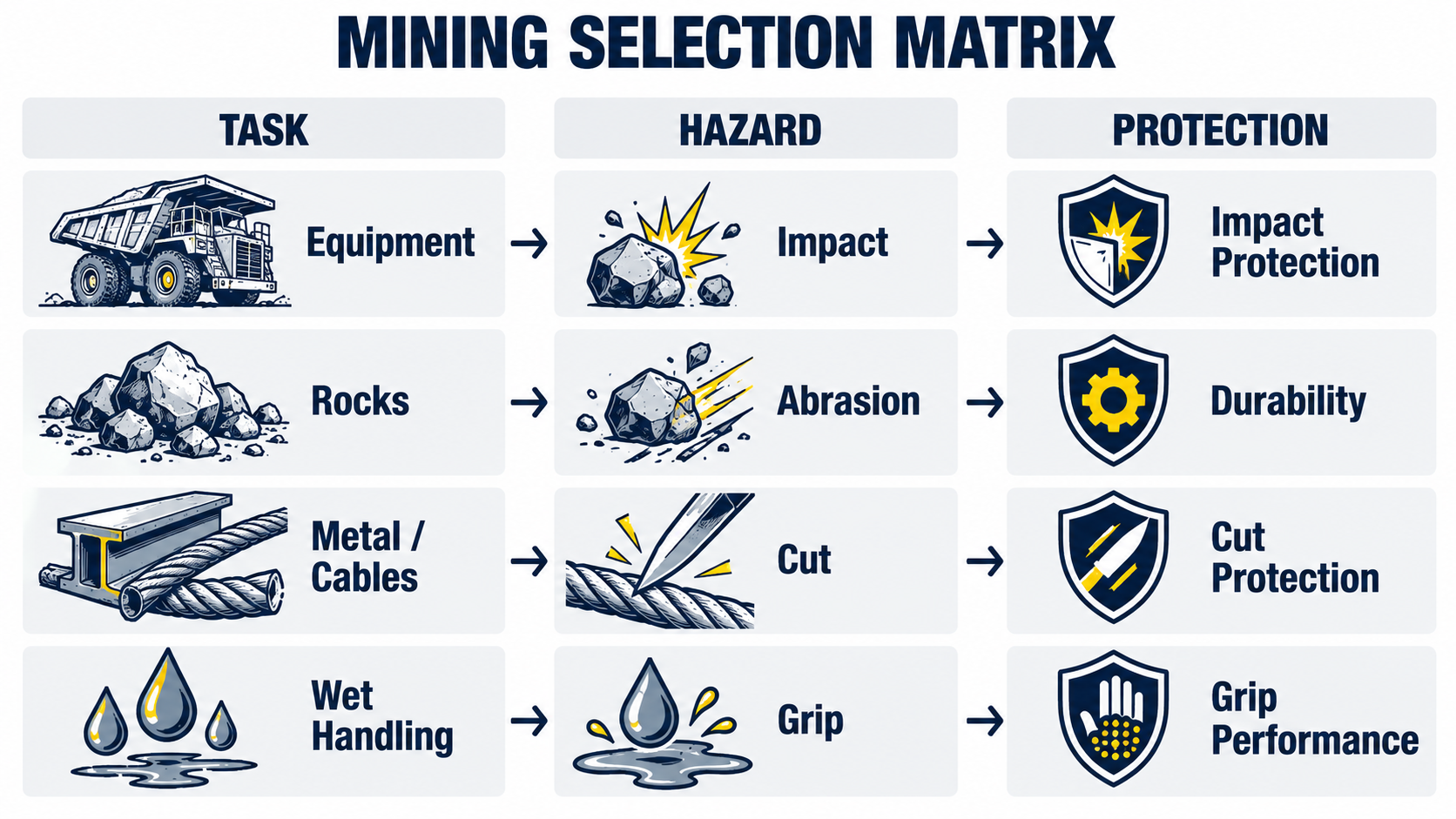
There is no single glove configuration suitable for every mining activity.
| Mining Task | Main Hazards | What to Look For |
| Heavy Equipment Work | Impact / abrasion | Back-of-hand protection + durability |
| Rock & Material Handling | Cut / puncture / abrasion | Mechanical protection + durable palm |
| Cable & Metal Handling | Cut / grip | Appropriate cut resistance + secure grip |
| Equipment Maintenance | Grip / abrasion / dexterity | Grip + flexibility + mechanical protection |
| Wet or Muddy Work | Grip / abrasion | Reliable handling grip + durability |
No single glove is ideal for every mining task. Protection should be selected according to the actual hazard assessment and required handling performance.
3.When Do Mining Workers Need Impact Protection?
Impact protection becomes particularly important where workers handle heavy machinery, tools, rocks or large materials, or where the back of the hand may be exposed to knocks and blows.However, buyers should distinguish between physical TPR protection construction and actual EN 388 impact-test evidence.A glove with TPR on the back of the hand is not automatically EN 388 impact tested.
Under EN 388, the optional impact test is indicated by the letter: P
Safeyear TPR9004, for example, carries an EN 388 rating of: 4X44DP
This includes:
This creates a clear selection chain: Hazard → Standard → Product Evidence
For mining buyers, this distinction is important because the physical appearance of a protective glove should never replace actual test evidence.
4.Cut, Puncture or Abrasion: What Protection Matters?
These three mechanical hazards are related, but they are not interchangeable.
1.Cut Resistance
Cut resistance is relevant when workers handle:
sharp metal edges, cables, components or other cutting hazards.
2.Puncture Resistance
Puncture resistance addresses penetration by pointed objects or sharp projections.It is a different performance property from cut resistance.
3.Abrasion Resistance
Abrasion resistance relates to repeated rubbing and wear against:
rocks, rough surfaces, cables and equipment.
This distinction matters because:
A high cut rating does not automatically mean high puncture or abrasion resistance.
Mining glove selection should therefore consider the complete mechanical hazard profile instead of focusing on only one rating.
Learn more:
VarioNova™ Cut Protection
DuralVanta™ Durability Technology
EN 388 Mechanical Protection Guide
5.How Important Is Grip in Mining Work?
Grip remains an important part of mining hand protection because workers may handle:
tools;
machinery;
cables;
wet or muddy materials.
A glove that offers strong mechanical protection but poor handling control may not be appropriate for every task.Grip performance can vary according to the coating material, surface texture and actual working conditions.For this reason, buyers should avoid assuming that one grip technology or coating performs identically in every wet, muddy or industrial environment.
→ GripVanta™ Grip Technology
6.Recommended Safeyear Gloves for Mining Work
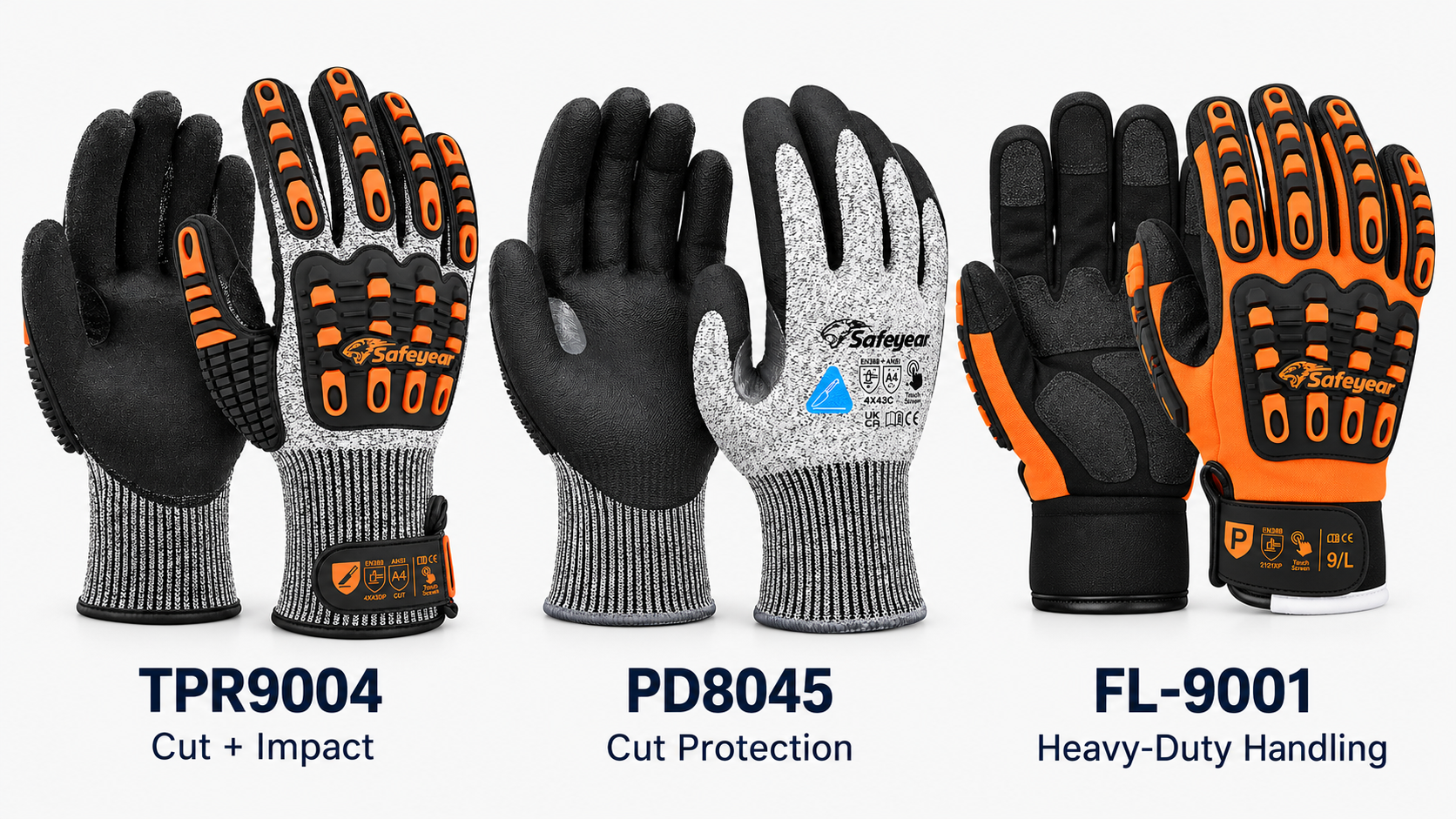
For this mining guide, three gloves cover three different protection priorities.
1.TPR9004 — Heavy-Duty Cut & Impact Protection
Best for:
Heavy Equipment · Rock Handling · Heavy-Duty Mining Tasks
Evidence:
EN 388 4X44DP
ISO 13997 Cut Level D
Impact P
TPR Back-of-Hand Protection
TPR9004 is the primary mining recommendation where workers need both cut and tested impact protection.
Positioning:
Cut + Impact
2.PD8045 — Cut Protection
Best for:
Metal Handling · Cable Handling · Sharp Material Tasks
PD8045 should be positioned as the dedicated cut-protection option for mining tasks involving sharp materials.
Specific performance levels should follow the current PD8045 product technical documentation rather than being generalized in the article.
Positioning:
Cut Protection
3.FL-9001 — Heavy-Duty Handling
Best for:
General Mining Handling · Tools & Equipment · Material Handling
Key construction features include:
TPR Structure
Reinforced Synthetic Leather Palm
Adjustable Wrist
FL-9001 can be positioned around heavy-duty handling and protective construction.
However, it should not be described as an EN 388 impact-tested glove unless supporting evidence is available.
Positioning:
Heavy-Duty Handling
7.Mining Work Glove Selection Checklist
Before choosing mining gloves, buyers should confirm:
What mining task is being performed?
Is back-of-hand impact protection required?
Are sharp edges or cut hazards present?
Is puncture resistance important?
How abrasive are the handled materials?
Are wet or slippery conditions involved?
What EN 388 performance is appropriate?
The goal is to match the glove's actual tested performance and construction to the worksite hazard rather than selecting protection based only on appearance.
8.Mining Work Gloves FAQ
Q:What are the best gloves for mining work?
The best mining gloves depend on the task and hazards. Heavy equipment work may require impact protection, while cable or metal handling may emphasize cut resistance. Rock handling can require abrasion, puncture and durability performance.
Q:Do mining workers need impact-resistant gloves?
Not always, but impact protection can be important for tasks involving heavy machinery, rocks, tools or back-of-hand exposure. Where EN 388 impact performance is required, buyers should confirm the optional P marking on the tested product.
Q:What is the difference between cut and puncture resistance?
Cut resistance measures protection against cutting hazards, while puncture resistance evaluates resistance to penetration by pointed objects. Strong performance in one category does not automatically mean strong performance in the other.
Q:What EN 388 rating is suitable for mining gloves?
There is no single EN 388 rating suitable for all mining tasks. The correct rating depends on the combination of abrasion, cut, tear, puncture and optional impact hazards involved in the job.
Conclusion
Mining work can expose hands to a demanding combination of impact, cuts, punctures, abrasion and grip challenges.The best mining glove is therefore not simply the toughest glove available. It is the glove whose mechanical protection, tested performance and handling characteristics match the actual task.For heavy equipment and high-impact work, tested impact protection may be important. Sharp metal and cables may require greater cut resistance, while rock and material handling can place more emphasis on abrasion and durability.
The most effective selection process is:
Identify the Task → Identify the Hazards → Verify the Protection → Select the Glove
Explore Mining & Heavy Industry Gloves for Safeyear mining hand-protection solutions.

 English


