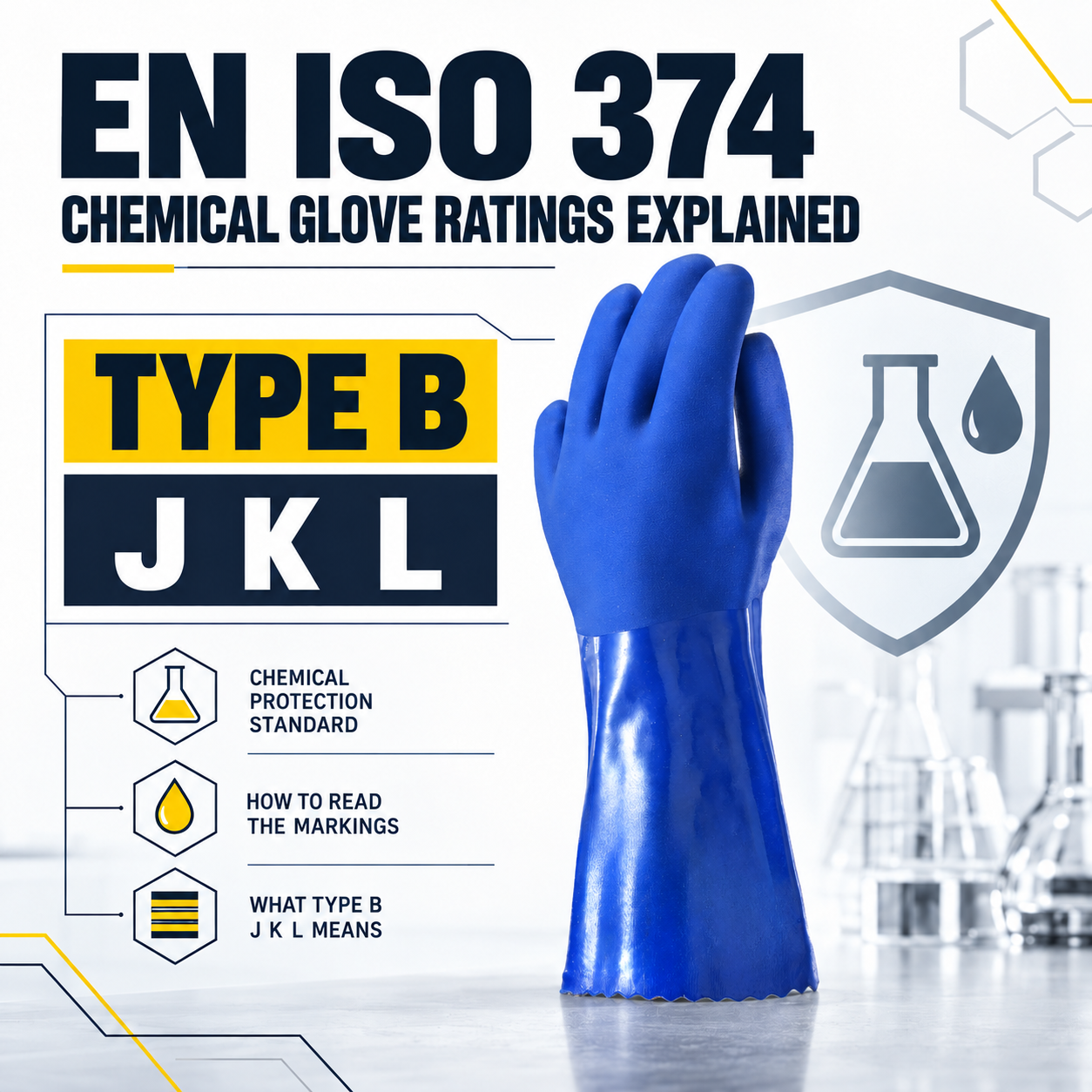
A chemical glove marked EN ISO 374 is not automatically resistant to every chemical. The standard uses protection types, chemical code letters and standardized testing to describe the performance of a specific glove against particular chemical hazards. Understanding these markings helps safety professionals compare chemical gloves using test evidence rather than material names or broad "chemical resistant" claims. Chemical protection should always be evaluated against the specific substance, concentration, exposure conditions and test data of the individual glove model.
What Is EN ISO 374?
EN ISO 374 is a standards framework for protective gloves against dangerous chemicals and microorganisms. It is not a single pass/fail test. EN ISO 374-1 addresses chemical risks, while EN ISO 374-5 addresses protection against microorganisms. Other parts of the series define test methods for aspects such as permeation, penetration and degradation. This guide focuses on Type A, Type B and Type C classifications, chemical code letters and the evidence buyers need to connect a glove marking to the actual hazard.
What Do EN ISO 374 Type A, B and C Mean?
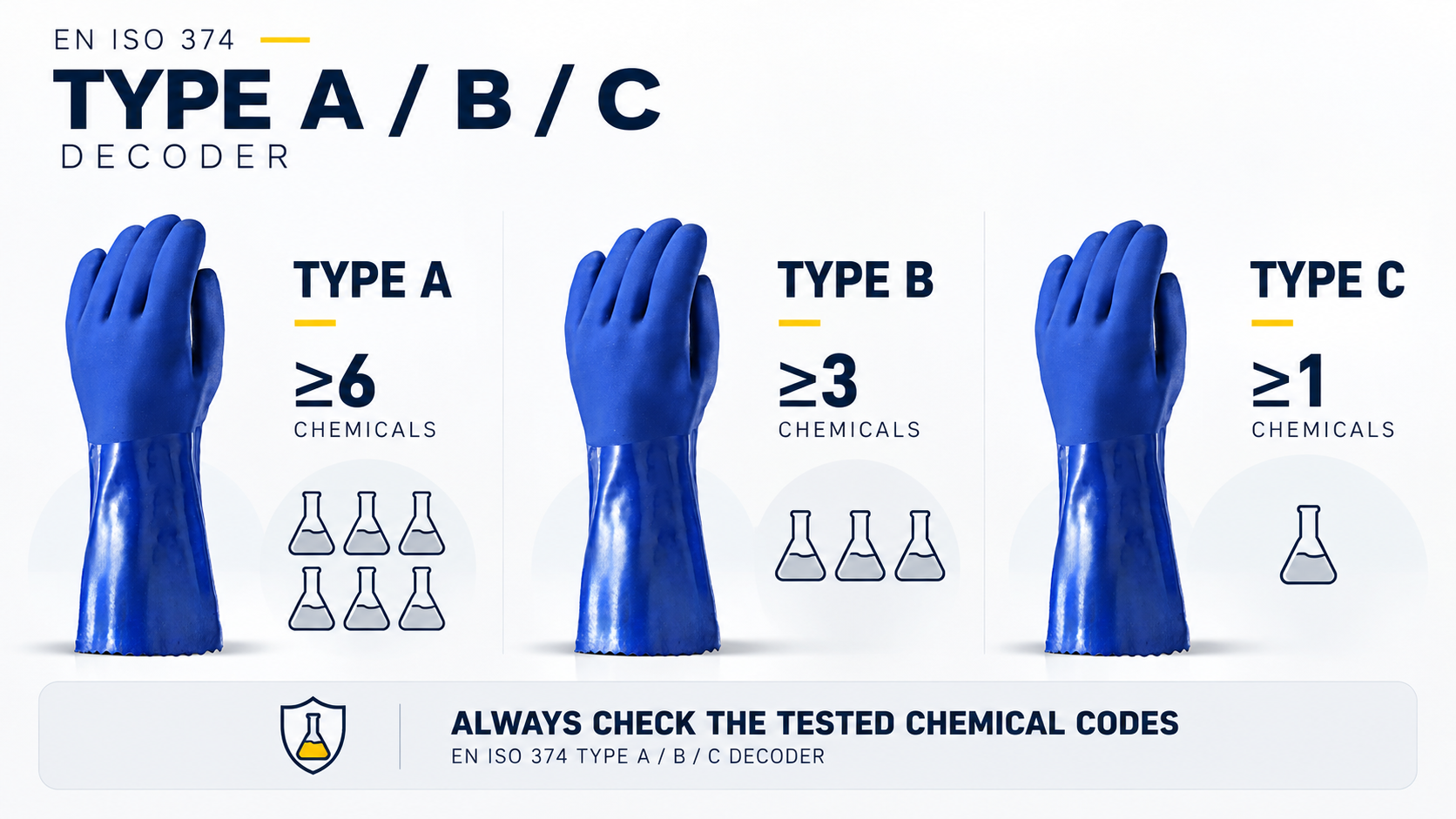
Type A, B and C describe the breadth of qualifying chemical-permeation performance across the standard's listed test chemicals. They are useful classification signals, but they should never be read without the chemical codes and supporting test data.
Classification | Minimum Test Requiremen |
Type A | ≥30 min breakthrough time for at least 6 listed test chemicals |
Type B | ≥30 min breakthrough time for at least 3 listed test chemicals |
Type C | ≥10 min breakthrough time for at least 1 listed test chemical |
Type A is not automatically "better" than Type B for every chemical-handling task. Type A covers more qualifying test chemicals, but the decisive question is still: which chemicals were tested? A broader classification alone does not establish compatibility with the workplace chemical.
What Do the Chemical Code Letters Mean?
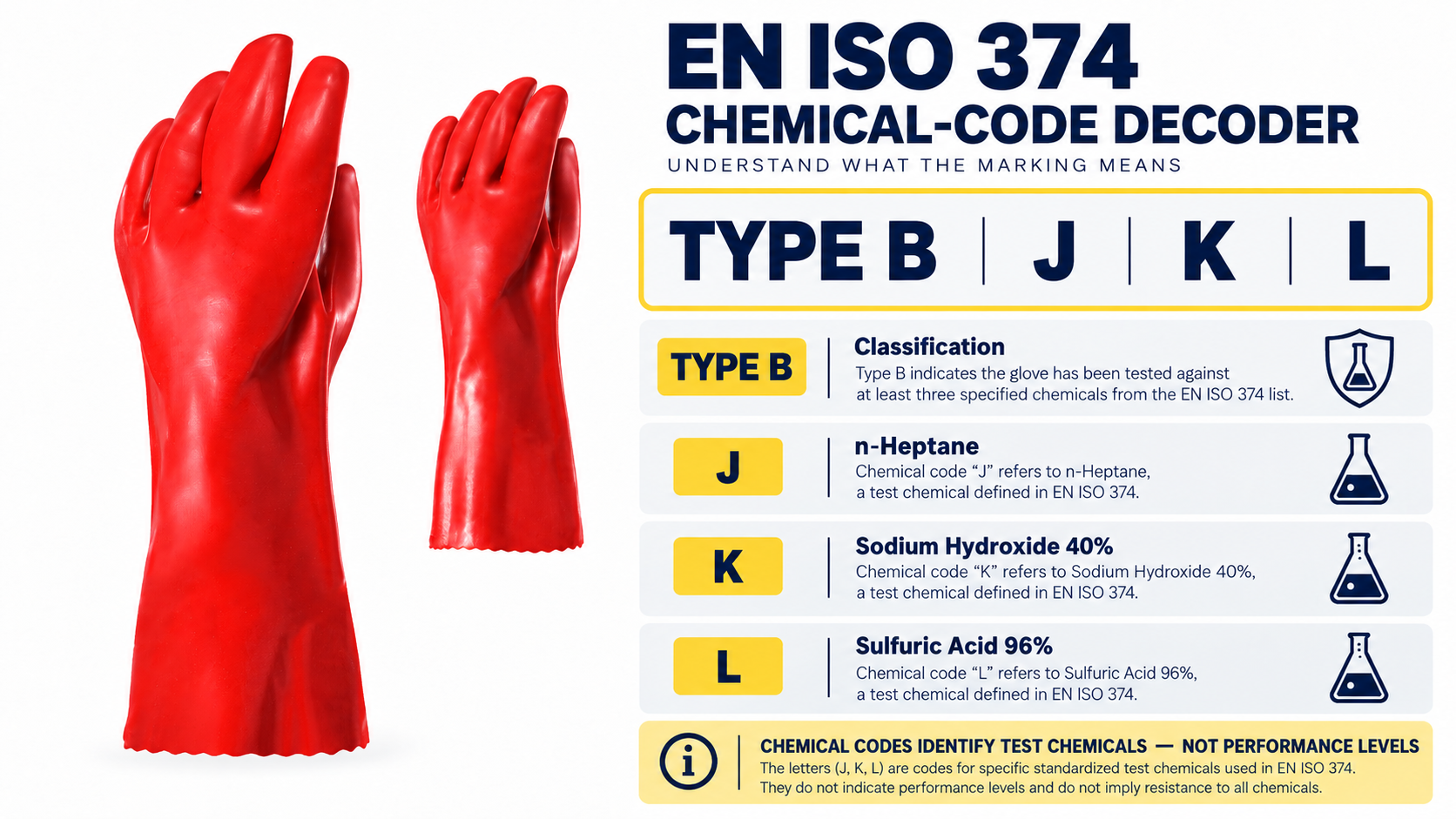
The letters printed with an EN ISO 374 chemical classification identify specific standardized test chemicals; they are not performance grades. In other words, J is not "Level J." The code tells the buyer which test substance is represented, so the letters must be interpreted together with the glove's classification and test documentation.
Code | Test Chemical |
J | n-Heptane |
K | Sodium Hydroxide 40% |
L | Sulfuric Acid 96% |
For Safeyear GSP0211R, the marking Type B JKL means that Type B is the chemical-protection classification, while J, K and L identify the standardized test chemicals for which the model has relevant evidence. It should not be described as a generic "chemical resistance level JKL."
Permeation, Penetration and Degradation: What’s the Difference?
Permeation, penetration and degradation describe different aspects of chemical protection and should not be treated as interchangeable.
Permeation
Permeation describes a chemical moving through the glove material at the molecular level. The key measurement is breakthrough time under standardized test conditions.
Penetration
Penetration describes a chemical passing through holes, seams, pinholes or other physical imperfections in the glove.
Degradation
Degradation describes changes in the glove material caused by chemical contact, such as swelling, softening, cracking or loss of strength.
What Does Breakthrough Time Mean?
Breakthrough time is measured under standardized laboratory test conditions. It is useful for comparing test performance, but it is not a guaranteed safe-use time in the workplace. Real exposure can vary with temperature, movement and flexing, concentration, contamination, glove condition and whether contact is a splash, intermittent or prolonged. Use breakthrough data as one part of a broader chemical-compatibility assessment.
EN ISO 374-1 vs EN ISO 374-5: What’s the Difference?
EN ISO 374-1 focuses on protection against dangerous chemicals, including classification and chemical-code information. EN ISO 374-5 addresses protection against microorganisms. These are distinct protection dimensions. Microorganism protection should not automatically be described as virus protection unless model-specific testing or marking supports that claim. For GSP0211R, the supplied evidence supports the wording EN ISO 374-5 Microorganism Protection.
How Should You Use EN ISO 374 to Choose Chemical Gloves?
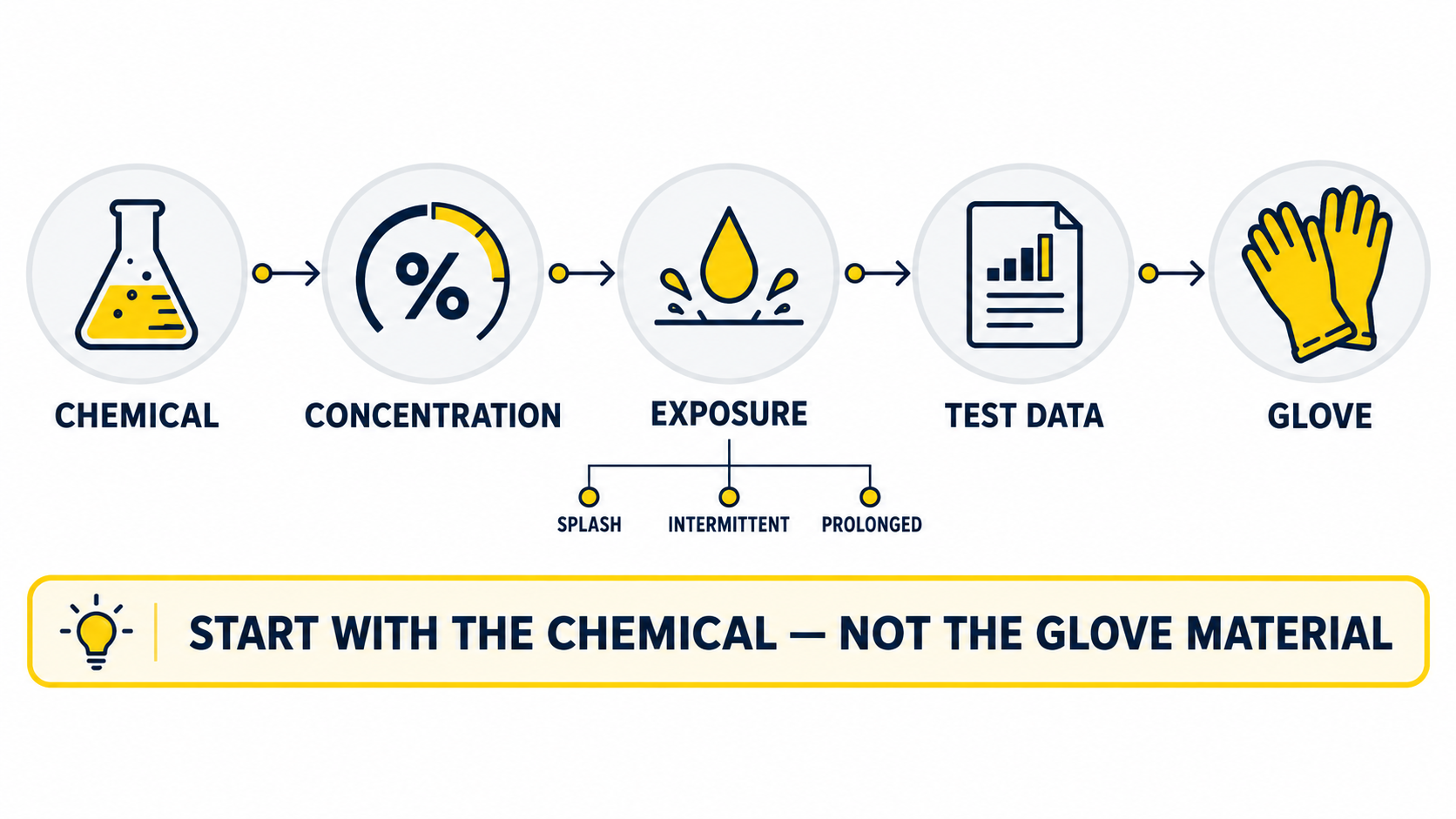
Chemical glove selection should start with the chemical, not the glove material. A nitrile, PVC or other material name can be useful background information, but it does not replace model-specific test evidence. A practical purchasing process is:
Step | What to Check |
1 | Identify the chemical |
2 | Check concentration |
3 | Determine splash or prolonged contact |
4 | Review EN ISO 374 chemical codes |
5 | Review permeation / degradation data |
6 | Consider grip and mechanical hazards |
7 | Select the appropriate glove model |
This sequence helps buyers avoid selecting a glove from a general "chemical resistant" claim without confirming relevant evidence for the actual substance and exposure pattern.
EN ISO 374 Rating Example: Safeyear GSP0211R
Safeyear GSP0211R provides a useful example of how several markings work together. Its chemical marking is EN ISO 374-1 Type B JKL. The classification and letter codes should be read separately, then combined with the model's other documented protection data.
Type B — Chemical Protection Classification
Type B identifies the EN ISO 374-1 chemical-protection classification for the model.
J — n-Heptane
J identifies n-Heptane as one of the standardized test chemicals represented in the glove marking.
K — Sodium Hydroxide 40%
K identifies Sodium Hydroxide 40% as one of the standardized test chemicals represented in the glove marking.
L — Sulfuric Acid 96%
L identifies Sulfuric Acid 96% as one of the standardized test chemicals represented in the glove marking.
EN ISO 374-5 — Microorganism Protection
The supplied evidence supports EN ISO 374-5 Microorganism Protection. Do not expand this to virus protection unless separate product-specific evidence supports that claim.
GSP0211R also carries EN ISO 374-5 Microorganism Protection and EN 388 4121X for mechanical performance. Chemical and mechanical protection are different standard dimensions, so buyers may still need to review grip and relevant mechanical hazards before final selection.
Does Type A Always Mean Better Chemical Protection Than Type B?
No. Type A covers more qualifying listed test chemicals than Type B, but broader classification does not mean universal compatibility. The glove still needs relevant evidence for the substance being handled, at the appropriate concentration and exposure conditions. A Type B glove that directly matches the workplace chemical may be more relevant than a Type A glove whose tested chemicals do not. Classification breadth is not universal chemical compatibility.
Chemical Glove Selection Checklist
[ ] What exact chemical is being handled?
[ ] What is its concentration?
[ ] Is exposure splash, intermittent or prolonged?
[ ] Which EN ISO 374 chemical codes apply?
[ ] What permeation and degradation data is available?
[ ] Is microorganism protection required?
[ ] Are grip or mechanical hazards also present?
EN ISO 374 FAQ
Q1.What is EN ISO 374 and what does it cover?
A.EN ISO 374 is a standards framework for protective gloves against dangerous chemicals and microorganisms. EN ISO 374-1 addresses chemical risks; EN ISO 374-5 addresses microorganism protection.
Q2.What is the difference between EN ISO 374 Type A, B and C?
A.Type A demonstrates qualifying permeation performance against at least six listed test chemicals, Type B against at least three, and Type C against at least one. The tested chemical codes still need to be checked.
Q3.What do letters such as J, K and L mean?
A.They identify specific standardized test chemicals; they are not performance levels. In the GSP0211R example, J is n-Heptane, K is Sodium Hydroxide 40%, and L is Sulfuric Acid 96%.
Q4.What is chemical breakthrough time?
A.It is a laboratory permeation measurement, not a guaranteed workplace safe-use time. Real exposure conditions can differ from standardized test conditions.
Q5.Does EN ISO 374 mean a glove protects against all chemicals?
A.No. Chemical protection must be evaluated against the specific substance, concentration, exposure conditions and model-specific test data.
Conclusion
EN ISO 374 markings are most useful when they are read as evidence, not as a generic promise of chemical resistance. Start with the chemical, identify its concentration and exposure pattern, then review the glove's Type A/B/C classification, chemical codes, permeation and degradation data, and any microorganism or mechanical-protection requirements. EN ISO 374 certification does not mean a glove protects against every chemical; the final selection should always be based on the exact hazard and the test evidence of the individual glove model.

 English


