Updated for ANSI/ISEA Z89.1-2026 and EN 397:2025
Introduction
Choosing a safety helmet starts with the hazard - not the helmet style. A vented shell may improve airflow, a non-vented shell may be appropriate for some electrical configurations, and a Type II helmet may provide additional off-center impact protection. But none of these features should be selected in isolation.
A practical head-protection decision should consider impact direction, electrical exposure, ventilation needs, helmet retention, accessory compatibility and the standard that applies to the market or project. The label and current product documentation matter more than colour, shell shape or marketing terminology.
QUICK ANSWER: Choose a safety helmet by matching impact protection, electrical class and retention requirements to the job hazards. Then check ventilation, fit and accessory compatibility. Type describes impact protection; Class describes electrical performance. Verify the exact model label and supporting documentation before ordering. |
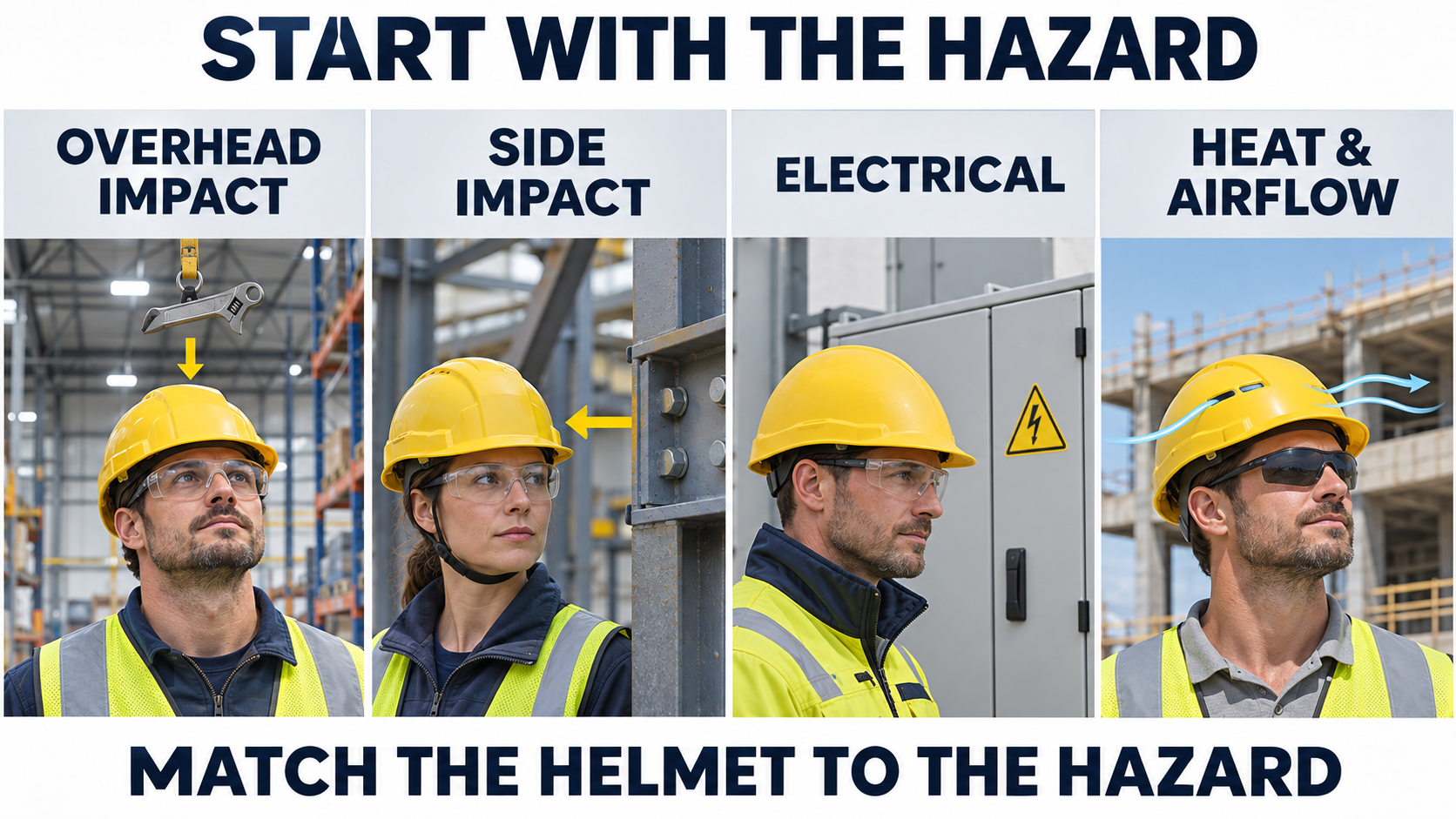
1. Start with the Hazard, Not the Helmet Style
No single helmet configuration is automatically best for every worksite. Begin with a hazard assessment and identify the protection function that matters most for the task.
Hazard | What to Consider |
Overhead impact | Falling tools, materials, suspended loads and overhead structures. |
Side / multi-directional impact | Structures, moving equipment, slips, falls and impacts from the front, rear or sides. |
Electrical exposure | Utility, electrical maintenance and other work where the required electrical classification must be verified. |
Heat & airflow | Hot outdoor construction and long-duration wear where ventilation may improve comfort. |
Retention | Wind, climbing, movement or work-at-height situations where helmet displacement may be a concern. |
KEY PRINCIPLE: The correct helmet is the one whose certified performance matches the actual hazard profile of the job. |
2. Quick Safety Helmet Selection Guide
Work Environment | Main Selection Issue | Starting Direction |
General construction | Overhead impact + heat | Vented Type I / Type I+ where applicable and permitted by the hazard assessment. |
Electrical / utilities | Electrical exposure | Non-vented configuration with the required certified electrical class. |
Infrastructure | Overhead + off-center impact | Consider Type II / Type II+ where multi-directional hazards are identified. |
Oil & gas / industrial | Mixed impact + PPE integration | Hazard-based Type selection plus compatible face/hearing protection as required. |
Mining / forestry | Impact + heat + accessories | Helmet system compatible with required hearing, face and eye protection. |
Work at height | Impact + retention | Evaluate off-center protection and retention/chin-strap requirements from the risk assessment. |
This table is a starting point only. Job title alone should never determine helmet Type or electrical Class.
3. Type I vs Type II: Choose the Required Impact Protection
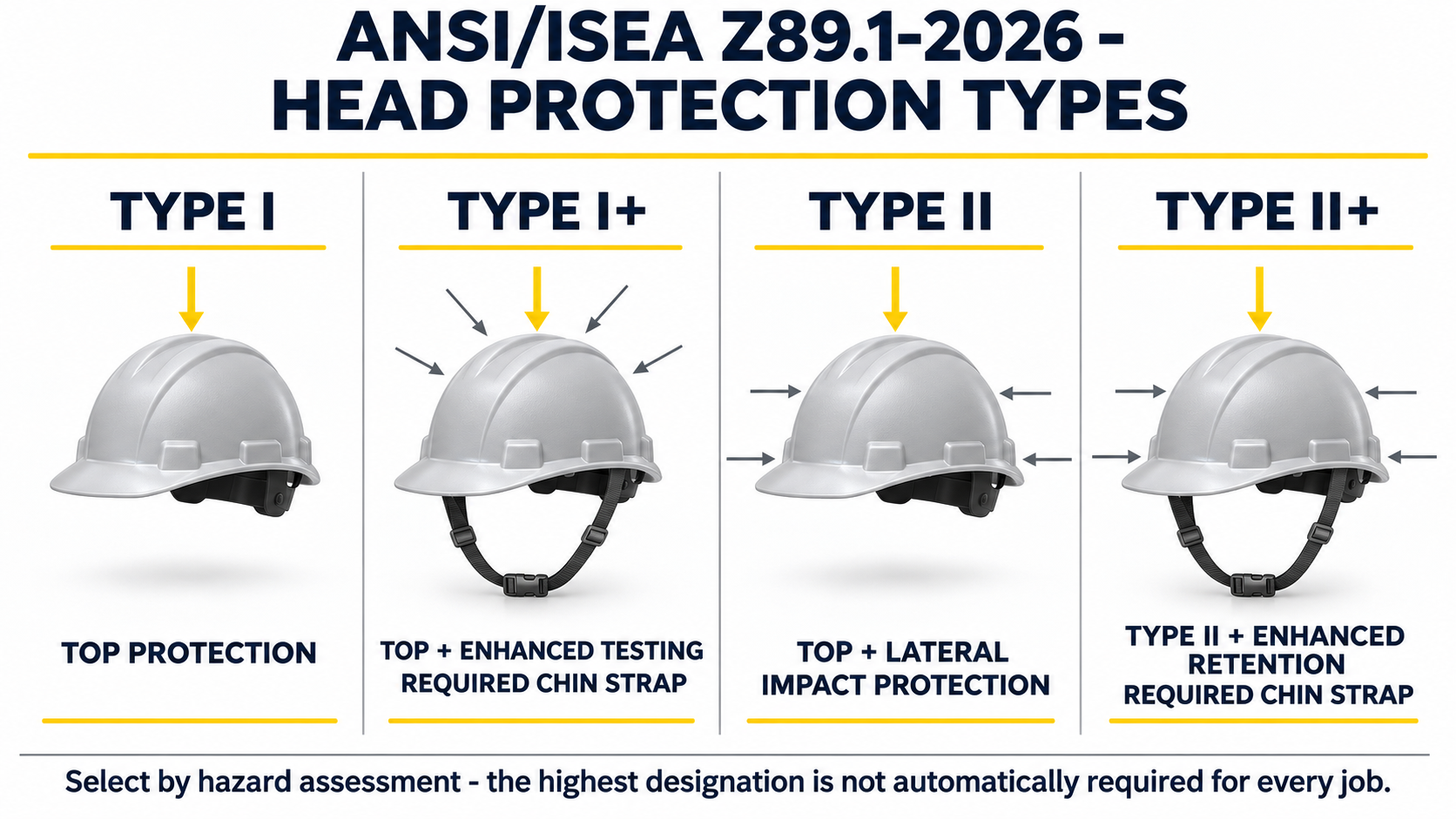
ANSI/ISEA Z89.1-2026 keeps the familiar Type I and Type II classifications and adds optional Type I+ and Type II+ designations. The "+" identifies head protection tested beyond the base Type requirements for enhanced retention and chin-strap performance; Type I+ also adds off-center force-transmission testing at the front, rear and sides.
ANSI Designation | Protection / Additional Testing |
Type I | Top-of-head impact force transmission and apex penetration resistance. |
Type I+ | Type I protection plus required chin strap, enhanced retention and off-center front/rear/side force-transmission testing. |
Type II | Type I base requirements plus lateral impact-energy attenuation and off-center penetration resistance. |
Type II+ | Type II protection plus required chin strap and enhanced helmet-retention performance. |
DO NOT ASSUME: Type II+ is not automatically the correct choice for every worker. The appropriate designation depends on the hazard assessment. |
A Note on Standard Updates
The publication of a new standard edition does not automatically make existing compliant helmets obsolete. Confirm the edition and performance requirements specified by the applicable regulations, employer and project.
4. Class C, G and E: Check Electrical Protection
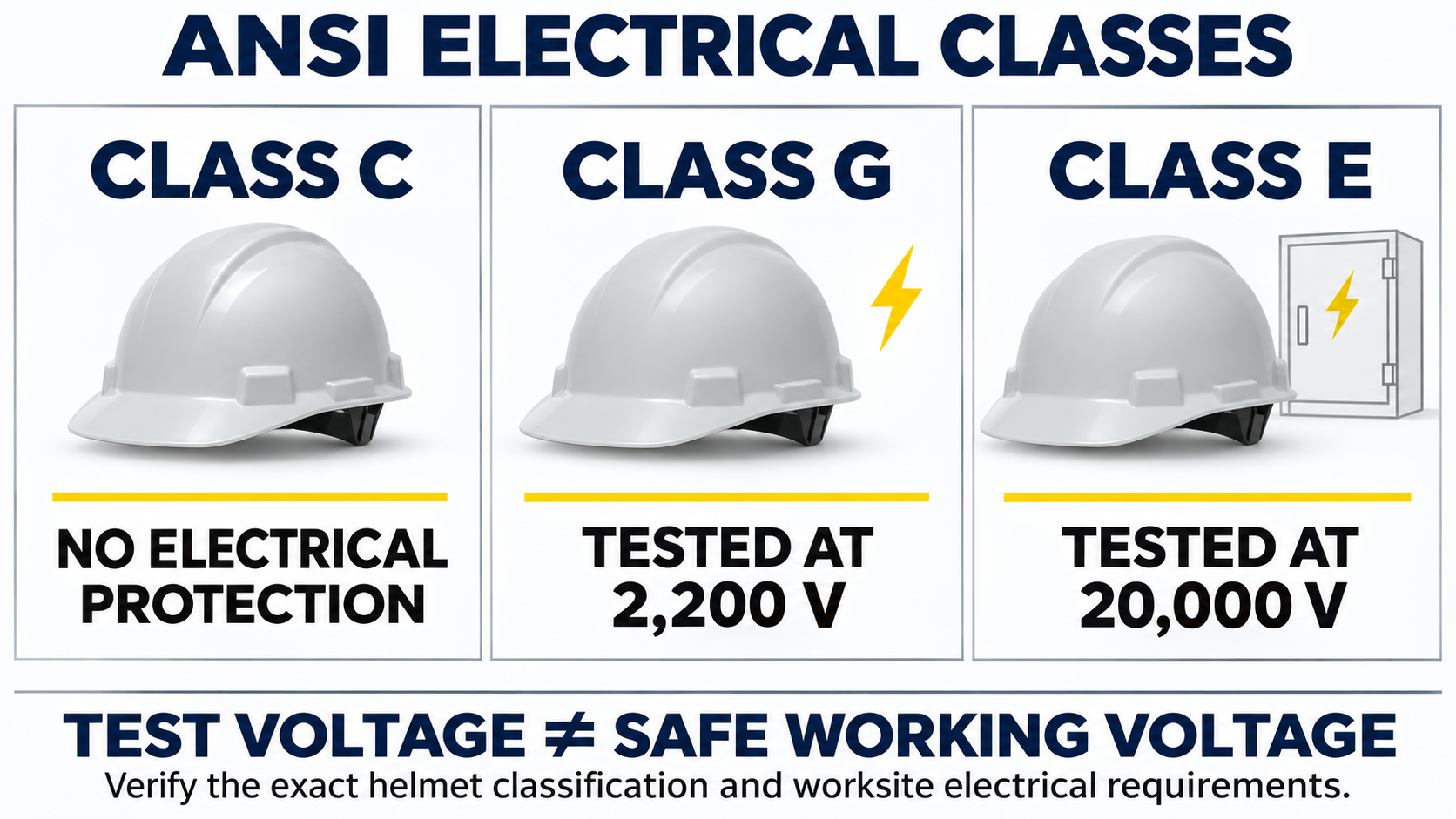
ANSI/ISEA Z89.1 also classifies industrial head protection by electrical performance. This classification is separate from Type I, Type I+, Type II or Type II+.
Electrical Class | Meaning | Test Basis |
Class C | No electrical protection | No dielectric protection classification. |
Class G | General electrical protection | Tested at 2,200 V. |
Class E | Electrical protection | Tested to withstand 20,000 V. |
CRITICAL NOTE: Test voltage is not the same as a safe working voltage. Electrical PPE selection must follow the worksite electrical hazard assessment, applicable rules and the exact helmet certification. |
5. Vented vs Non-Vented Safety Helmets
Vented helmets
Vent openings can improve airflow and may reduce heat buildup during extended wear. This can make vented helmets a practical choice for general construction, infrastructure and industrial work in hot environments where electrical insulation is not a project requirement.
· Useful where airflow and wearing comfort are priorities.
· Common in outdoor construction and hot-weather working conditions.
Non-vented helmets
A non-vented helmet uses a solid shell without open ventilation ports. This can be appropriate for dusty environments and for helmet configurations designed to meet particular electrical requirements.
IMPORTANT:
Vented hard hats and safety helmets must not be used for electrical work under OSHA guidance. Select non-vented head protection with the required electrical classification. A non-vented shell alone does not establish Class G or Class E performance. |
A common purchasing mistake is to treat shell ventilation and electrical protection as the same decision. They are related in some helmet designs, but they are not interchangeable classifications.
· Do not assume every non-vented helmet is Class E.
· Do not select electrical PPE from appearance alone.
· Confirm the electrical class printed on the helmet label and supported by the model documentation.
· Where a project specifies Class E, verify the exact certified configuration before purchase.
6. Chin Straps, Fit and Accessory Compatibility
Retention matters when there is a realistic possibility that a helmet could shift or come off during movement, wind, climbing, slips or falls. ANSI/ISEA Z89.1-2026 makes a chin strap and enhanced retention performance mandatory for Type I+ and Type II+.
· Consider helmet displacement risk during the task.
· Confirm whether the selected standard/designation requires a chin strap.
· Use and adjust the chin strap according to the manufacturer instructions.
· A chin strap retains the helmet; it does not prevent a worker from falling.
Many industrial users combine head protection with earmuffs, face shields, safety eyewear, lamps or winter liners. Accessory compatibility should therefore be considered before bulk purchasing, not after the helmets arrive on site.
EN 397:2025 places greater emphasis on helmet and accessory compatibility. For any market, use accessories that are approved or specified for the helmet system and confirm that they do not interfere with fit, retention or certified performance.
7. ANSI/ISEA Z89.1 vs EN 397: What Buyers Should Check
The latest European and American systems now both contain multi-directional protection concepts, but the classifications are not interchangeable.
Standard | Classification | General Direction |
ANSI/ISEA Z89.1-2026 | Type I / I+ / II / II+ | American industrial head-protection Type and electrical-Class framework. |
EN 397:2025 | Type 1 / Type 2 | European industrial helmet framework; Type 2 adds on-crown and off-crown impact requirements. |
EN 397:2025 introduces Type 1 for general on-crown impact protection and Type 2 for additional on-crown and off-crown protection, including front, rear and side directions. Although ANSI Type II and EN 397:2025 Type 2 both address multi-directional impact, the test methods, performance requirements and markings are different.
REMEMBER: ANSI Type II is not the same classification as EN 397:2025 Type 2. Verify the standard and exact model certificate required for the target market. |
Electrical markings should not be converted directly between the American and European systems. Under ANSI/ISEA Z89.1, Class E is the electrical classification tested at 20,000 V. In Europe, the former 440 V option associated with the older EN 397 framework has been removed from EN 397:2025; electrical insulation for applicable low- and medium-voltage helmet use is addressed through EN 50365:2023.
NOT EQUIVALENT: ANSI Class E and European EN 50365 electrical certification are different systems. Do not present one as a direct substitute for the other. |
8. Compare Safeyear Safety Helmet Options
Model | Configuration | Best Selection Direction |
W-018 | Vented ABS shell, 6-point suspension, ratchet adjustment | General construction and industrial work where airflow is a priority. Confirm the current project standard and electrical requirements before use. |
W-003 | Non-vented ABS shell, 6-point suspension; ANSI Type I / Class E | Projects requiring a Type I / Class E configuration, subject to the worksite electrical hazard assessment and current certificate. |
W-6000 | ANSI Type II; EN 397:2025 Type 2; EN 12492:2012 listed on current product documentation | Demanding worksites where multi-directional impact protection is part of the hazard assessment. |
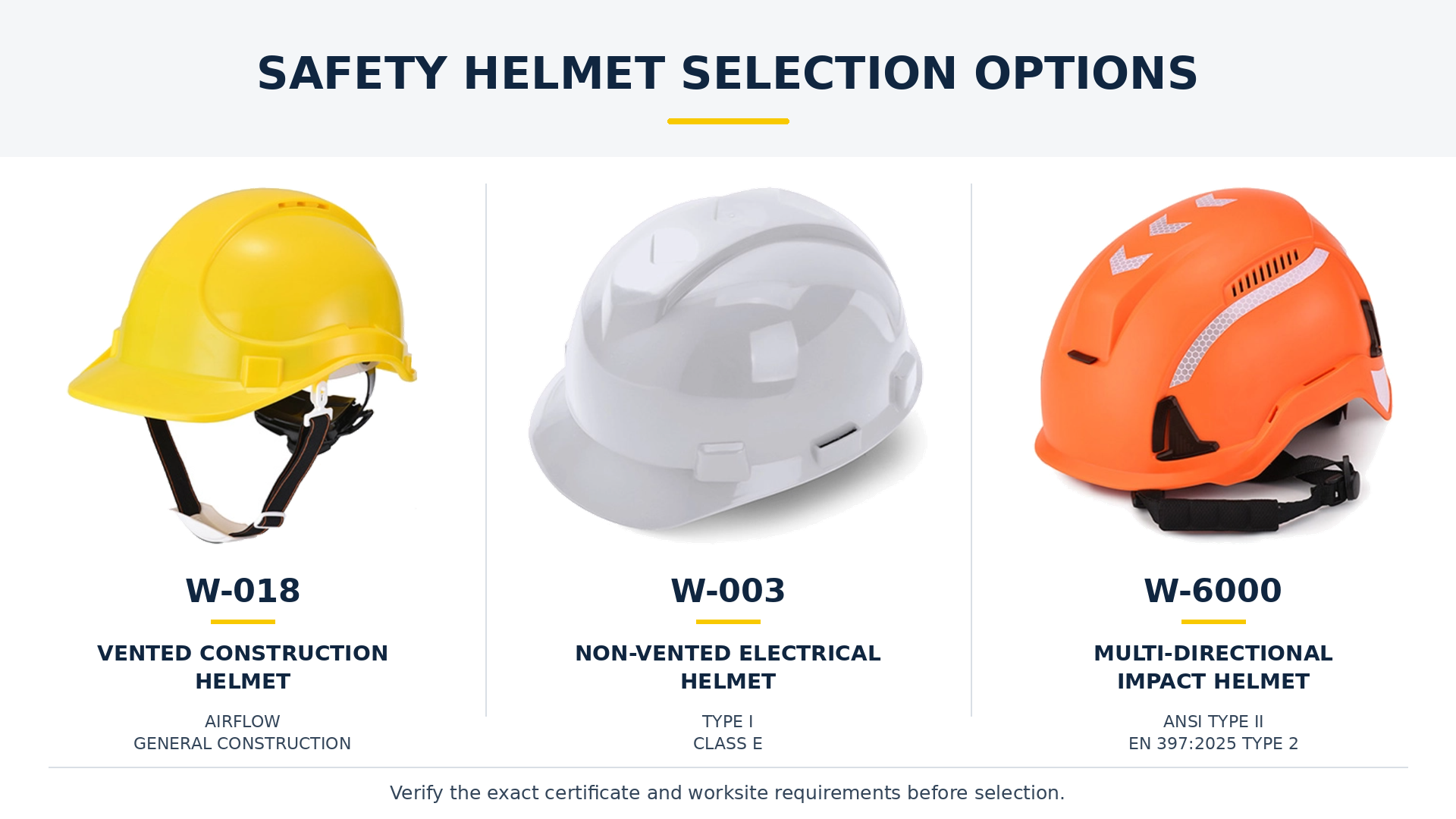
The exact certificate edition and product documentation should always be checked during quotation, tendering and bulk procurement. Do not infer a protection level from shell appearance alone.
9. Safety Helmet Buyer Checklist
1. Identify the direction and severity of likely impact hazards.
2. Confirm whether electrical exposure requires a specific Class or electrical helmet standard.
3. Decide whether ventilation is suitable for the work environment.
4. Check retention and chin-strap requirements.
5. Confirm the standard required by the target market, project or employer.
6. Check compatibility with earmuffs, face shields, eyewear and other accessories.
7. Verify the exact certificate, label and current technical datasheet before ordering.
BUYER RULE: Do not select a helmet from colour, shell shape or marketing name alone. Read the label and verify the documentation. |
10. Frequently Asked Questions
What is the difference between Type I and Type II helmets?
Type I primarily addresses top-of-head impact and penetration. Type II adds additional front, rear and side impact/penetration performance under ANSI/ISEA Z89.1.
What are Type I+ and Type II+?
They are new optional performance designations in ANSI/ISEA Z89.1-2026. Both require a chin strap and enhanced retention testing; Type I+ also adds expanded off-center impact testing.
Is a non-vented helmet automatically Class E?
No. Class E is a certified electrical classification. A solid shell alone does not prove Class E performance.
Can a vented safety helmet be used for electrical work?
No. OSHA guidance states that vented hard hats and safety helmets cannot be used for electrical work. Select non-vented head protection with the electrical classification required by the worksite hazard assessment. A non-vented shell alone does not establish Class G or Class E performance.
What does Class E mean?
Under ANSI/ISEA Z89.1, Class E head protection is tested to withstand 20,000 V. That test value is not a safe working voltage.
Is EN 397:2025 Type 2 the same as ANSI Type II?
No. Both address multi-directional impact, but they are separate standards with different testing, marking and performance requirements.
Do all workers need Type II or Type II+ helmets?
No. The correct protection should be selected from the actual hazard assessment. Higher or newer designations are not automatically required for every job.
Conclusion: Select the Helmet from the Hazard Profile
Safety helmet selection should start with the hazard profile: impact direction, electrical exposure, ventilation needs, retention requirements, accessory compatibility and the applicable market standard. Type, electrical Class and shell design are separate decisions and should always be verified against the exact model documentation.
For PPE buyers, the most reliable sequence is simple: Hazard Assessment -> Required Standard -> Type / Electrical Class -> Ventilation & Retention -> Accessory Compatibility -> Exact Product Certificate. This approach is more reliable than selecting a helmet from appearance, job title or a single marketing feature.
Need Help Selecting a Safety Helmet?
Share your target market, worksite hazards, required standard, electrical class and order quantity. Our team can recommend suitable Safeyear models and provide model-specific technical documents.

 English


