Choose waterproof work boots by matching water exposure, workplace protection and fit. A boot for repeated rain and walking may need a different construction from one used in standing water or washdown. Men and women should also check the fit of the actual model rather than rely on a universal size conversion.
This guide explains waterproof and water-resistant construction, European water-resistance markings, wet-surface traction and practical fitting checks. It also helps industrial buyers compare Safetoe options before requesting samples.
Quick answer: Start with moisture depth and exposure duration. Check whether the boot provides upper water resistance or verified whole-footwear water resistance, then compare toe protection, puncture resistance, traction, insulation and fit.
1 Waterproof and water resistant work boots
Water-resistant uppers help manage limited moisture, such as light splashes. Waterproof footwear uses a construction designed to resist external water penetration under specified conditions. Neither term, on its own, tells you the permitted water depth, exposure time or protective features of a particular boot.
Exposure | Water-resistant footwear | Waterproof footwear |
Light splashes | May be sufficient for occasional exposure. | May suit the task, subject to the model specification. |
Repeated rain and wet ground | Performance depends on materials and construction. | Usually the more suitable starting point. |
Mud and prolonged wet work | Upper resistance alone may be insufficient. | Check whole-footwear performance and traction. |
Standing water and washdown | Do not rely on upper resistance alone. | Consider a suitable Wellington design and shaft height. |
A waterproof membrane is one possible solution; moulded rubber or polymer footwear can use a different barrier construction. Choose according to the finished boot and its intended use, rather than assuming that every waterproof boot needs a membrane.
2 How waterproof boot construction works
Upper material
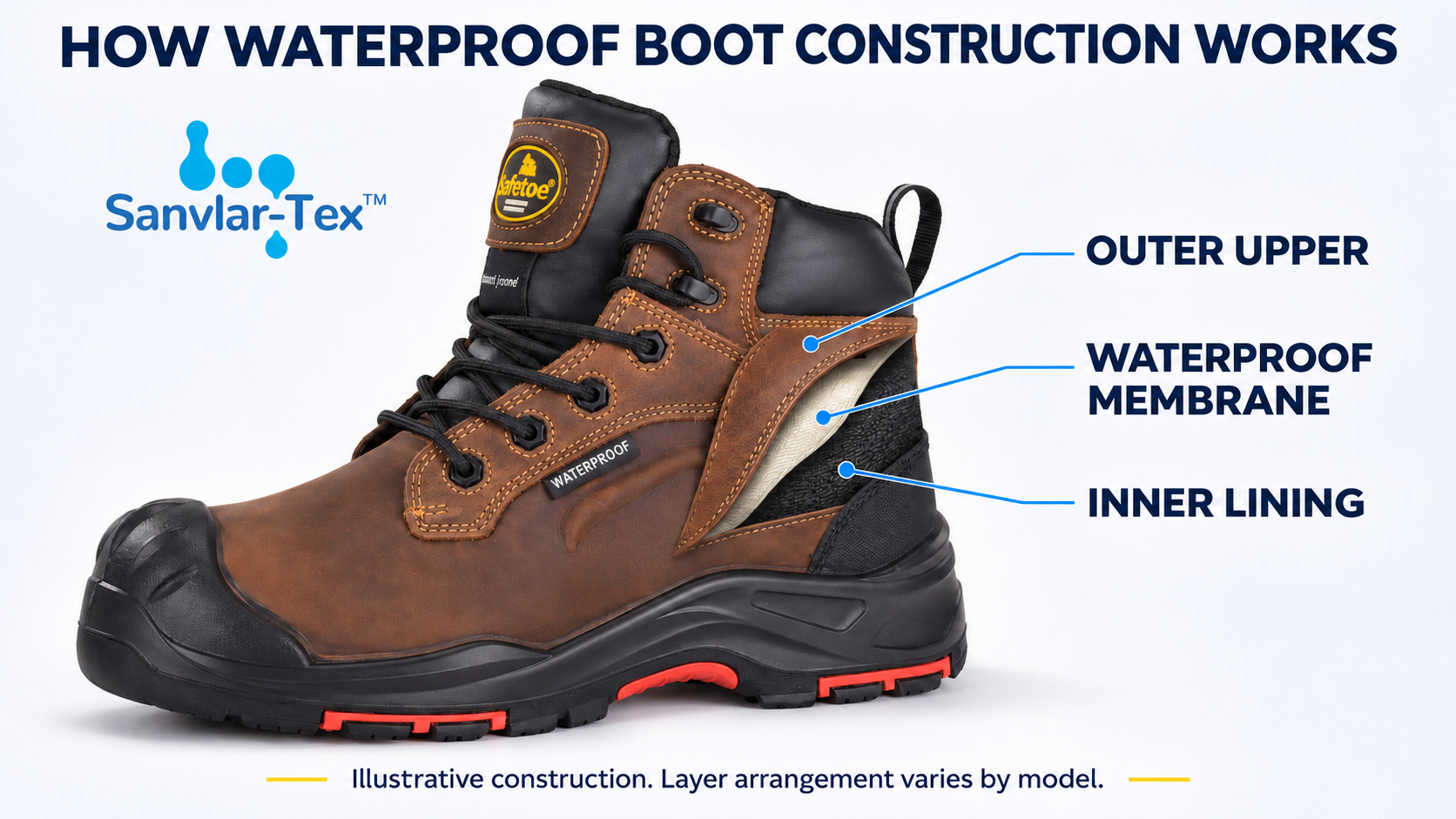
Leather and other uppers provide the outer surface exposed to rain, mud and abrasion. Surface treatments may help water bead and run off. A water-resistant upper does not, by itself, establish that the seams, tongue and complete footwear resist water penetration.
Membrane and lining
A waterproof membrane provides an internal barrier against external liquid water. Where designed for water-vapour transfer, it can also support moisture management. Comfort still depends on temperature, activity, socks, lining and the complete boot construction.
Selected Safetoe models use Sanvlar-Tex™ Waterproof Technology. Check the construction specified for the model you plan to order.
Tongue and complete boot construction
Seams, tongue construction, the upper-to-sole connection and the height of the waterproof barrier all matter. Water can enter through the opening if it rises above the protected area. A higher shaft may help with exposure, but it does not establish an unlimited immersion depth.
3 Understanding WPA WR S3S and S7S
Under EN ISO 20345:2022 and its applicable amendment, upper water requirements and whole-footwear water resistance are distinct. These markings help buyers identify what has been evaluated.
Marking | What it tells the buyer |
WPA | Water penetration and absorption requirements for the upper material. |
WR | Water resistance of the whole footwear under the specified test conditions. |
S2 | S1 requirements plus upper water penetration and absorption requirements. |
S3 / S3L / S3S | S2 requirements plus a cleated outsole and the applicable penetration resistance. |
S6 | S2 requirements plus whole-footwear water resistance. |
S7 / S7L / S7S | The corresponding S3 / S3L / S3S requirements plus whole-footwear water resistance. |
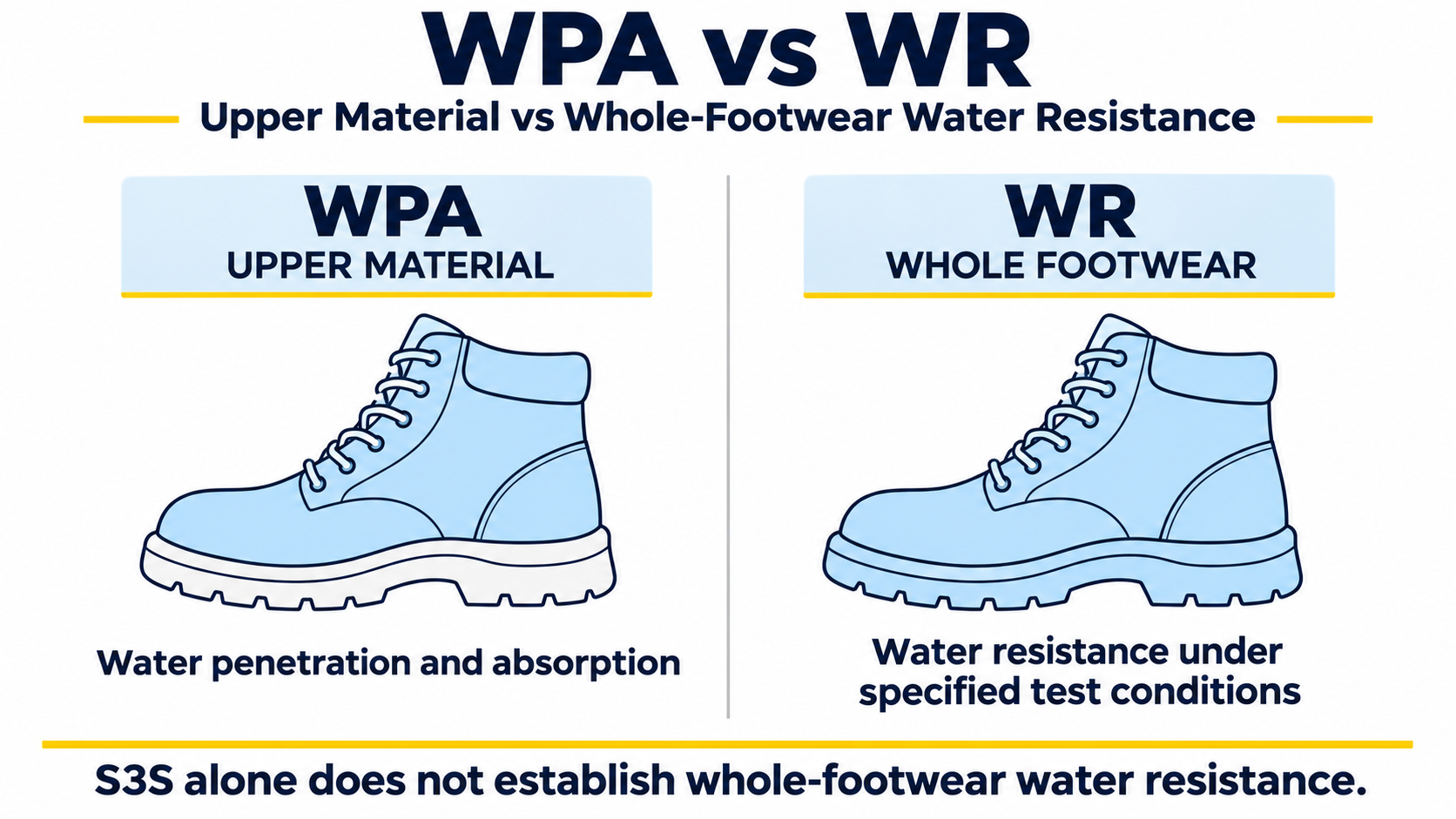
S3S alone does not establish whole-footwear water resistance. Look for WR or the relevant S6 or S7 category in the actual model marking. The L and S suffixes distinguish non-metallic penetration-resistance requirements; they are not additional waterproof ratings.
For a fuller explanation, read EN ISO 20345 Safety Ratings Explained.
European water-resistance markings should not be inferred from an ASTM or CSA reference alone. For each market, check the exact protection claims and supporting model documents.
4 Match the boot to the work environment
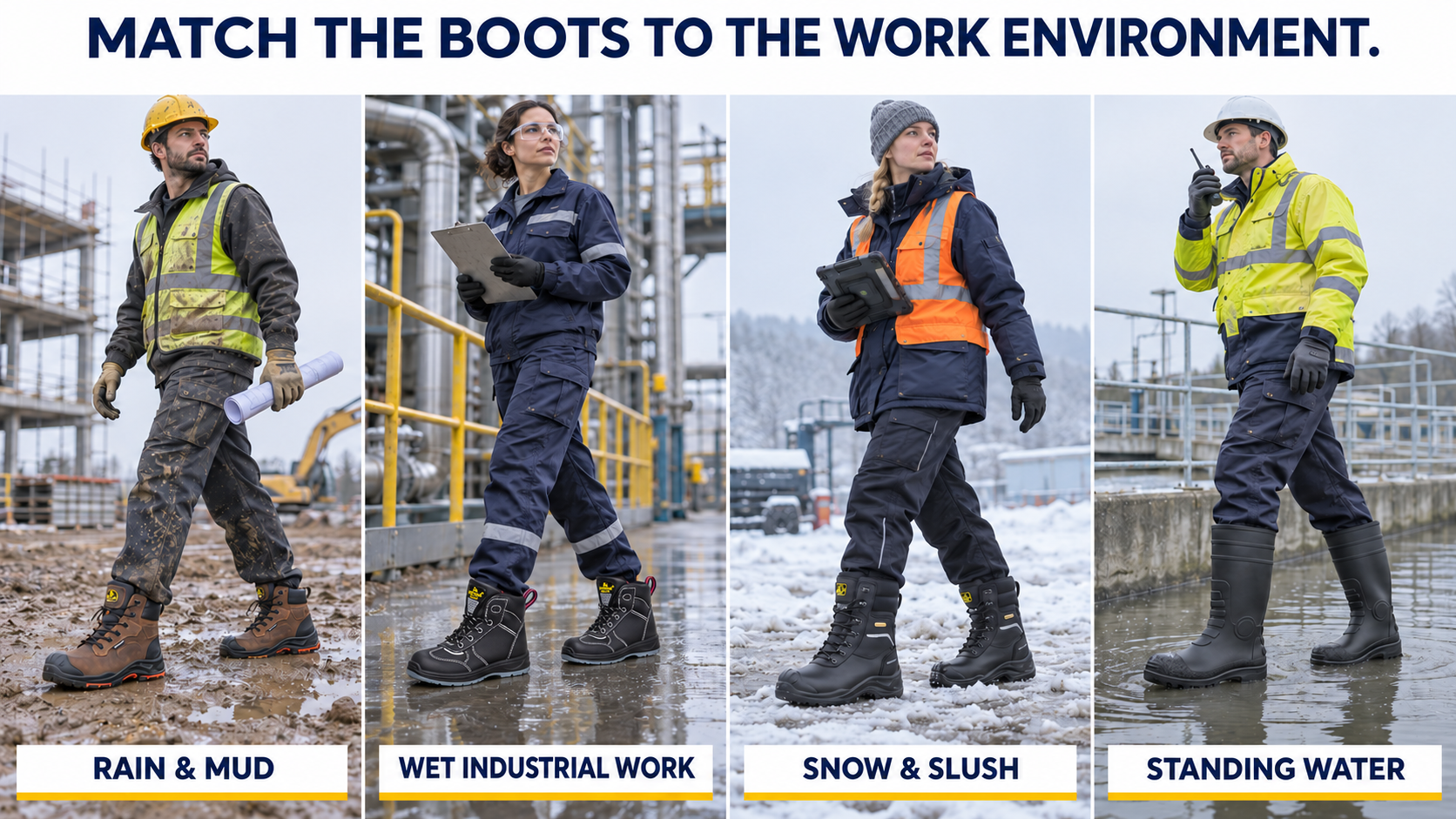
Work environment | Selection priorities |
Construction and maintenance | Rain and mud protection, toe and puncture protection, and traction for the actual ground. |
Oil and gas sites | Water protection, outsole resistance to fuel oil where required, and slip performance for the surface contamination. |
Winter outdoor work | Waterproofing, suitable insulation, fit with work socks and traction for snow or ice exposure. |
Mixed indoor and outdoor work | Appropriate moisture protection, manageable weight and comfort during repeated walking. |
Standing water and washdown | Suitable Wellington construction, shaft height, slip performance and compatibility with cleaning agents. |
Leather or membrane boots can suit mobile work across mixed terrain. Wellington boots may be more appropriate where water exposure is deeper or sustained. Neither design automatically provides chemical protection: cleaning chemicals and other contaminants need a separate suitability check.
Compare Safety Wellington Boots for sustained wet work, or read the Winter Safety Boot Buying Guide for cold conditions.
5 Check protection beyond waterproofing
Water protection is only one part of safety-footwear selection. Match the following features to the hazards of the job.
· Toe protection — confirm the required impact and compression performance. Steel, composite and aluminium toe caps should be evaluated by the applicable rating and fit.
· Puncture resistance — verify the specified metallic or non-metallic protective component and its rating. A Puncture-Resistant Textile Midsole should be identified in the model documentation.
· Traction — evaluate wet, oily, muddy and icy surfaces separately. Tread design, contamination and outsole wear affect performance; no outsole prevents every slip.
· Temperature protection — waterproofing does not establish insulation, cold suitability or resistance to hot surfaces. Check these properties separately.
For European markings, SR concerns additional slip-resistance testing, while FO concerns outsole resistance to fuel oil. FO does not establish grip on oily floors or resistance to every chemical. CI and HI concern insulation against cold and heat; HRO concerns outsole resistance to contact heat.
6 Fit and sizing for men and women
Heel hold, forefoot room, instep volume and the shape of the protective toe area all affect fit. A women’s model may offer a different fit from a men’s model, but the actual last and size chart should guide selection. A smaller numerical size alone does not guarantee a suitable fit.
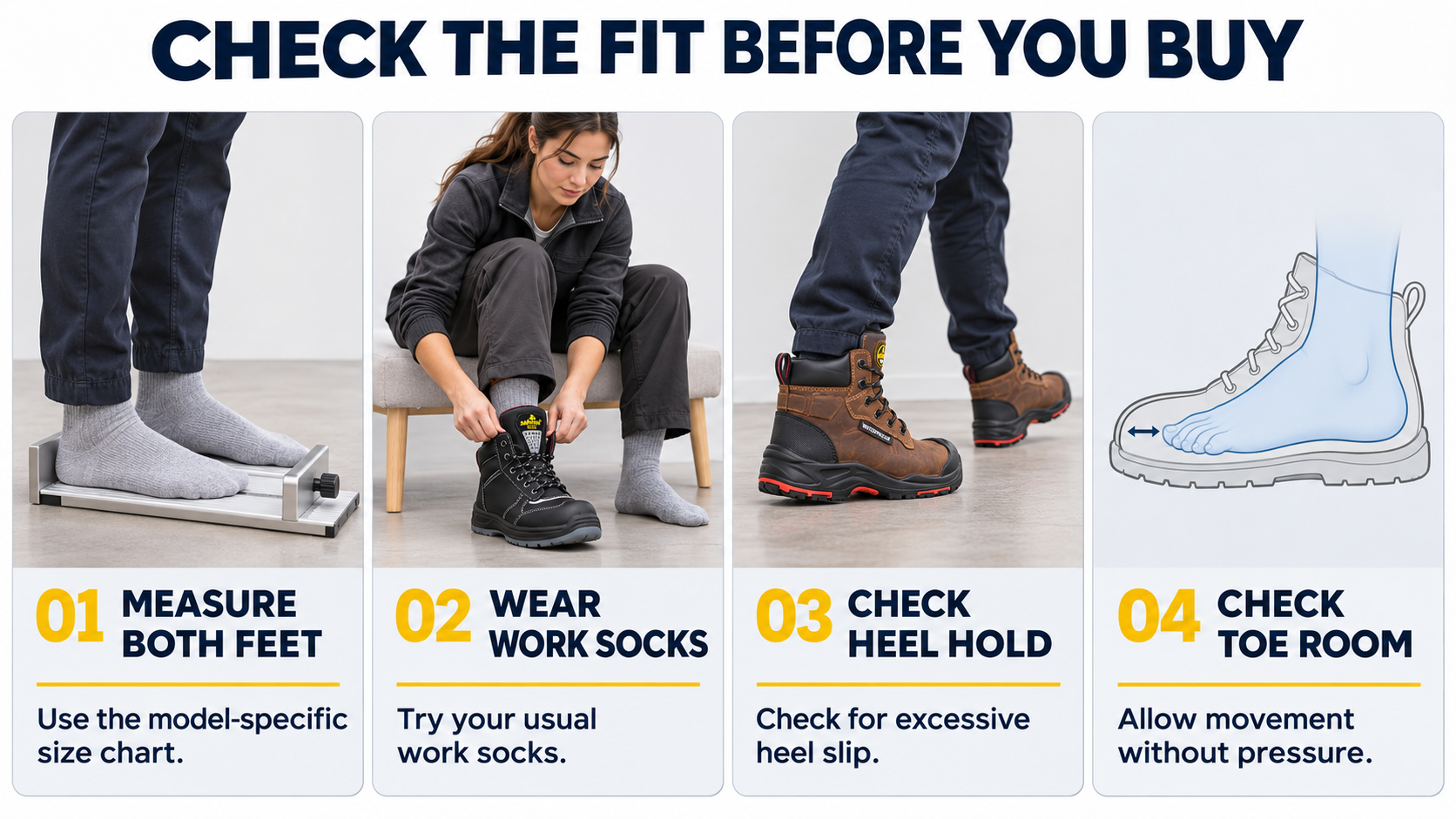
Measure both feet
Measure while standing and compare the larger foot with the model-specific size chart. Follow the manufacturer’s instructions for any fitting allowance. Avoid automatically buying a larger size to solve pressure from an unsuitable width or shape.
Try the normal work socks
Use the socks normally worn on the job, including winter socks where relevant. Check fit with the intended footbed; replacement insoles must be suitable for the footwear and must not compromise the protective fit.
Check the heel and forefoot
Fasten the boot correctly and walk, turn and bend. The heel should feel secure without excessive slipping. Toes need appropriate movement space without pressure from the toe cap, while the foot should not slide excessively inside the boot.
Approve representative sizes
For workforce purchases, trial representative sizes and fit needs before approving the size mix. Include women in fitting trials and use feedback from the actual wearers.
Explore Women’s Safety Footwear to compare available styles and model-specific sizing.
7 Why waterproof boots can feel wet inside
Damp socks do not always indicate membrane leakage. Water may enter from above the boot opening, and perspiration can build up during warm or active shifts. A wet outer surface also does not, by itself, show that water has reached the foot.
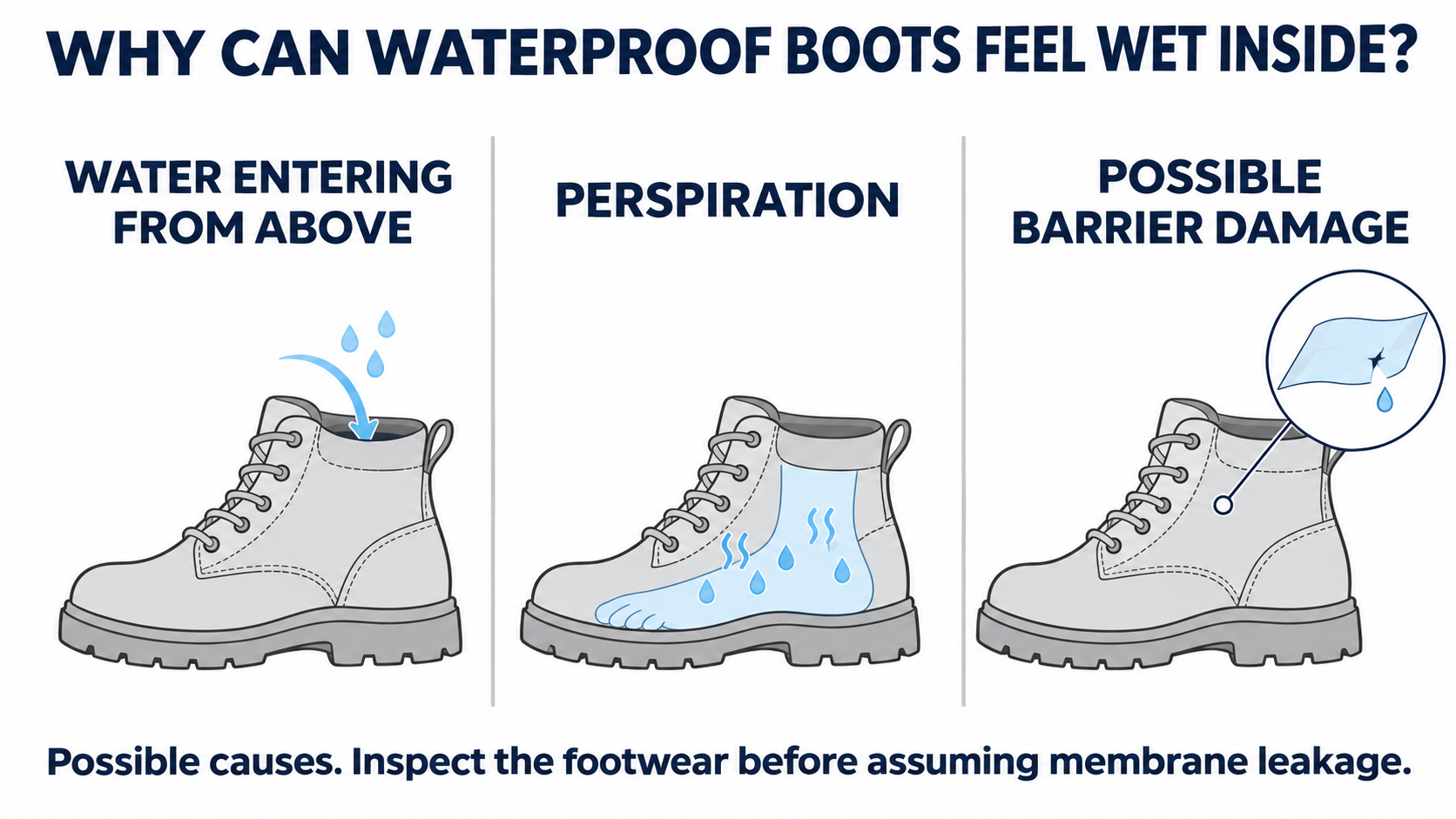
Consider where the moisture appears, the water depth, work duration and activity level. Inspect the tongue, seams, lining and sole connection for damage. If leakage is suspected, follow the manufacturer’s inspection or warranty process rather than relying on an improvised home immersion test.
Clean away mud and contamination using methods suitable for the boot. Dry according to the manufacturer’s instructions, avoid direct heat unless specifically permitted, and use compatible care products. Surface water-repellent treatment does not repair a damaged waterproof membrane.
8 Compare Safetoe waterproof work boot options
The following models offer starting points for different work needs. Product descriptions identify options to investigate; the required market rating, size range and configuration must be agreed for the actual order.
Model | Recommended Application | Key Features |
M-8552 | Wet industrial and oil and gas work | Sanvlar-Tex™ membrane, composite toe and puncture-resistant midsole. |
M-8565 | Black leather industrial boot | Waterproof membrane construction, protective components and fit. |
H-9552 ThermoGrip | Cold and wet outdoor work | Waterproof construction, insulation specification and winter outsole suitability. |
M-8516W GraceShield | Women’s waterproof work boot | Available sizes, protective specification and fit with work socks. |
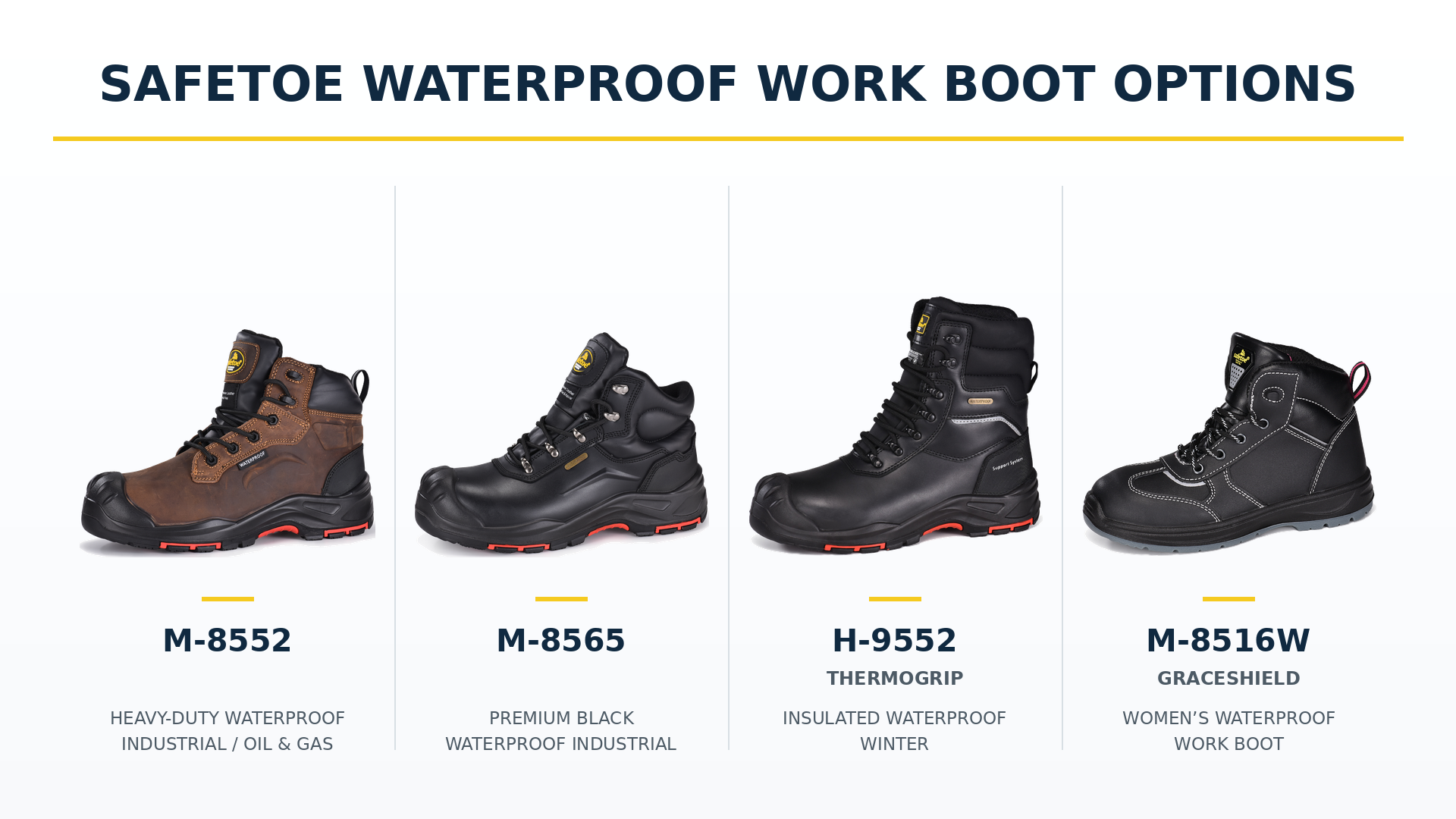
For example, the M-8552 product page lists an S7S configuration. Confirm the relevant certificate, Declaration of Conformity and technical datasheet for the version supplied. Do not transfer ratings between similar-looking models, regional versions or different insulation options.
9 A seven point buyer checklist
1 Moisture exposure. Identify rain, splashes, mud, snow, slush, washdown or standing water, including depth and duration.
2 Waterproof construction. Distinguish upper water resistance from verified whole-footwear water resistance.
3 Toe protection. Confirm the required impact and compression protection for the job.
4 Puncture protection. Check the exact rating where sharp-object hazards are present.
5 Traction. Assess the actual wet, oily, muddy or icy walking surfaces.
6 Comfort and fit. Trial the boot with normal work socks and consider weight, cushioning and shift demands.
7 Certification. Match model identification, target-market requirements and supporting technical documents.
10 Before placing a bulk order
Send a purchasing brief that describes the country of sale, worksite, moisture exposure, contaminants, temperature and required protection. Include the preferred style, quantity, size breakdown, branding and delivery requirements.
Request representative samples and agree on fit, appearance and performance acceptance criteria. For EU supply, review the applicable Declaration of Conformity and model certification; for other markets, request the relevant conformity and test documentation. Make sure the product label and technical datasheet identify the same configuration.
Where a style changes, confirm whether the materials, waterproof construction, protective components or supporting documents are affected before approving repeat production.
Frequently asked questions
Are waterproof work boots completely waterproof?
Waterproof footwear is designed to resist water penetration under stated conditions. Water can enter above the protected height, and damage or wear can affect performance. Check the model’s intended exposure and care instructions.
Is S3S the same as S7S?
No. S3S includes upper water penetration and absorption requirements. S7S adds whole-footwear water resistance to the corresponding protection combination. Check the exact standard edition and marking.
Does waterproofing require a membrane?
No. Many leather work boots use a membrane, while moulded rubber or polymer footwear can use a different waterproof construction. Evaluate the finished footwear and supporting performance information.
Are waterproof boots suitable for winter?
Only when the insulation, fit and traction also suit the conditions. Waterproofing addresses external moisture; it does not establish a safe temperature limit or reliable grip on ice.
Why are my socks damp inside waterproof boots?
Possible causes include perspiration, water entering through the opening or a damaged waterproof barrier. Review exposure and inspect the footwear before deciding that the membrane has failed.
Can women choose a smaller men’s size?
Some wearers may find a suitable fit, but size conversion alone is insufficient. Compare the actual model’s length, width, heel hold and volume, and try women’s options where available.
Are waterproof work boots chemical resistant?
Not automatically. Water resistance, outsole fuel-oil resistance and chemical protection are separate properties. Select footwear using the specific substance, concentration, exposure and relevant protective requirements.
Find waterproof safety boots for your team
Start with the wet-work conditions, then confirm the required protection and fit. For help comparing Safetoe models, share your target market, work environment, size range and estimated quantity. Our team can discuss suitable options, technical documents and samples.
EXPLORE OIL & GAS SAFETY BOOTS
Request product documents and samples

 English


