Learn how to read EN ISO 20345 safety footwear ratings and markings, including S1PS, S3S, S7S, P/PL/PS, SR, HRO, CI, HI, FO, LG and other protection codes.
What does “EN ISO 20345:2022+A1:2024 S3S SR FO CI HI HRO” actually tell a buyer? The standard reference identifies the requirements used; S3S identifies a protection category; and the remaining codes identify additional tested properties. This example is illustrative, not a certification claim for a particular Safetoe model.
The key principle is simple: choose the markings that match workplace risks, rather than choosing footwear simply because it displays more codes.
1. How to Read a Safety Footwear Marking
Read the label in three parts: the applicable EN ISO 20345 edition, the basic protection category (such as S3S); and any additional properties (such as SR, FO, CI, HI or HRO). Check the exact model and its certificate before treating an illustrative code string as a product claim.
2. What Do S1, S2, S3, S6 and S7 Mean?
Class |
General direction |
S1 |
Closed heel, antistatic properties and heel energy absorption, in addition to basic requirements |
S2 |
S1 plus water penetration and absorption requirements for the upper |
S3 / S3L / S3S |
S2 plus a cleated outsole and P / PL / PS penetration protection, respectively |
S6 |
S2 plus whole-footwear water resistance |
S7 / S7L / S7S |
S3 / S3L / S3S plus whole-footwear water resistance, respectively |
Suffixes matter: S3, S3L and S3S should not be treated as identical. For broader class selection, read Safetoe's S1P vs S3 vs S7 comparison.
3. P vs PL vs PS: Understanding Penetration Resistance
P identifies a metallic penetration-resistant insert. PL identifies a non-metallic insert tested with a 4.5 mm test nail; PS identifies a non-metallic insert tested with a 3.0 mm test nail. These designations describe different testing arrangements, not interchangeable marketing labels. They also explain the distinction between S1P, S1PL and S1PS, or between S3, S3L and S3S.
Safetoe's FlexBarrier™ Puncture Protection terminology describes a technology family; a model’s actual P, PL or PS classification must be supported by its documentation.
4. SR, FO, HRO, HI and CI Explained
Code | Meaning |
SR | Additional slip-resistance test on ceramic tile with glycerol |
FO | Fuel-oil resistance of the outsole |
HRO | Contact-heat resistance of the outsole |
HI | Heat insulation through the sole complex |
CI | Cold insulation through the sole complex |
SR does not mean slip-proof: floor contamination, footwear wear and housekeeping still affect real-world slip risk. HRO and HI measure different thermal properties, while CI should never be translated into a universal minimum working temperature.
5. Water Resistance: WPA, WR and S7S
WPA addresses water penetration and absorption of upper material. WR addresses whole-footwear water resistance. S7S combines an S3S-type protection classification with whole-footwear water resistance. A water-resistant upper alone is not the same as a whole-footwear WR claim. Verify the exact certification when selecting wet-environment footwear.
6. What Do LG, SC and M Mean?
LG denotes ladder grip; SC denotes scuff-cap abrasion resistance; M denotes metatarsal protection. These are additional, application-specific requirements and should only be claimed when the chosen model has the corresponding test evidence.
7. Is S7S Better Than S3S?
Not automatically. S3S may suit a dry workplace requiring its specific protection properties. Where whole-footwear water resistance is required, S7S may be a more appropriate option. Select by hazard assessment, not by the highest-looking category.
8. Verify the Claim Before Purchasing
Check that the shoe marking, EU type-examination certificate, EU Declaration of Conformity (DoC) and technical datasheet identify the same model and corresponding protection class. Review any additional markings rather than relying on a CE logo alone.
EN ISO 20345 Marking Quick Reference
Code | Buyer interpretation |
S1 / S2 / S3 / S6 / S7 | Main protection categories, with appropriate variants |
P / PL / PS | Metallic / non-metallic 4.5 mm / non-metallic 3.0 mm penetration-resistant insert |
SR / FO | Additional slip resistance / fuel-oil-resistant outsole |
HRO / HI / CI | Outsole contact heat / heat insulation / cold insulation |
WPA / WR | Upper water penetration and absorption / whole-footwear water resistance |
LG / SC / M | Ladder grip / scuff-cap abrasion / metatarsal protection |
Frequently Asked Questions
1. What is EN ISO 20345:2022+A1:2024?
It is a European adoption of the ISO safety-footwear standard with the 2024 amendment. It specifies requirements and test-related markings for safety footwear.
2. What is the difference between S3S and S7S?
S7S adds whole-footwear water resistance to the S3S-type combination of requirements.
3. What is the difference between P, PL and PS?
P is metallic; PL and PS are non-metallic inserts tested using 4.5 mm and 3.0 mm nails, respectively.
4. Does SR mean safety footwear cannot slip?
No. SR indicates an additional laboratory slip test, not guaranteed traction on every workplace surface.
5. How can buyers verify certification?
Compare the product label, EU type-examination certificate, DoC and technical datasheet for model and rating consistency.
Do not select safety footwear by the number of markings. Select the markings that correspond to the actual workplace hazards.
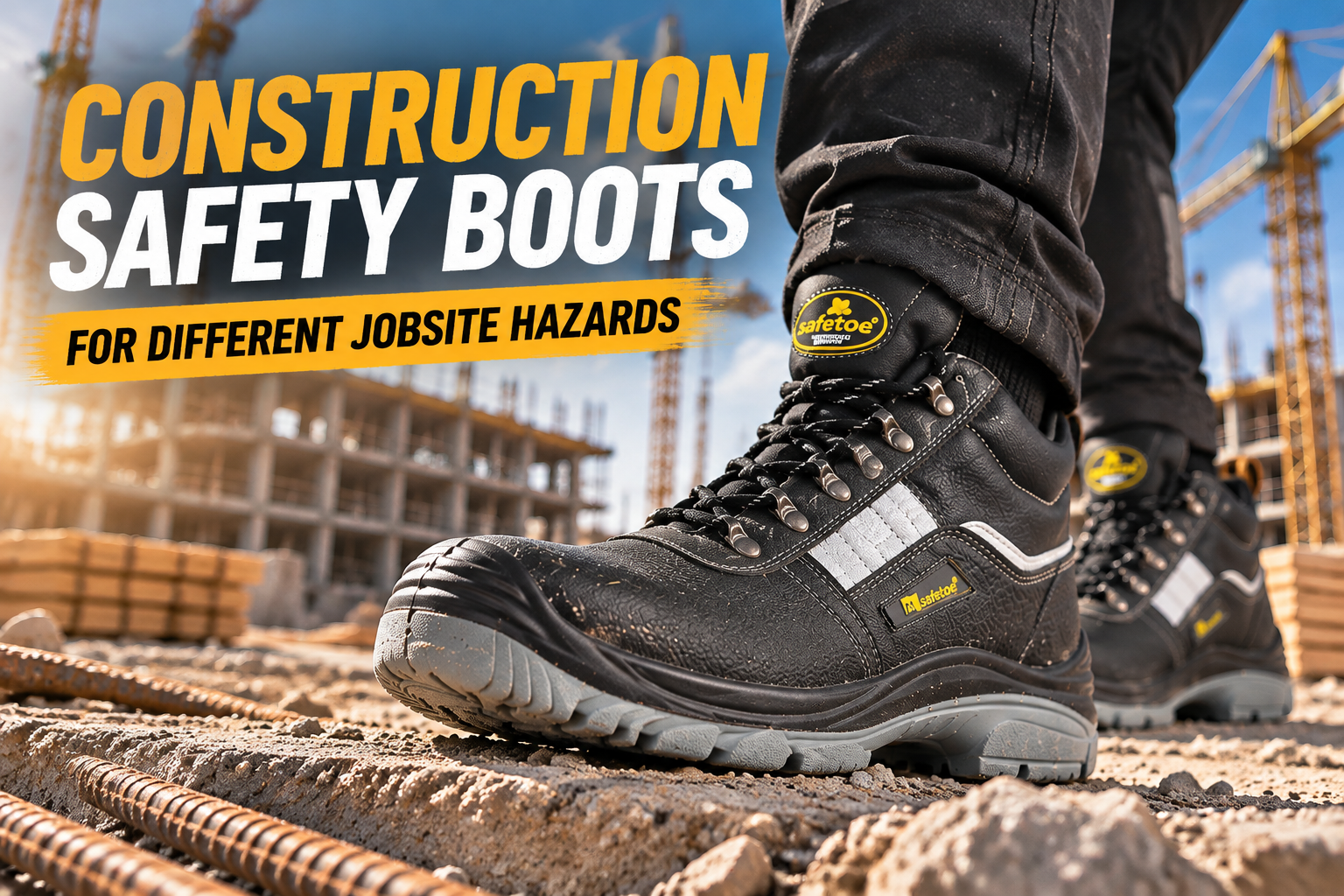
Construction sites expose workers to different combinations of foot hazards. Falling materials, sharp debris, slippery surfaces, standing water and hot roadwork surfaces can all create risks, but each requires a different approach to footwear protection.A suitable safety boot should address the actual hazards of the job rather than relying on a generic "construction boot" label. Understanding the injury mechanism helps buyers identify the protection needed and select footwear that matches the working environment.
Explore Safetoe Construction Safety Footwear Solutions for footwear designed for different construction applications.
For a broader buying checklist covering footwear features and certification, read our guide: How to Choose Safety Boots for Construction Work.
| Construction Hazard / Worksite | Main Protection Need | Footwear Direction |
| Falling materials | Toe protection | Certified safety boots |
| Nails and sharp debris | Puncture resistance | Puncture-resistant safety boots |
| Wet or uneven ground | Grip and stability | Suitable slip-resistant construction boots |
| Standing water and deep mud | Waterproof protection | Safety Wellington boots |
| Asphalt and hot surfaces | Heat-resistant outsole | Specialized paving safety boots |
| Electrical work | Electrical hazard protection | Model-specific footwear with appropriate evidence |
FAQ: Construction Site Safety Boots
1. What are the most common foot hazards on construction sites?
Common hazards include falling objects, nails and sharp debris, slippery or uneven surfaces, water and mud, and specialized risks such as hot surfaces or electrical hazards. The risks vary by task, so footwear should be selected according to the actual worksite conditions.
2. Do all construction workers need puncture-resistant safety boots?
Not necessarily. Puncture-resistant footwear is important where nails, screws, metal offcuts or other sharp objects may penetrate the sole. The need depends on the jobsite risk assessment and project requirements.
3. What safety footwear is best for muddy construction sites?
For deep mud, standing water and persistently wet conditions, safety Wellington boots may be more appropriate than conventional leather safety boots. Buyers should also verify the required toe protection, puncture resistance and slip performance.
4. Do road construction workers need different safety boots?
Some roadwork tasks, particularly asphalt paving, expose footwear to elevated temperatures and loose aggregate. Specialized paving boots with appropriate outsole heat resistance may be needed. Buyers should verify the required markings and technical documentation for the specific model.

 English


