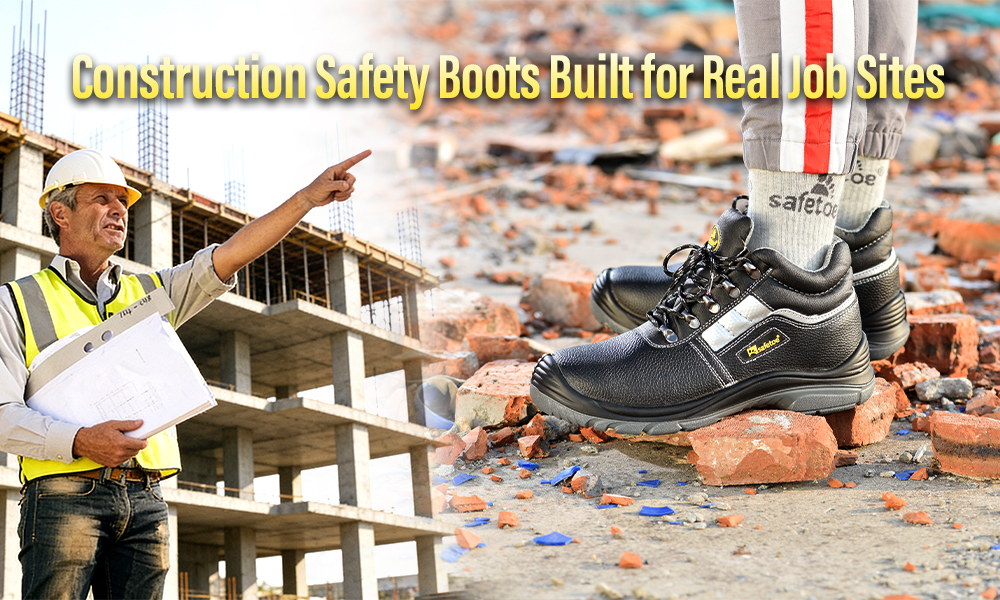
Construction sites expose workers to several foot hazards at once, including falling materials, nails and sharp debris, wet or uneven surfaces, and long hours of standing and walking. Choosing construction safety boots therefore requires more than looking for a steel toe or a "heavy-duty" label.Buyers should match certified footwear protection, outsole performance, comfort features and construction to the actual jobsite hazards and project requirements.
Explore Safetoe Construction Safety Footwear Solutions for footwear options across building, infrastructure, roadwork and concrete applications.
1. Start with the Hazards on the Construction Site
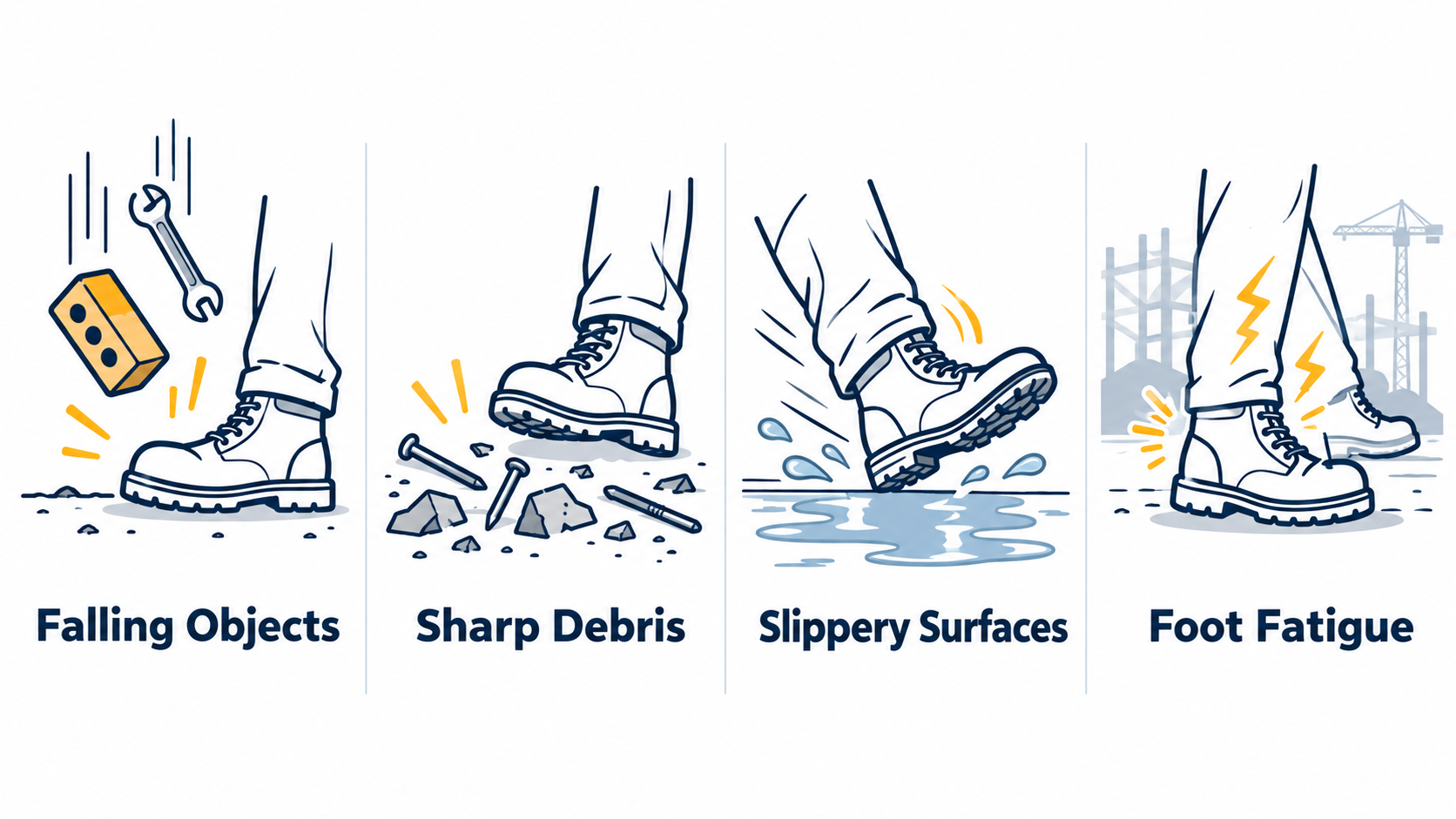
Before choosing safety boots, identify the hazards workers are most likely to encounter. Different construction tasks can expose feet to several risks simultaneously.
1.Falling Objects and Impact
Bricks, tools, building materials and equipment components can fall or strike the foot. Appropriate certified toe protection is essential where these impact hazards exist.
2.Nails and Sharp Debris
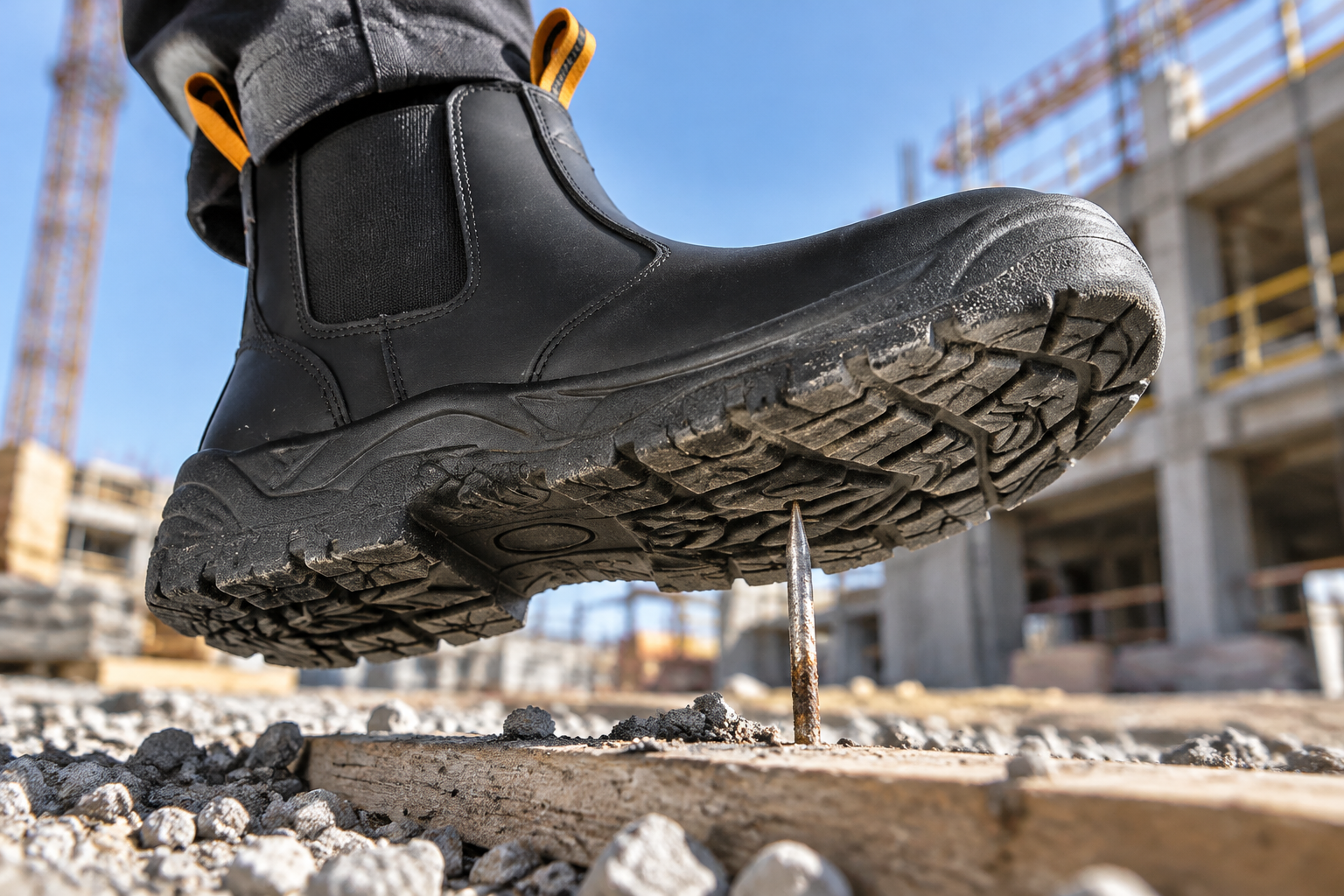
Nails, screws, reinforcement wire and metal offcuts can create penetration hazards underfoot. Buyers should consider puncture-resistant footwear when these materials are present.
3.Wet, Slippery and Uneven Surfaces
Wet concrete, mud, loose debris, ramps and changing terrain can affect traction and stability. Outsole design should suit the actual working surface.
4.Long Working Hours
Standing, walking, climbing and carrying materials place repeated demands on workers' feet. Fit, cushioning, weight and shock absorption should therefore be part of the selection process.
The best starting point is a jobsite risk assessment, not a single footwear feature.
2. Choose the Right Toe Protection
Toe protection is a fundamental consideration when selecting construction safety boots. However, steel, composite and aluminum toe caps have different characteristics, and no material is automatically the best choice for every project.
Steel toe caps are a traditional option widely used in construction footwear.
Composite toe caps offer a non-metallic alternative for projects with particular weight, thermal or metal-free requirements.
Aluminum toe caps can provide another lightweight protection option.
The most important consideration is whether the specific footwear meets the required impact-protection standard and project specifications. Buyers should check the product's certification and technical documentation rather than choosing by material name alone.
Safetoe groups its certified steel, composite and aluminum toe protection systems under VortiGard™ Toe Protection Technology.
3. Do Not Overlook Puncture Resistance
A protective toe does not protect the sole of the foot. On construction sites, exposed nails, screws, metal offcuts and sharp debris can create penetration hazards even when footwear has an appropriate safety toe.Buyers should check whether the footwear includes a suitable penetration-resistant insert.
Steel penetration-resistant plates and non-metallic textile inserts offer different characteristics in terms of weight, flexibility, coverage and construction. The appropriate option depends on the worksite hazards and the footwear's certified configuration.
Do not assume that every safety boot includes puncture protection simply because it has a protective toe cap.
Safetoe's FlexBarrier™ Anti-Penetration Protection Technology covers different penetration-resistant construction approaches.
4. Check Slip Resistance and Outsole Design
Construction workers may move between wet concrete, mud, loose gravel, dusty floors, ramps and ladders during a single shift. These changing surfaces make outsole selection an important part of footwear assessment.
Buyers should consider:
Tread design: Whether the outsole suits the expected terrain.
Surface conditions: Whether workers regularly encounter water, mud or other contaminants.
Stability: Whether the footwear suits the movement and terrain involved.
Maintenance: Whether accumulated dirt or debris could affect outsole contact.
No slip-resistant outsole can prevent every fall. Actual performance depends on the footwear, the surface, contamination and working conditions.
For models equipped with advanced traction systems, PlumaShield™ Slip-Resistant Outsole Technology is designed to improve grip on wet, oily and slippery surfaces. Buyers should verify which features apply to the specific model.
5. Consider Comfort for Long Construction Shifts
Construction workers often spend hours standing, walking, climbing and carrying materials. Footwear that fits poorly or feels unnecessarily heavy can become difficult to wear consistently throughout a shift.
When evaluating comfort, consider:
Cushioning and shock absorption for repeated walking and standing.
Fit and sizing for secure, comfortable wear.
Weight and flexibility for the demands of the job.
Lining and breathability for the working environment.
Ankle support where the footwear design and task require it.
Comfort is not separate from safety when workers wear footwear for an entire shift. However, comfort features should complement, not replace, the required protective performance.
Learn more about Zorbtion™ Shock Absorption Technology.
6. Match the Safety Standard to the Market and Project
Construction footwear requirements vary by destination market, project specifications and workplace regulations. Buyers should confirm the applicable standard before placing an order.
| Market | Common Standard | What Buyers Should Check |
| Europe / International | EN ISO 20345 | Protection class and additional markings |
| United States | ASTM F2413 | Required impact, compression and additional protection specifications |
| Canada | CSA Z195 | Project and market requirements |
| Australia | AS 2210.3 | Certified model and required protection level |
These standards should not be treated as interchangeable classification systems. Buyers should identify the requirements that apply to their market and project.For European requirements, check the applicable EN ISO 20345 safety footwear certification. For the United States, consult the ASTM F2413 Safety Footwear Standard.
Certification and protection levels are model-specific. Buyers should verify the technical datasheet, certificate and required markings for the exact footwear model.
7. Match the Boot to the Construction Environment
The most suitable footwear also depends on the type of construction work being performed.
1.General Building and Contractors
Prioritize appropriate toe protection, puncture resistance, outsole grip and comfort for routine building tasks.
2.Civil Engineering and Infrastructure
Consider durability, penetration hazards and stability on uneven terrain.
3.Wet and Muddy Construction
Waterproof construction and suitable traction become particularly important where workers regularly encounter mud, standing water or wet ground.For continuously wet or muddy worksites, safety Wellington boots may be more suitable than conventional leather construction boots.
Explore Safetoe Construction Safety Wellington Boots for applications that require waterproof footwear construction.
4.Electrical Construction and Utilities
Where electrical hazards exist, buyers must verify the specific electrical-protection requirements. Ordinary construction safety boots should not automatically be assumed to provide electrical hazard protection.
8. Recommended Safetoe Construction Safety Boots
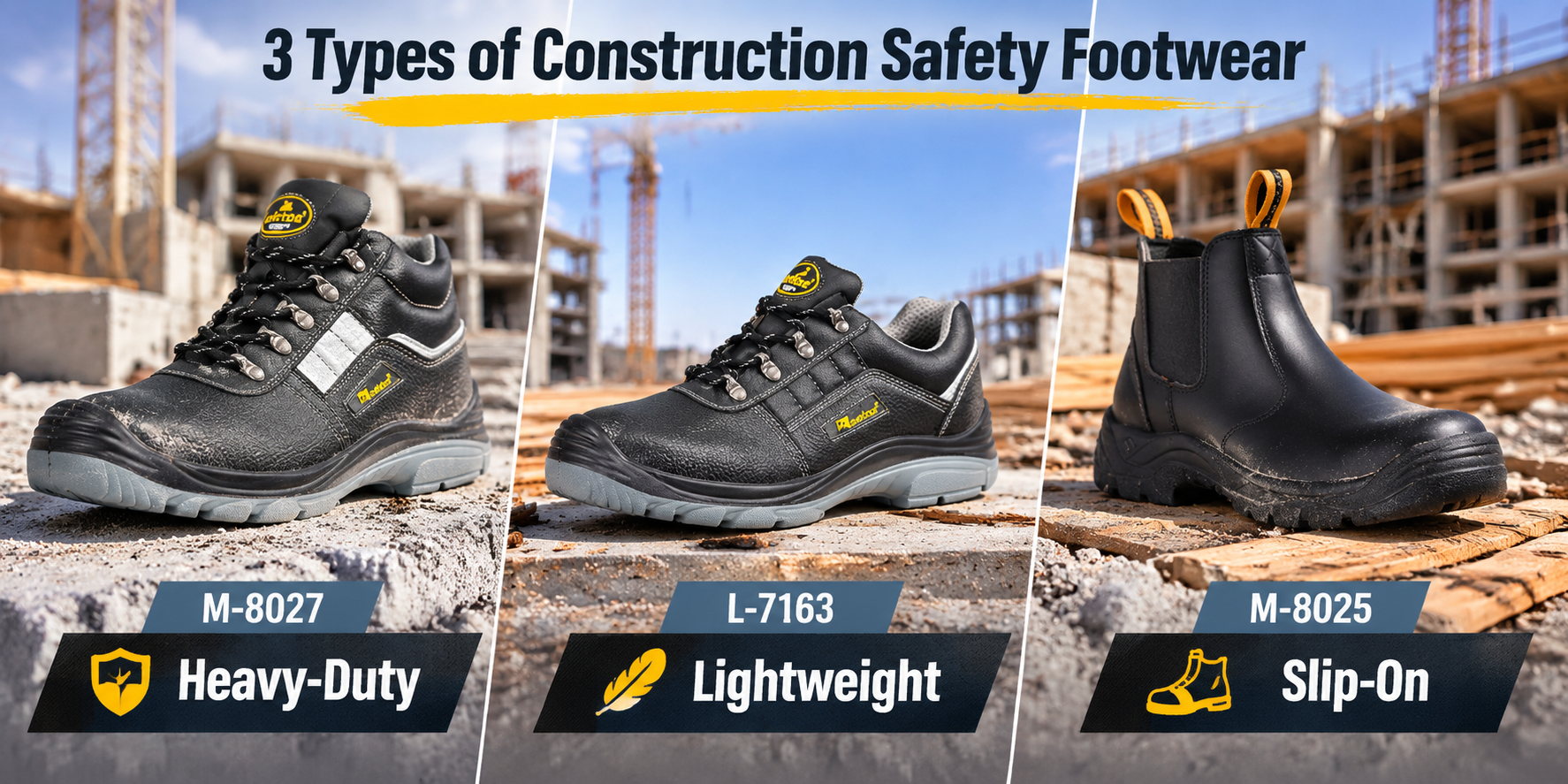
Different construction tasks call for different footwear designs. The following three options represent distinct selection priorities rather than a universal ranking.
Best suited to: Building, civil engineering and structural work.
M-8027 WorkGuard Pro features a steel toe, a steel penetration-resistant plate and an outsole designed for demanding work environments.
Its listed specification is EN ISO 20345:2022+A1:2024 S3 SR FO.
For projects requiring substantial mechanical protection, this model is a relevant option to evaluate against the site's risk assessment and purchasing requirements.
Best suited to: Construction tasks involving frequent movement.
L-7163 WorkShield Pro is positioned as a lightweight option for workers who move frequently around the jobsite. Buyers should verify its specific protection features, certification and technical specifications before selecting it for a project.
Best suited to: General construction and contractor applications where easy on-and-off use is important.
M-8025 SiteShield Pro provides a slip-on footwear option. Its suitability should be assessed against the project's required protection level, fit and working conditions.
Construction Safety Boots Buying Checklist
Before placing an order, buyers should confirm:
Identify the main jobsite hazards.
Verify certified toe protection.
Check puncture resistance.
Evaluate outsole grip and terrain.
Consider wet-weather requirements.
Assess comfort and fit for long shifts.
Confirm the required market certification.
Review the exact model's technical documentation.
Construction Safety Boots FAQ
1. What safety boots are best for construction work?
Q:The right construction safety boots depend on the jobsite hazards. Buyers should assess toe protection, puncture resistance, slip performance, comfort and applicable certification. The best choice is the model that meets the project's requirements and suits the actual working conditions.
2. Do construction workers need puncture-resistant boots?
Q:Puncture-resistant footwear can be important where nails, screws, metal offcuts or other sharp debris may penetrate the sole. Whether it is required depends on the risk assessment, project specifications and applicable workplace rules.
3. Are steel toe or composite toe boots better for construction?
Q:Neither is universally better. Steel and composite toe caps have different characteristics, and the appropriate choice depends on certified protection requirements, weight preferences, metal-free needs and project specifications. Buyers should compare the complete footwear configuration rather than the toe material alone.
4. What safety standard should construction boots meet?
Q:Requirements depend on the destination market and project. Common references include EN ISO 20345, ASTM F2413, CSA Z195 and AS 2210.3. Buyers should verify the applicable standard and the certification of the exact footwear model.
5. Are waterproof safety boots necessary for construction?
Q:Not for every construction site. Waterproof footwear can be valuable for outdoor work and wet conditions. Where workers regularly encounter deep mud or standing water, Wellington boots may be more suitable than conventional leather safety boots.
Conclusion
Choosing construction safety boots starts with understanding the worksite, not simply selecting the heaviest footwear or the highest protection rating.Buyers should match toe protection, puncture resistance, outsole performance, comfort and certification to the actual job requirements. They should also verify that every claimed feature applies to the exact model being purchased.
Identify the Hazards → Match the Protection → Verify the Certification → Select the Right Footwear.
Explore Safetoe Construction Safety Footwear Solutions to evaluate footwear options for different construction applications.

 English


