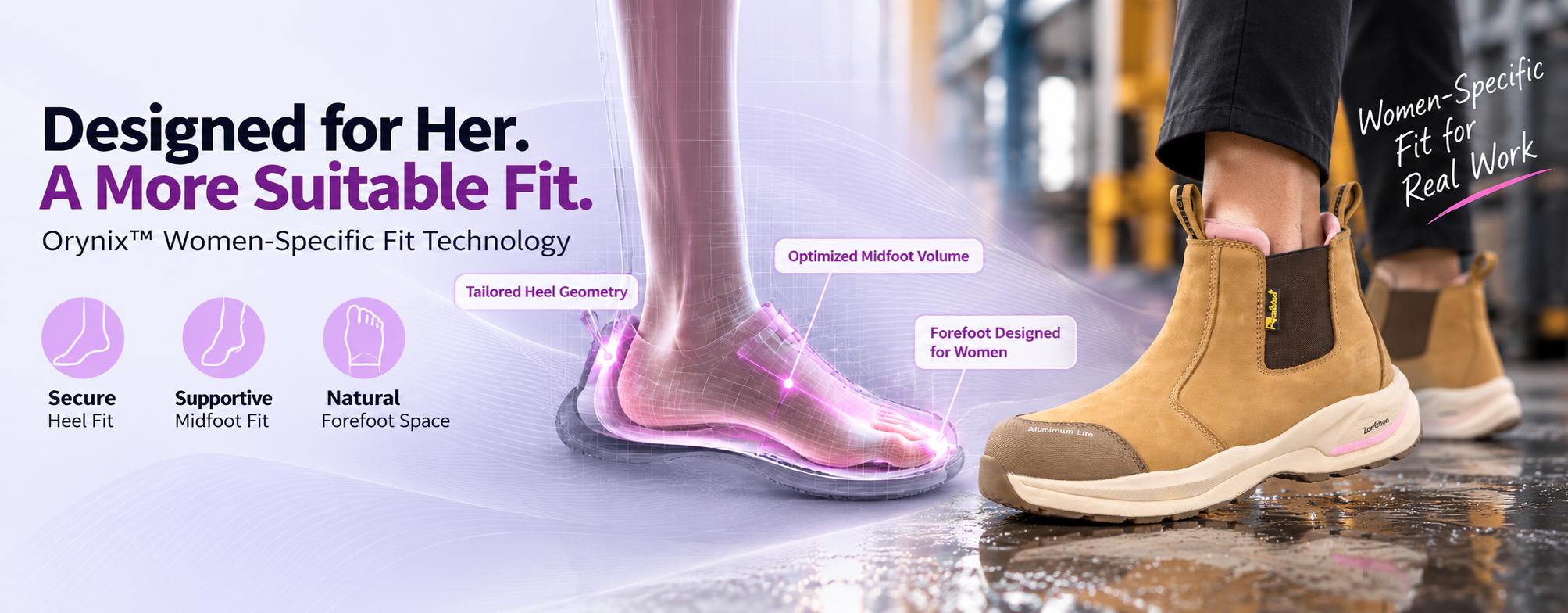
Introduction: Fit Starts with the Last
A footwear last defines much of a shoe's internal shape and fit. In safety footwear, simply reducing the size of a men's last does not necessarily create a women-specific fit.
Heel shape, midfoot volume, forefoot geometry and the protective toe structure all need to work together. Understanding these design elements helps footwear buyers evaluate how women-specific safety footwear is developed and why last geometry matters beyond shoe size alone.
1. What Is a Shoe Last?
A shoe last is the three-dimensional form used to shape footwear during design and manufacturing. It influences the internal dimensions, heel shape, midfoot volume, forefoot shape and overall fit of the finished shoe.
In safety footwear, the last must also accommodate protective components such as the toe cap.
The relationship between the last and the finished shoe is therefore important: the shape of the last influences how the footwear is constructed and how its internal space is distributed.
For professional safety footwear, last design must consider both fit and the space required by protective components.
2. Why Downsizing a Men's Last Is Not Enough
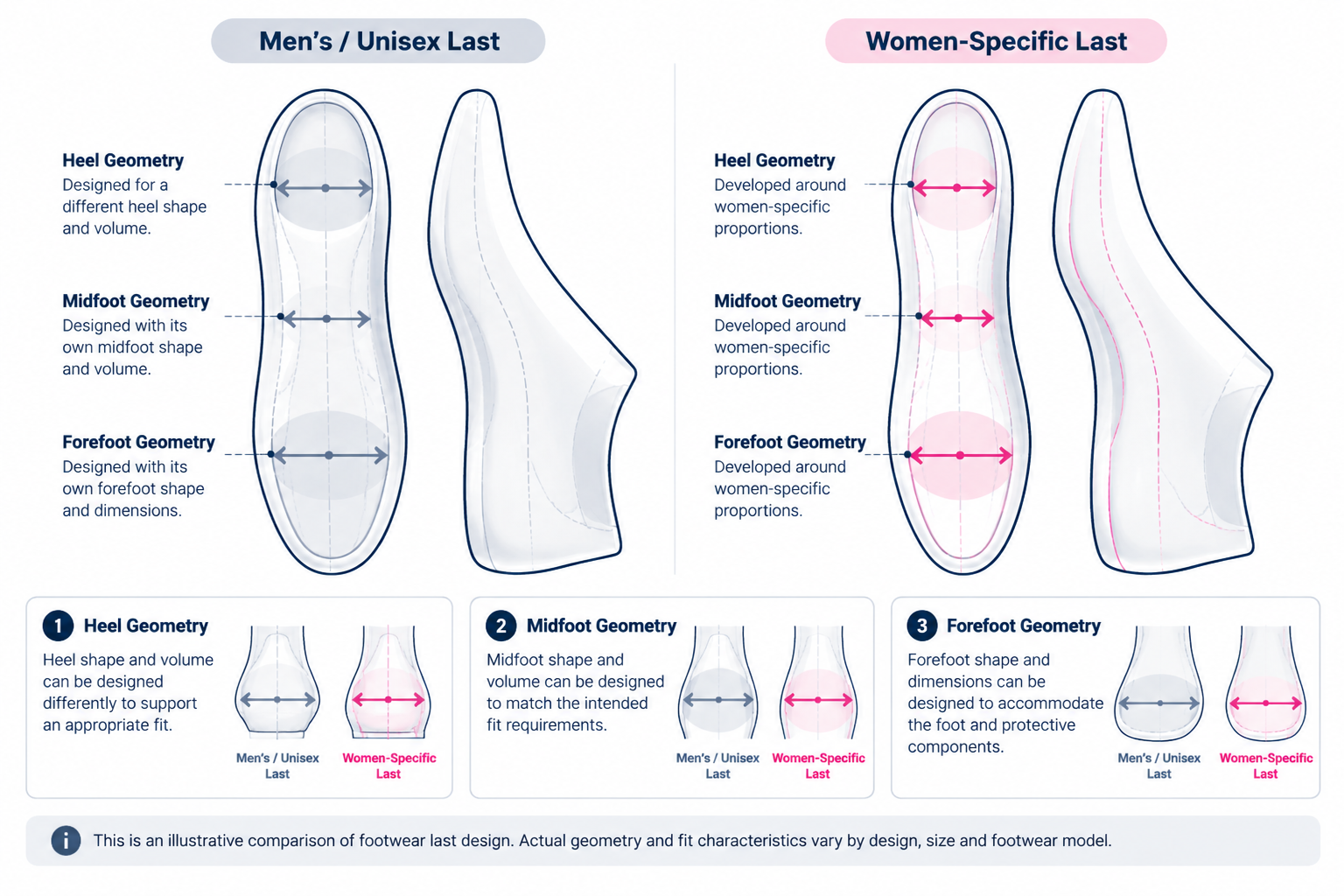
Fit depends on proportion and geometry—not shoe size alone.
Reducing the length of an existing last does not automatically adjust every part of its shape to suit a different foot. Women-specific safety footwear can require different proportions across the heel, midfoot and forefoot.
Heel Geometry
The heel area influences how securely the foot sits inside the shoe. Appropriate heel geometry can help reduce unnecessary heel movement while avoiding uncomfortable pressure.
Midfoot Volume
Midfoot volume affects how the shoe wraps around the foot. The goal is to provide suitable support and a secure fit rather than simply making the entire shoe narrower.
Forefoot Geometry
The forefoot must accommodate the shape and natural positioning of the foot while allowing sufficient internal space for the protective toe cap.
These areas need to work together. A shoe that feels secure at the heel may still be uncomfortable at the forefoot if the overall proportions are not appropriate.
Women-specific footwear is not simply narrower footwear. It is footwear designed around an appropriate combination of proportions and geometry.
3. Why Protective Toe Geometry Matters Too
A women-specific last is only one part of safety footwear design. The protective toe cap also affects the space available around the forefoot.
A protective toe cap must meet the applicable performance requirements while fitting within the overall footwear construction.
If the last geometry is redesigned but the protective toe structure is not appropriately matched, the intended fit may be difficult to achieve. The internal shape, toe cap dimensions and surrounding construction therefore need to be considered together.
Two important design elements are:
Women-Specific Last Geometry: Shapes the internal space around the heel, midfoot and forefoot.
Matching Protective Toe Geometry: Helps accommodate the required protective component within the footwear design.
The aim is to coordinate fit and protection rather than treating them as separate design tasks.
For buyers evaluating women's safety footwear, this relationship is an important consideration when comparing product construction and fit.
4. Inside Orynix™ Women-Specific Fit Technology
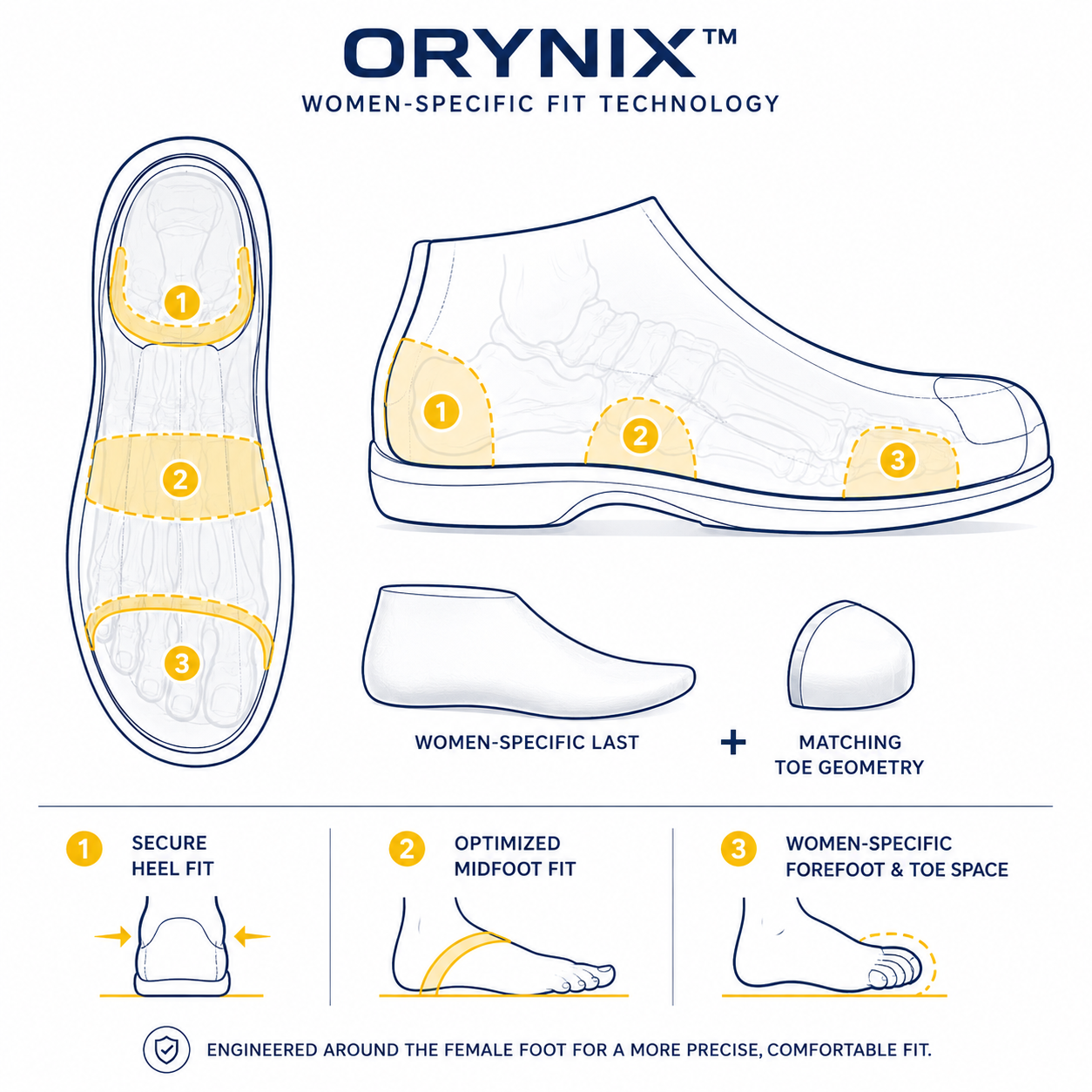
Orynix™ is SAFETOE's women-specific fit system, developed around dedicated women's lasts and matching protective toe geometries to support a more appropriate fit in professional safety footwear.
Its design concept focuses on three connected elements.
Women-Specific Last
Dedicated last geometry provides the foundation for developing footwear around the intended fit proportions.
Secure Fit Architecture
Heel, midfoot and forefoot proportions are considered together to support a suitable overall fit.
Matching Protective Toe Geometry
Protective toe components are designed to work with the women-specific last, helping coordinate forefoot space with the intended protective construction.
Together, these elements establish the core concept behind Orynix™: women-specific fit through coordinated footwear geometry.
Orynix™ is a fit technology, not a substitute for safety certification. The protective performance of each finished shoe must still be verified against its applicable requirements.
Explore Orynix™ Women-Specific Fit Technology
5. From Better Fit to Professional Safety Footwear
Fit is an important part of safety footwear, but it is not the only selection criterion.
The finished shoe must also provide the protection required by the intended work environment. Depending on the workplace risk assessment, buyers may need to consider:
Toe Protection: Appropriate protective toe caps for identified impact and compression hazards.
Puncture Resistance: Suitable penetration-resistant components where sharp objects present a risk.
Slip Resistance: Outsole performance appropriate to the actual floor conditions.
Other Required Performance: Additional properties and certification specified for the job or market.
SAFETOE offers women's safety footwear in different styles for a range of industrial applications.
The collection includes the M-8553W Pro women's safety boots, M-8025W Pro Chelsea safety boots and L-7613 women's safety sneakers. Buyers should review each model's actual specifications and available certification before selecting footwear for a particular application.
Explore SAFETOE Women's Safety Footwear Solutions
Frequently Asked Questions (FAQs)
1. What is a women-specific shoe last?
A women-specific last is a three-dimensional footwear form developed around the intended proportions and fit requirements of women's footwear. Rather than simply using a smaller size of a men's or unisex last, its geometry can be designed to address the heel, midfoot and forefoot as a coordinated system.
2. Is a women-specific last the same as a narrow last?
No. A women-specific last is not simply a narrower last. It considers the proportions and geometry of different footwear areas, including the heel, midfoot and forefoot, while accommodating the space required by protective components. Actual fit still depends on the individual wearer and the finished shoe's construction.
Conclusion: Fit Is an Engineering Decision
Women-specific safety footwear design involves more than adjusting shoe size. Last geometry, heel fit, midfoot volume, forefoot shape and protective toe geometry need to be considered together.
Orynix™ brings these elements into a women-specific fit system designed for professional safety footwear.
Explore our Orynix™ Women-Specific Fit Technology, view SAFETOE Women's Safety Footwear Solutions, or Contact SAFETOE to discuss your requirements, request product specifications or receive a quotation.
Author: Jay Yuan
Author Bio:
Jay Yuan writes about industrial safety footwear, footwear engineering, PPE standards and workplace protection solutions, helping global buyers understand footwear design, fit considerations and product requirements across different industrial applications.

 English


