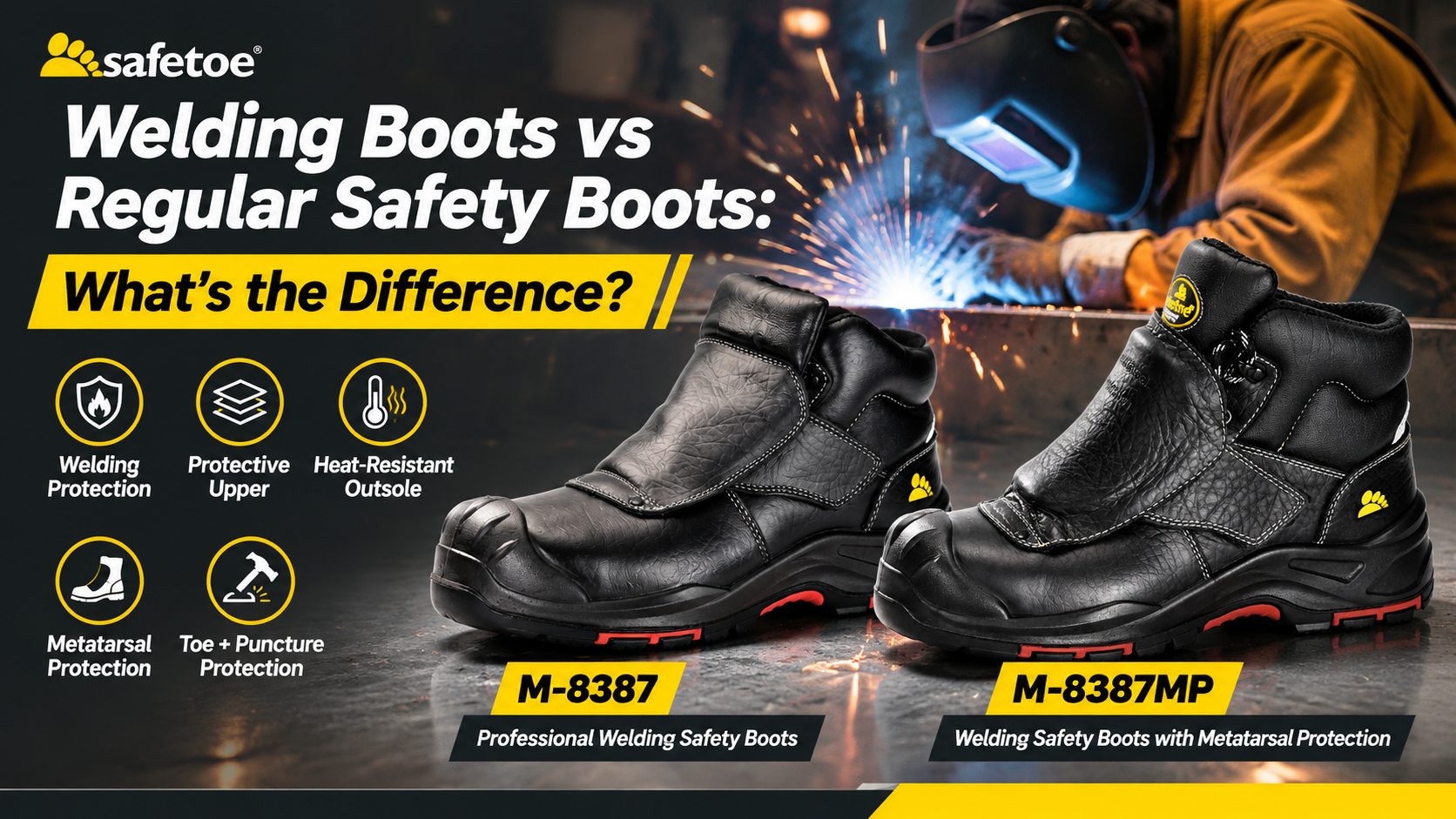
Welding Boots vs Regular Safety Boots: What's the Difference?
A regular safety boot may have a protective toe, puncture-resistant midsole and slip-resistant outsole—but does that make it suitable for welding? Not necessarily. Welding introduces sparks, spatter, heated surfaces and, in some applications, upper-foot impact risks. The distinction is not simply ''more protection''. It is where and how protection is built into the footwear, and whether the claimed performance has been verified.
Welding safety boots should be assessed as a complete design: upper, closure, sole and any additional protective components. This article compares those elements without assuming that every welding model has identical construction or certification. The difference is in the complete protective design—not just the toe cap.
1. What Are Regular Safety Boots Designed to Protect Against?
General-purpose safety boots can address falling objects, compression, underfoot hazards, slipping and workplace wear, depending on their certified configuration. Some also provide heat-resistant outsoles or metatarsal protection. They are not inferior footwear. They are designed and specified for particular hazards, and may be appropriate for construction, maintenance or industrial handling.
Problems arise when their documented capabilities are assumed to cover a specialised thermal exposure. A toe cap or general safety classification does not, by itself, establish resistance to welding spatter or suitable closure coverage.
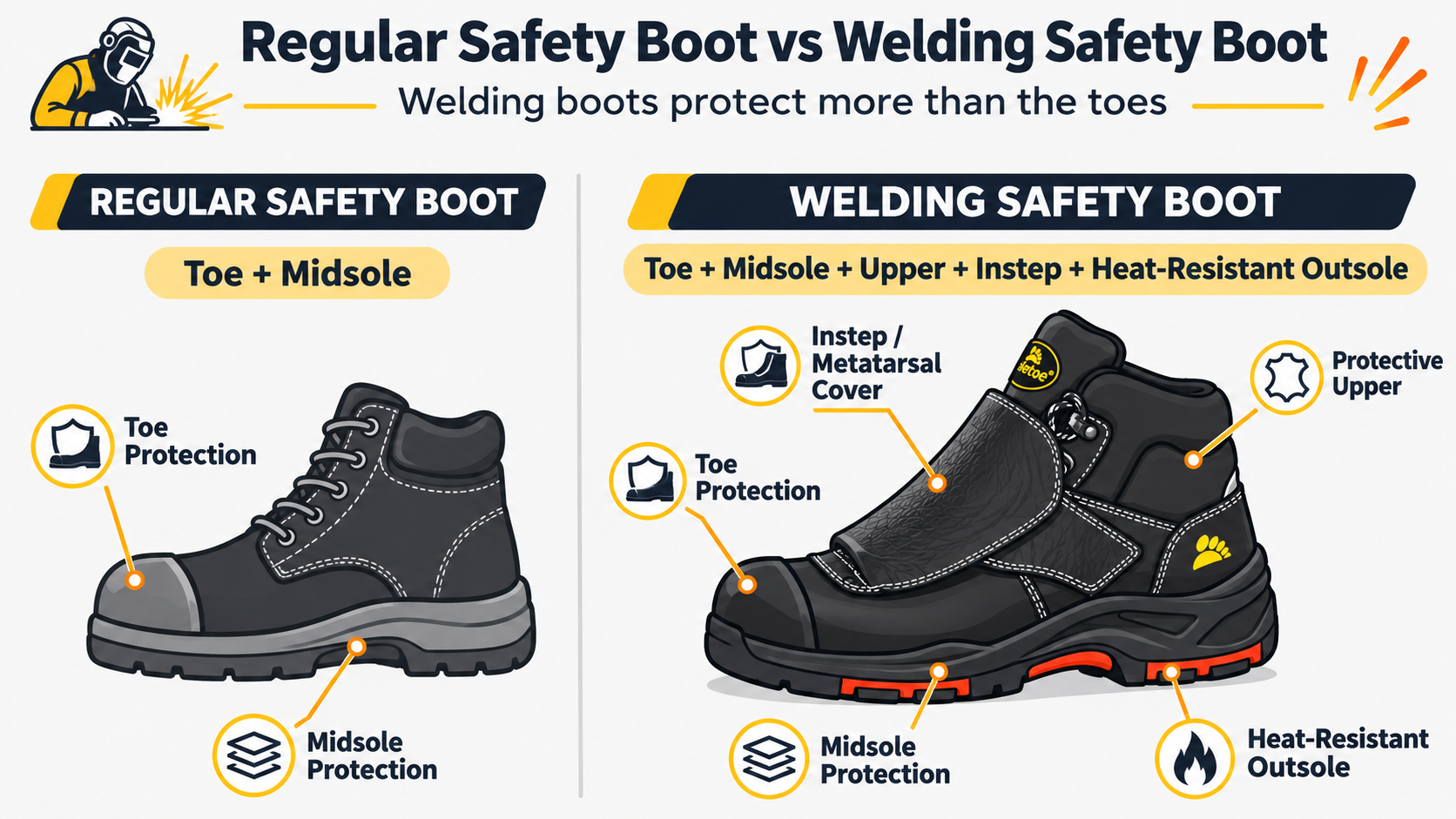
2. Welding Boots Protect More Than the Toes
A toe cap addresses impact and compression in the toe region. Sparks and spatter, however, may fall onto the instep, upper seams or fastening area. A boot can therefore provide toe protection while leaving other exposed components unsuitable for a particular welding task.
A certified toe cap does not establish protection for exposed laces or the upper against welding sparks and hot particles. Welding-oriented construction considers those pathways as well as underfoot protection. Appropriate clothing overlap also matters: the footwear must work with the other PPE used for the task.
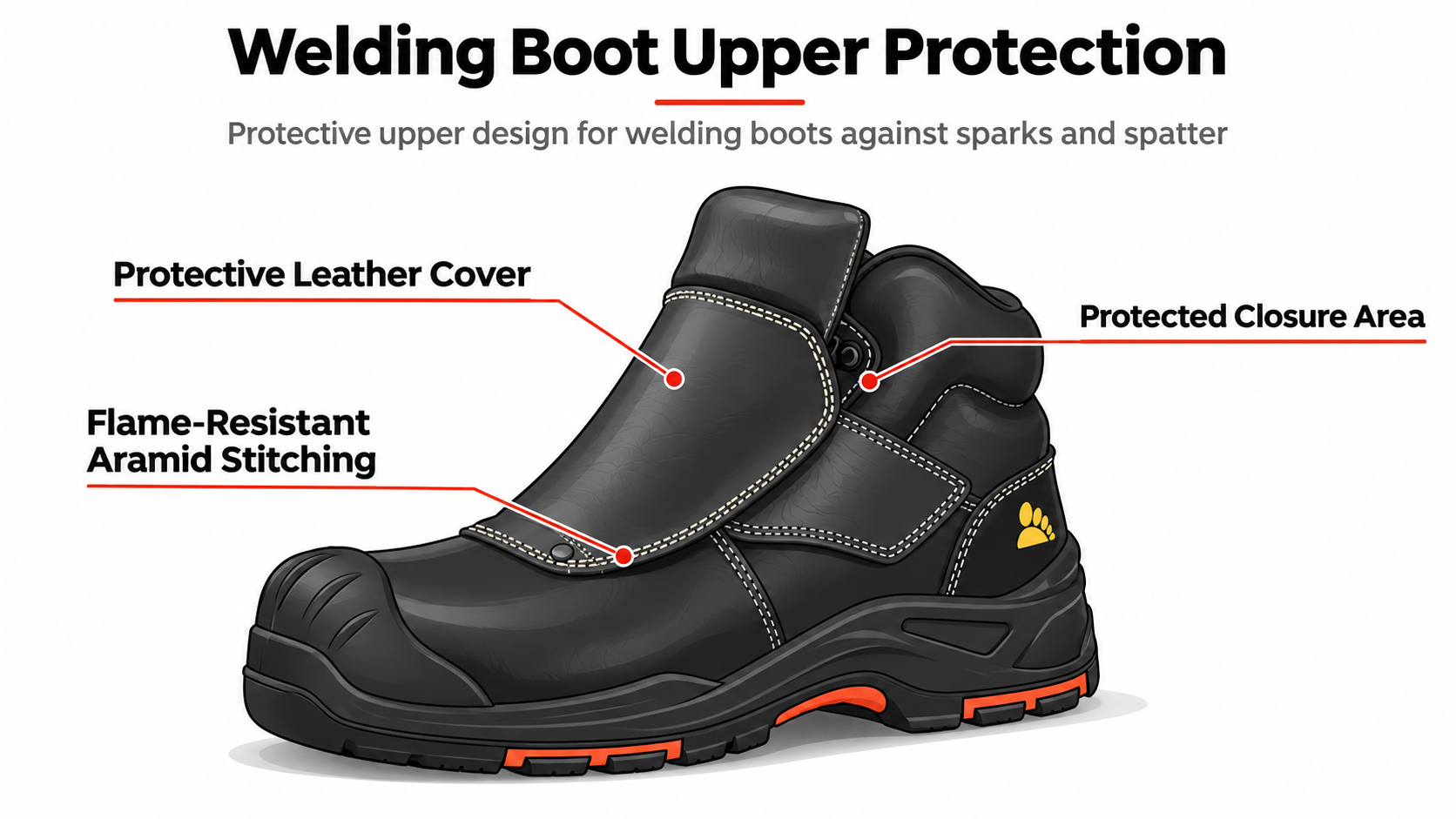
3. Upper Design: Why Sparks and Spatter Change the Boot
General industrial boots may use exposed laces, textile panels and construction details selected for flexibility or ventilation. These features are not automatically unsuitable, but require assessment where hot particles are present. A welding-oriented upper may instead use a protective leather cover, reduced lace exposure, smooth surfaces and flame-resistant stitching. The purpose is to reduce vulnerable areas and places where spatter can collect.
M-8387 Welding Safety Boots provide a structural example, combining a protective leather cover with flame-resistant aramid stitching. These features are design elements, not a blanket guarantee against hot-particle entry. The complete upper, closure and relevant thermal performance still need verification.
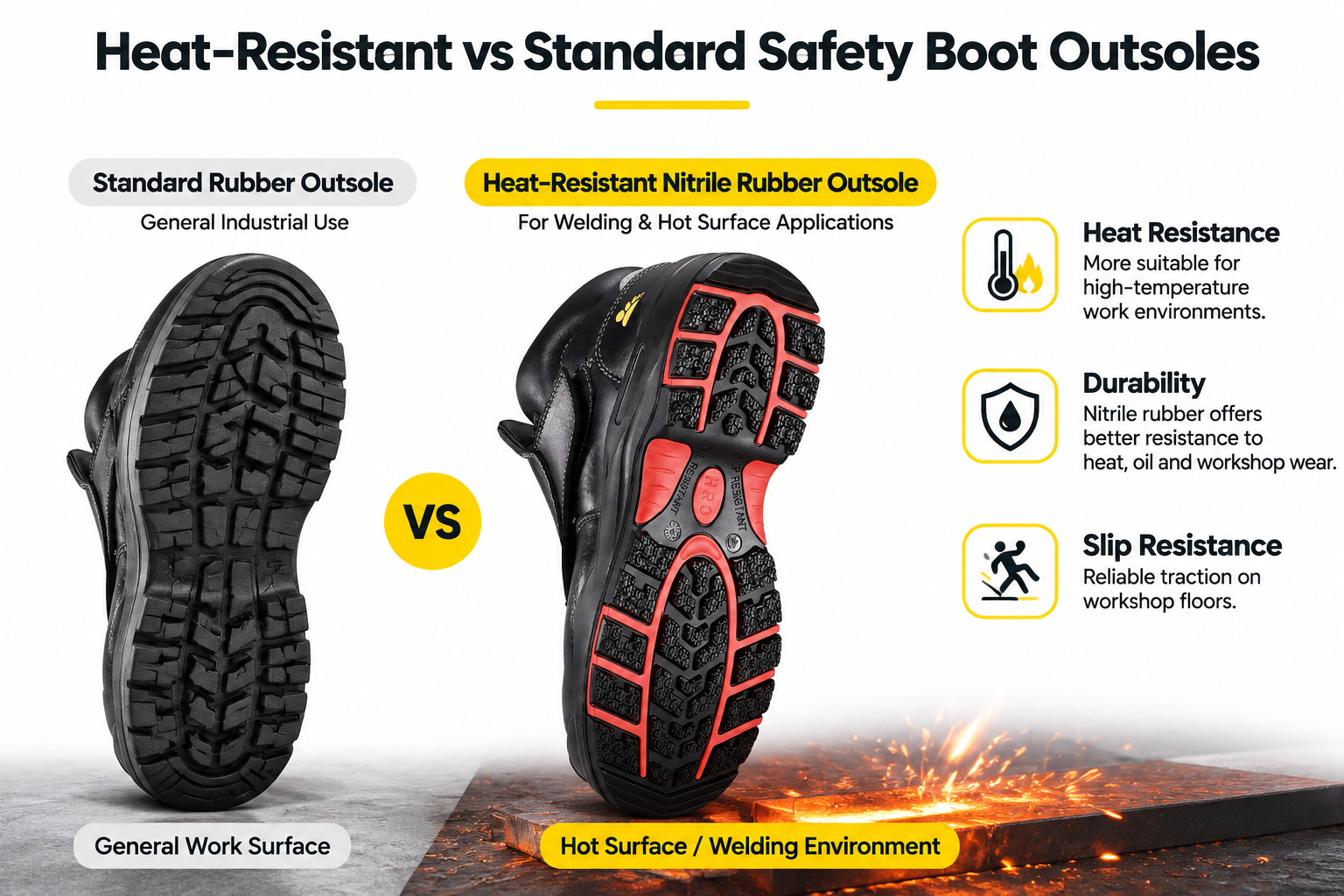
4. Heat-Resistant Outsole vs Standard Work Boot Outsole
Outsole specifications may address slip resistance, abrasion, fuel-oil resistance and durability. Welding or hot-surface applications can introduce an additional requirement: resistance to hot contact. The difference depends on the compound and tested performance, not simply whether the sole is described as rubber or nitrile rubber.
A 300°C contact-heat claim refers to outsole performance under specified laboratory conditions. It does not mean the entire boot is suitable for continuous use in a 300°C environment. HRO is an outsole hot-contact marking. It is distinct from heat insulation, upper flame performance and welding-spatter protection. Passing one test does not establish the others.
HeatVanta™ Heat-Resistant Outsole Technology provides related background. Interpret any temperature claim alongside the model, applicable standard and test conditions.
5. Toe Protection vs Metatarsal Protection
Toe protection and metatarsal protection address different areas. A toe cap primarily covers the toes; a metatarsal guard extends protection over the upper-foot region. A steel or composite toe does not automatically provide metatarsal protection. Additional upper-foot protection may be appropriate where heavy components, tools or workpieces can fall or roll onto the foot. It is not a universal requirement for every welder.
TuffTarsal™ Metatarsal Protection System addresses this protection function. M-8387MP illustrates a welding configuration with additional metatarsal protection. A lace cover and a metatarsal guard are not interchangeable concepts. Verify the guard's documented impact performance and protected area.
6. Does Welding Footwear Need Different Puncture Protection?
Welding and fabrication workshops may contain sharp offcuts and debris, so puncture resistance remains relevant. However, welding construction does not prove that a midsole retains puncture resistance longer after heat exposure. That would require evidence for the specific construction and conditions.
FlexBarrier™ Puncture Protection explains the underfoot protection function. Check the exact model’s certified puncture performance and use limitations; do not infer enhanced thermal durability from a welding product name.
7. EN ISO 20345 vs EN ISO 20349: Why the Standard Matters
EN ISO 20345 Safety Footwear addresses general safety-footwear requirements, including toe protection and applicable additional properties.
The EN ISO 20349 series addresses specific foundry and welding risks:
These are different application scopes, not interchangeable labels. EN ISO 20349 Welding & Foundry Protective Footwear provides further context. A general EN ISO 20345 certificate or HRO marking alone does not establish EN ISO 20349 conformity. Applicable requirements depend on the exposure, market and project.
Verify certification, protection markings and technical documentation for the exact footwear model. Appearance or intended application cannot replace that evidence.
8. Welding Boots vs Regular Safety Boots: Quick Comparison
Feature
| Regular Safety Boots | Welding Safety Boots |
Toe Protection
| Common | Common |
Puncture Protection | Model-specific | Model-specific |
Spark/Spatter Upper Design | Usually not specialized | Key consideration |
Protected Lace Area | Not always | Often important |
Heat-Resistant Outsole | Model-specific | Often required for hot work |
Metatarsal Protection | Model-specific | Important for selected welding risks |
General Standard | EN ISO 20345 | EN ISO 20345 + specialized requirements where applicable
|
Thermal Standard
| Usually not applicable | EN ISO 20349-2 where required |
Typical Use | Construction / Industrial / Maintenance | Welding / Fabrication / Hot Work |
Actual protection depends on the certified configuration of the specific footwear model
9. When Are Regular Safety Boots Not Enough?
Specialised footwear should be evaluated when the existing boot's documented protection does not address frequent sparks, hot spatter, heated surfaces, significant metatarsal hazards or project-specific thermal requirements. A worker's job title is not enough to determine that need. Someone moving materials near welding may face different exposure from a welder working beneath falling spatter.
The workplace hazard assessment—not the job title alone—should determine the footwear requirement.
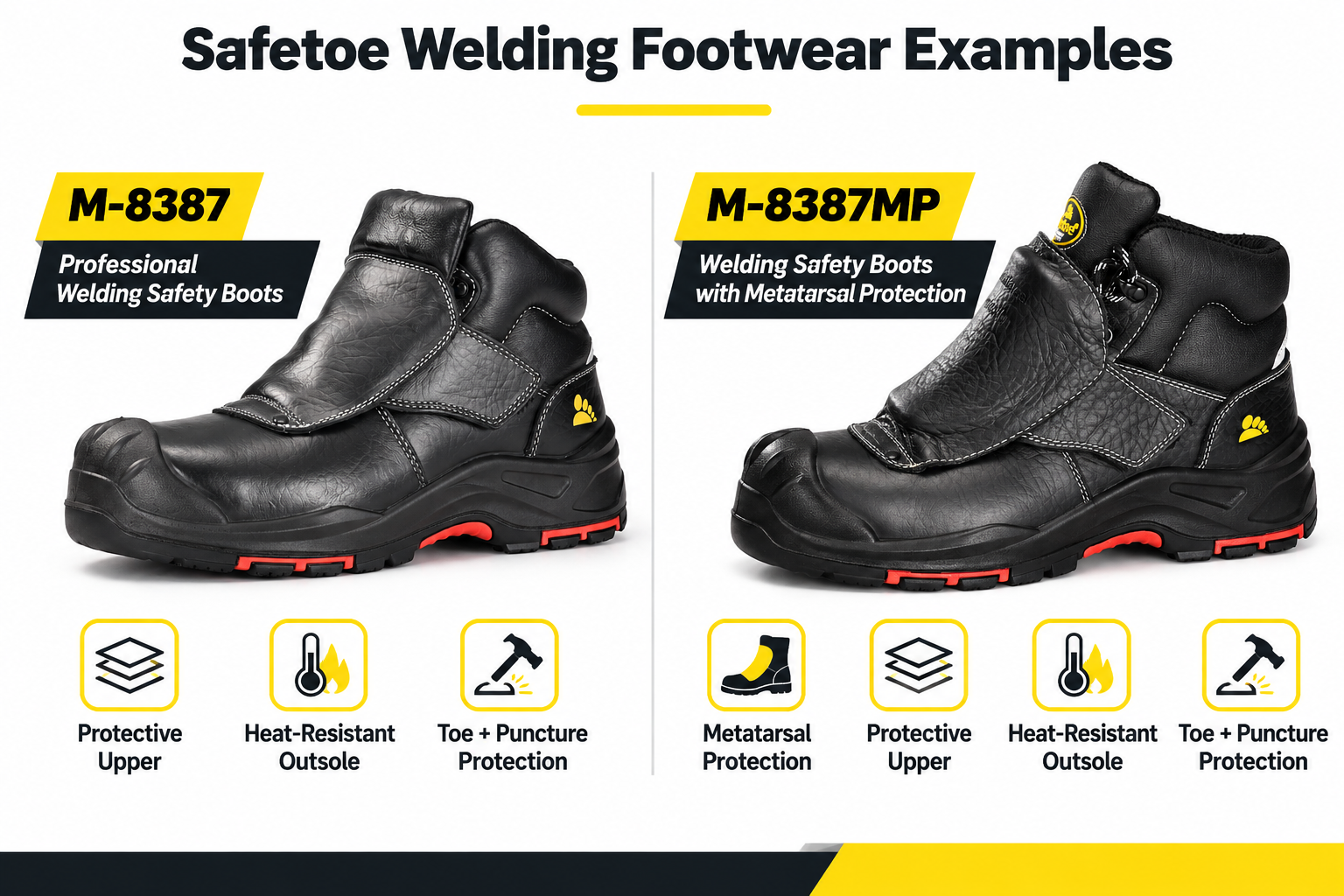
10. Safetoe Welding Footwear Examples
M-8387 — Professional Welding Safety Boots
M-8387 illustrates welding-oriented upper protection with a leather cover, flame-resistant aramid stitching and a heat-resistant outsole configuration. Toe and puncture performance should be confirmed for the supplied version.
M-8387MP — Welding with Metatarsal Protection
M-8387MP adds upper-foot protection as a further design consideration. Confirm its metatarsal performance and the other required properties in the model-specific documents.
Neither example should be assumed to carry every thermal certification. Foundry or severe molten-metal work requires a separate assessment.
FAQ:
Q: Are regular safety boots suitable for welding?
A: Sometimes, depending on their documented performance and the exposure. Toe protection alone is insufficient evidence of suitable upper, spatter or heat protection.
Q: What makes welding boots different from regular work boots?
A: The distinction is the complete design: upper coverage, protected closures, relevant outsole thermal performance and any additional protection required for the task.
Q: Do welding boots need a heat-resistant outsole?
A: Where hot-contact exposure requires it, yes. Verify the model’s performance; outsole hot-contact resistance is not the same as whole-boot heat protection.
Q: Do all welding boots need metatarsal guards?
A: No. Additional metatarsal protection depends on upper-foot impact risks. A toe cap or leather lace cover does not automatically provide it.
Q: What is the difference between EN ISO 20345 and EN ISO 20349?
A: EN ISO 20345 addresses general safety footwear. EN ISO 20349 adds application-specific requirements, with Part 1 for foundries and Part 2 for welding and allied processes.
Author: Jay Yuan, Technical Marketing Director, Safetoe
Source: Safetoe Academy




 English


