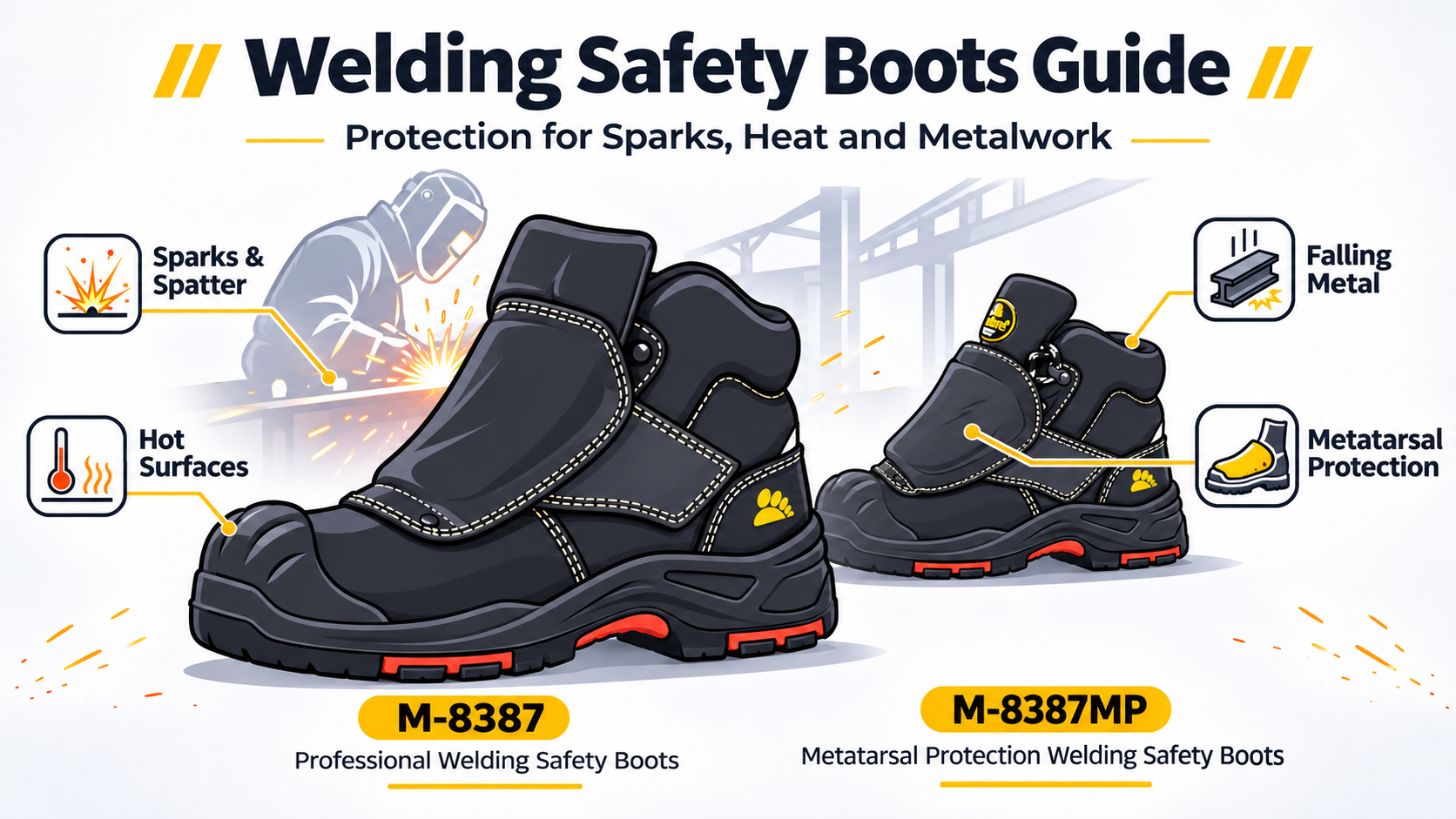
How to Choose Safety Boots for Welding Work
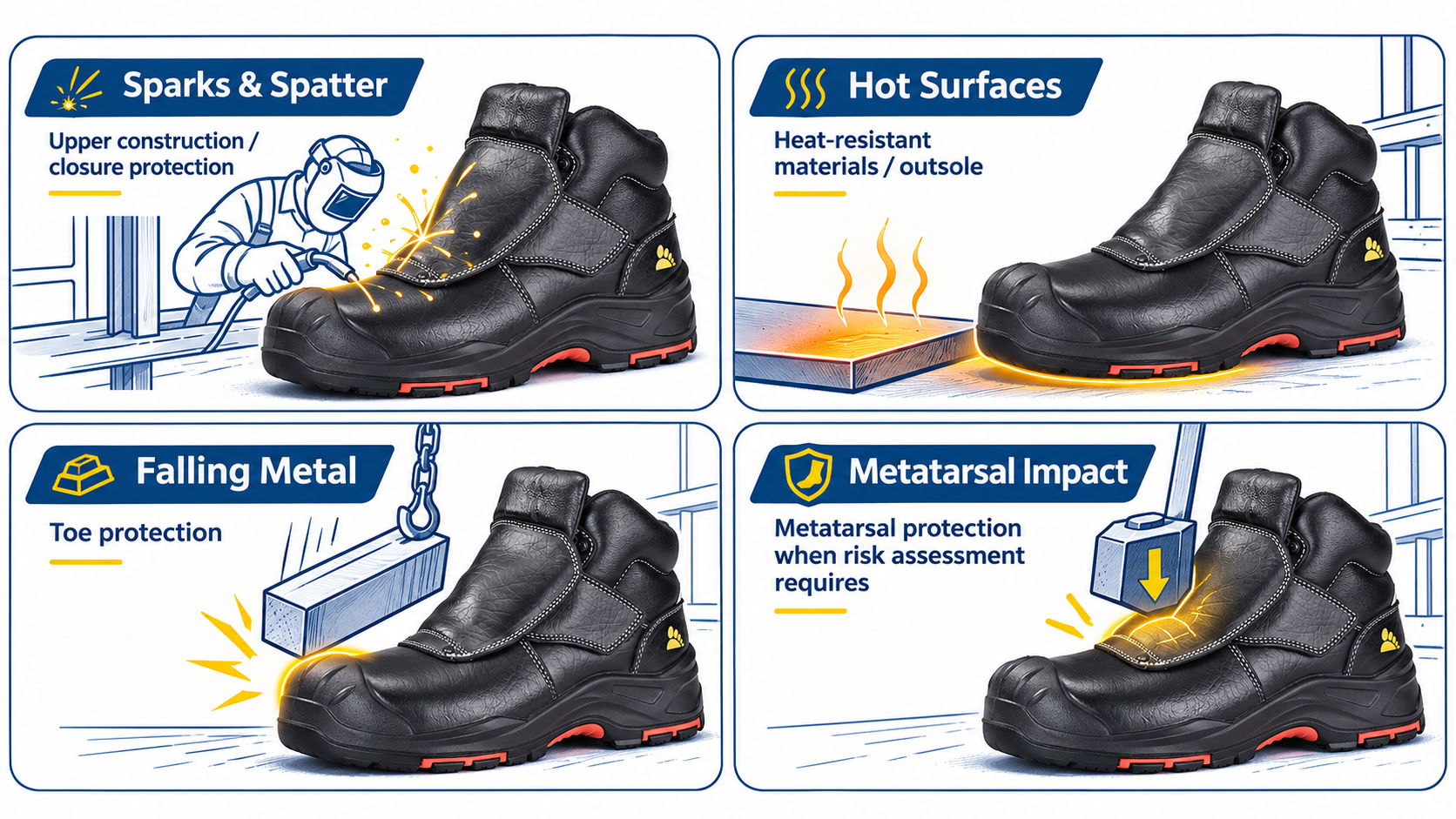
Welding exposes footwear to hot sparks, spatter, heated metal, hot surfaces and falling workpieces. These hazards can affect the upper, toes, metatarsal region and outsole, so ordinary toe protection alone does not establish suitability.
Selecting welding safety boots means looking at construction, thermal performance, mechanical protection and the applicable standard together. Requirements vary between light fabrication, structural welding and more demanding hot-work operations. Begin with the actual process, exposure and workplace risk assessment, then compare the exact product configurations. For related applications, explore Welding Safety Boots Solutions.
1. Start with the Hazards in the Welding Environment
Assess these five hazards:
Hot sparks and spatter: Consider upper construction and closure coverage.
Hot metal and heated surfaces: Assess the relevant material and outsole performance.
Falling workpieces: Verify the required toe impact protection.
Metatarsal impact: Assess heavy objects that may strike the upper foot.
Sharp metal debris: Check puncture protection for workshop offcuts and debris.
Do not assume all hot work involves the same exposure. Welding sparks and small spatter differ from the molten-metal hazards encountered in casting and foundry operations.
2. Look for an Upper Designed for Welding Sparks and Spatter
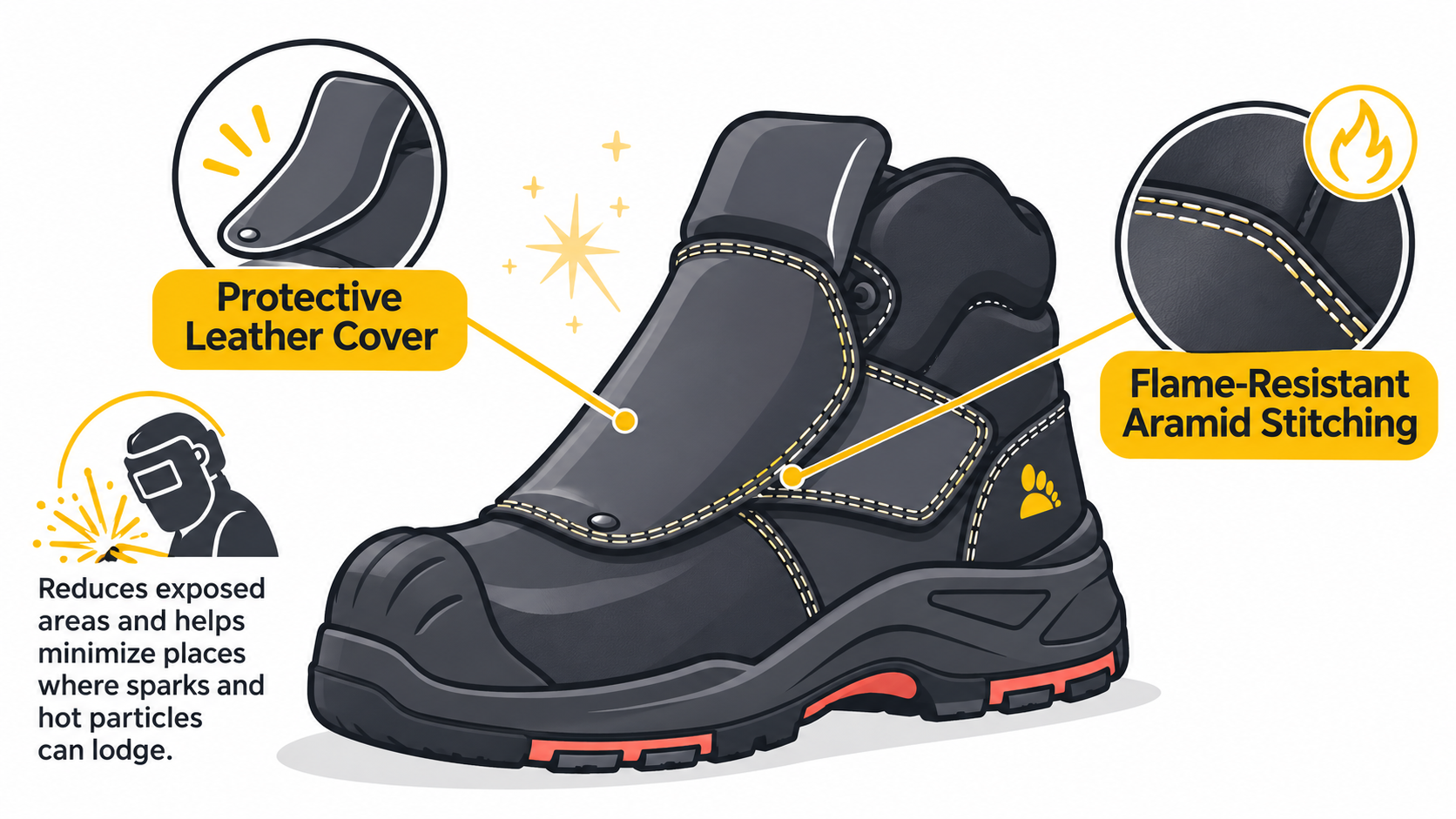
A welding boot should protect more than the toe area. Examine whether the upper and closure minimise places where hot particles can lodge. Look for a smooth protective upper, suitable overlap around closures, protected laces where relevant and flame-resistant stitching supported by the product specification. Assess the footwear together with protective trousers or other required PPE.
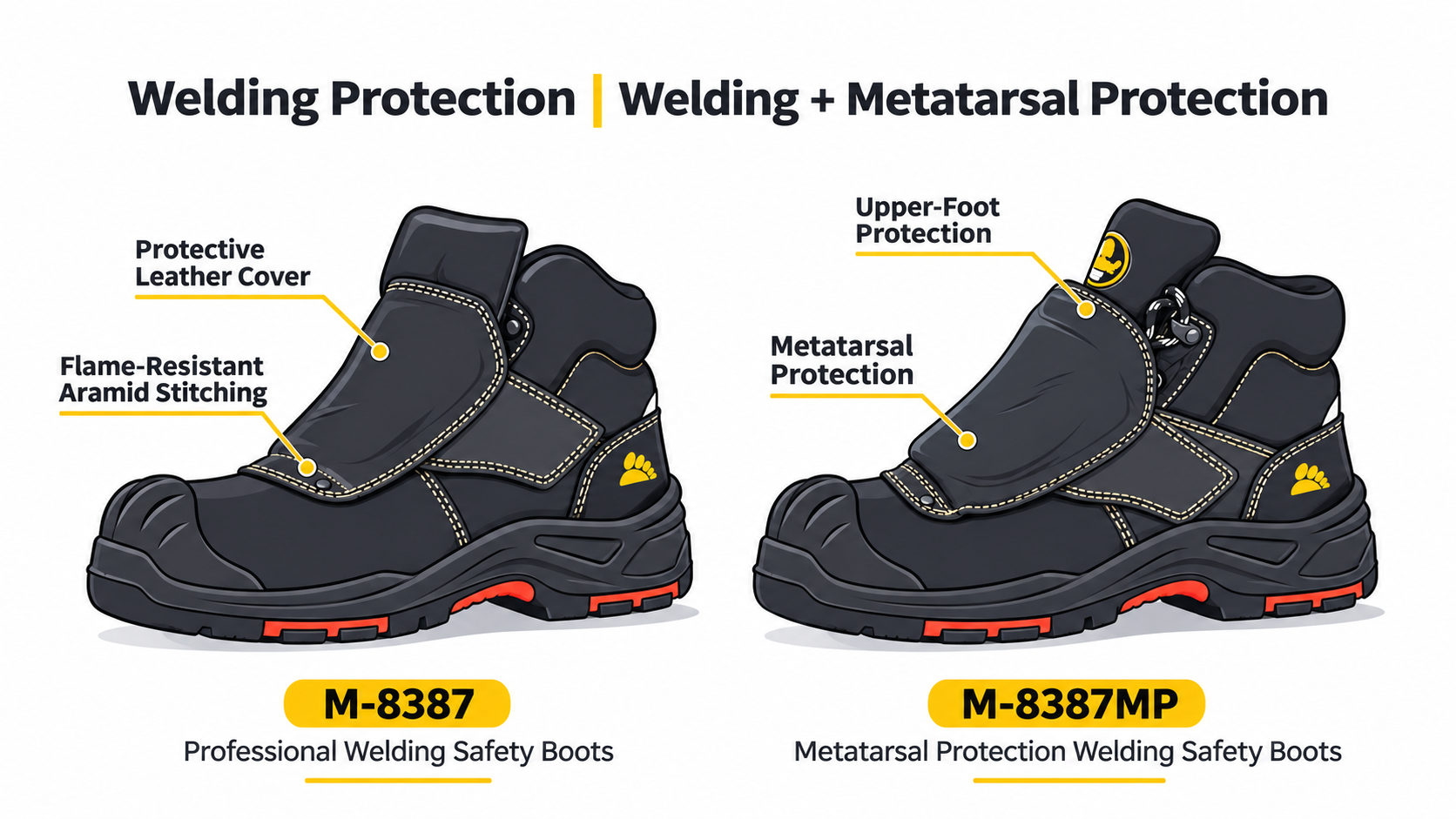
M-8387 illustrates an upper design incorporating a protective leather cover and flame-resistant aramid stitching. These features address upper construction; verify the protection required for the task.
3. Check Heat-Resistant Outsole Performance
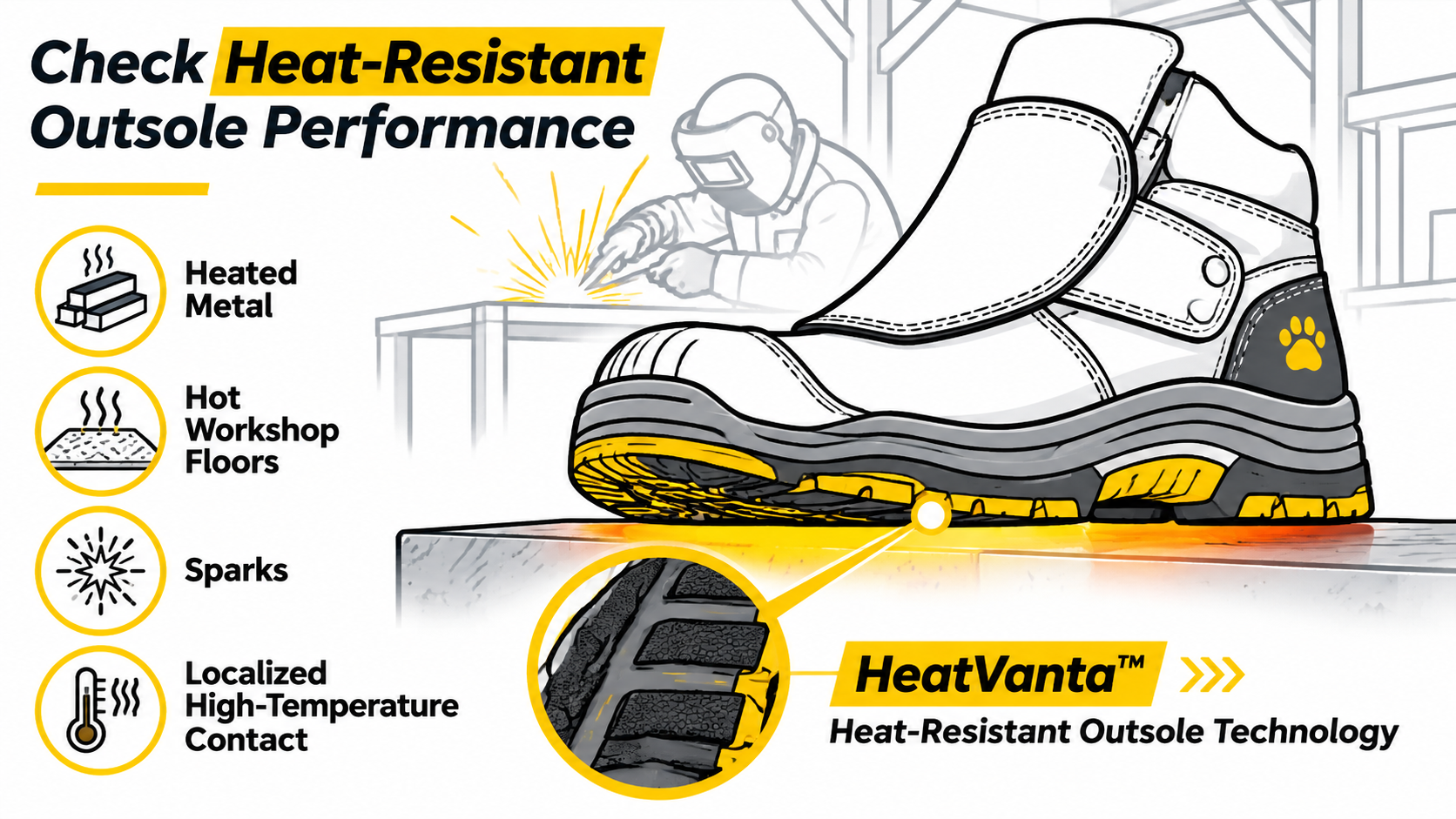
Heated workpieces, hot workshop surfaces and localised contact can place different demands on outsole materials.
HeatVanta™ Heat-Resistant Outsole Technology provides related guidance. Verify the model's outsole compound, performance and supporting evidence. HRO concerns resistance to hot contact under specified test conditions. It does not establish that the entire boot can operate continuously at 300°C, nor does it alone demonstrate heat insulation for the foot. Check outsole heat resistance, any required heat-insulation performance and upper protection separately. Select according to surface conditions and exposure, not a temperature headline.
4. Toe and Puncture Protection Still Matter
Steel sections, tools and fabricated components can fall during welding and handling. Sharp offcuts and workshop debris introduce separate underfoot risks.
Verify certified toe protection and the puncture-resistance properties required by the assessment.
VortiGard™ Toe Protection Technology and FlexBarrier™ Puncture Protection Technology explain these separate protection functions. Check the exact version's specifications.
5. When Do Welders Need Metatarsal Protection?
A toe cap primarily protects the toes. A metatarsal guard extends protection over the upper-foot region, where falling or rolling heavy components may strike outside the toe-cap area. Consider metatarsal boots where fabrication or heavy-workpiece handling creates an identified upper-foot impact risk.
TuffTarsal™ Metatarsal Protection Technology addresses this selection need. M-8387MP is a welding boot configuration with additional metatarsal protection. Check the documented impact performance and coverage; a leather lace cover alone is not proof of metatarsal protection.
6. Consider Closure Design and Emergency Removal
Footwear should remain secure during work while allowing practical removal appropriate to the thermal hazard. Compare lace covers, pull-on formats and other closures for fit, accessibility and locations where hot material could collect. Where quick removal is required, verify the specific design and any applicable tested requirements. Do not label a boot quick-release simply because it has a cover or side fastening. Evaluate adjustment and removal with the intended work clothing and gloves, following manufacturer instructions.
7. Understand General and Heat-Specific Footwear Standards
EN ISO 20345 Safety Footwear covers general safety-footwear requirements. Its marking and classification identify the protective properties claimed for the model. The EN ISO 20349 series addresses additional risks: Part 2 concerns welding and allied processes, while Part 1 concerns foundries. Review EN ISO 20349 Welding & Foundry Protective Footwear for related guidance.
The applicable standard depends on the actual hazard, destination market and project requirements. A welding product name or HRO marking alone does not establish EN ISO 20349 compliance. Certification and protection levels are model-specific. Verify the technical datasheet, certificate and required markings for the exact footwear supplied.
8. Match Welding Boots to the Actual Work
Shortlist by task:
| Welding Environment | Main Hazard | Footwear Direction |
| General Fabrication | Sparks + impact | Welding safety boots |
| Structural Welding | Sparks + falling steel | Heavy-duty welding boots |
| Heavy Metal Fabrication | Impact + metatarsal risk
| Metatarsal welding boots |
| Hot Workshop Floors | Contact heat | Heat-resistant outsole |
| Foundry / Molten Metal | Severe thermal hazards | Specialized foundry footwear |
9. Recommended Safetoe Welding Safety Boots
M-8387 — Professional Welding Safety Boots
Consider M-8387 for its protective leather cover, flame-resistant aramid stitching and heat-resistant outsole configuration. Verify toe, puncture and thermal performance against the specific version's documents.
M-8387MP — Welding with Metatarsal Protection
Consider M-8387MP when welding work also presents an upper-foot impact risk. Verify its metatarsal performance and other required protective properties.
For foundry or severe molten-metal applications, use Foundry Safety Footwear Solutions rather than assuming either welding model is suitable.
Welding Safety Boots Buying Checklist
Identify sparks, spatter and heat exposure.
Check upper and closure design.
Verify heat-resistant outsole requirements.
Confirm certified toe protection.
Assess puncture hazards from metal debris.
Determine whether metatarsal protection is required.
Consider practical footwear removal.
Verify the exact applicable safety standard.
Review model-specific certificates and technical documentation.
FAQ:
Q: What boots should welders wear?
A: Choose boots matching the assessed sparks, spatter, heat and mechanical hazards. Check upper coverage, outsole performance, toe protection, puncture resistance and any required metatarsal protection.
Q: Are regular steel toe boots suitable for welding?
A: Not necessarily. A steel toe addresses toe impact and compression; it does not establish suitable upper construction, spatter protection or heat performance.
Q: Do welding boots need heat-resistant soles?
A: Where hot-contact exposure requires them, yes. Assess the actual surfaces and duration, and distinguish outsole hot-contact resistance from heat insulation and whole-boot protection.
Q: Do welders need metatarsal protection?
A: Not always. Consider it when falling or rolling heavy metal may strike the upper foot. Toe caps and metatarsal guards protect different areas.
Q: What is the difference between welding boots and foundry boots?
A: Welding footwear addresses sparks, spatter, heat and mechanical hazards. Foundry applications can involve different molten-metal exposures requiring specialised protection. Check the appropriate standard part and model documentation.
Author: Jay Yuan, Technical Marketing Director, Safetoe
Source: Safetoe Academy




 English


