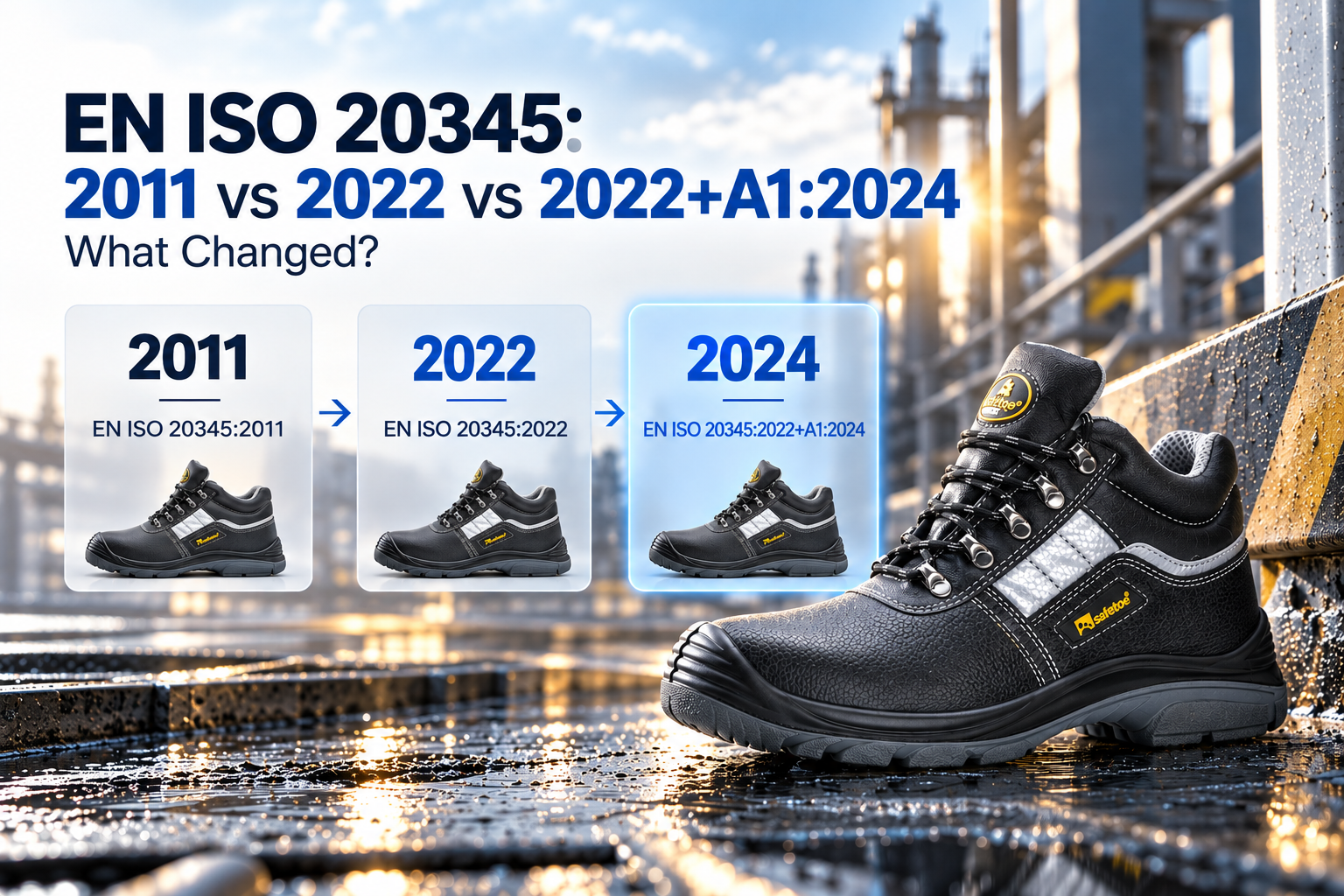
Safety footwear markings have changed significantly since EN ISO 20345:2011. Today, buyers may see S3, S3L, S3S, S7S, PL, PS and SR on product documents—while older purchase orders and tender specifications still reference the 2011 edition.
For PPE importers, distributors and project buyers, the challenge is not simply choosing the newest standard. It is identifying which protection requirements apply and whether the offered product's certification documents are acceptable for the intended market or tender.
1. How EN ISO 20345 Evolved: 2011 → 2022 → A1:2024
EN ISO 20345:2011 was the established European safety-footwear standard for many years. Its familiar classifications included S1P and S3, along with slip markings such as SRA, SRB and SRC.
ISO 20345:2021 revised the international standard, which was adopted in Europe as EN ISO 20345:2022. The revision expanded the classification and marking framework, including clearer distinctions between penetration-resistant insert types and whole-footwear water resistance.
A1:2024 is an amendment to the 2022 European edition. The combined edition is commonly cited as EN ISO 20345:2022+A1:2024 (or the base standard together with EN ISO 20345:2022/A1:2024). It is not a standalone “EN ISO 20345:2024” edition.
For up-to-date EU conformity decisions, buyers should also check the current published EU harmonised-standard references and applicable PPE legislation rather than relying on a standard title alone.
2. What Changed from 2011 to 2022?
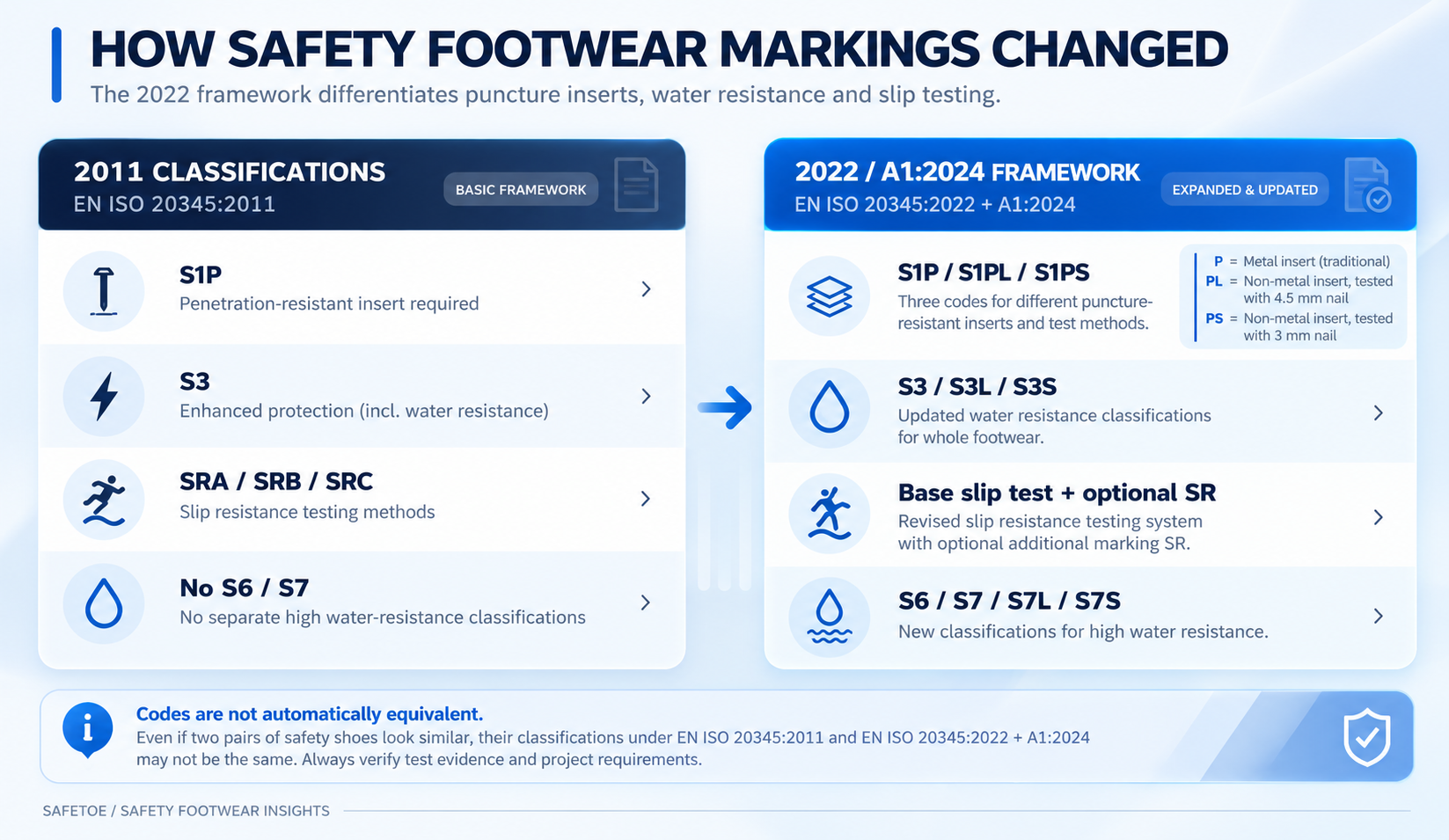
Puncture resistance: P, PL and PS
Under the 2011 framework, puncture protection was commonly communicated with P. The 2022 framework makes the type of insert and corresponding test more visible:
P: metallic penetration-resistant insert, tested using a 4.5 mm nail.
PL: non-metallic insert, tested using a 4.5 mm nail.
PS: non-metallic insert, tested using a 3.0 mm nail.
This distinction matters when comparing S1P vs S1PS or S3 vs S3S. The code alone should never replace a review of the exact protection requirement and supporting test or certification documentation.
New water-resistance classifications: S6 and S7
The updated classification system includes S6, S7, S7L and S7S, giving buyers more explicit classification options for whole-footwear water resistance. WPA refers to water penetration and absorption of the upper; WR refers to water resistance of the whole footwear. These are different properties.
Slip-resistance markings changed
Older product literature frequently shows SRA, SRB or SRC. In the 2022 system, a baseline slip-resistance test is built into general requirements for most footwear, with SR marking used for an additional specified test. Therefore SRC and SR are not interchangeable labels; the test conditions and marking approach differ.
Additional marking updates
The 2022 system also includes LG for ladder grip, SC for scuff-cap abrasion, and WPA in place of earlier WRU terminology. Buyers should interpret each marking in the context of the relevant edition and actual test documentation.
3. Quick Comparison: EN ISO 20345:2011 vs 2022
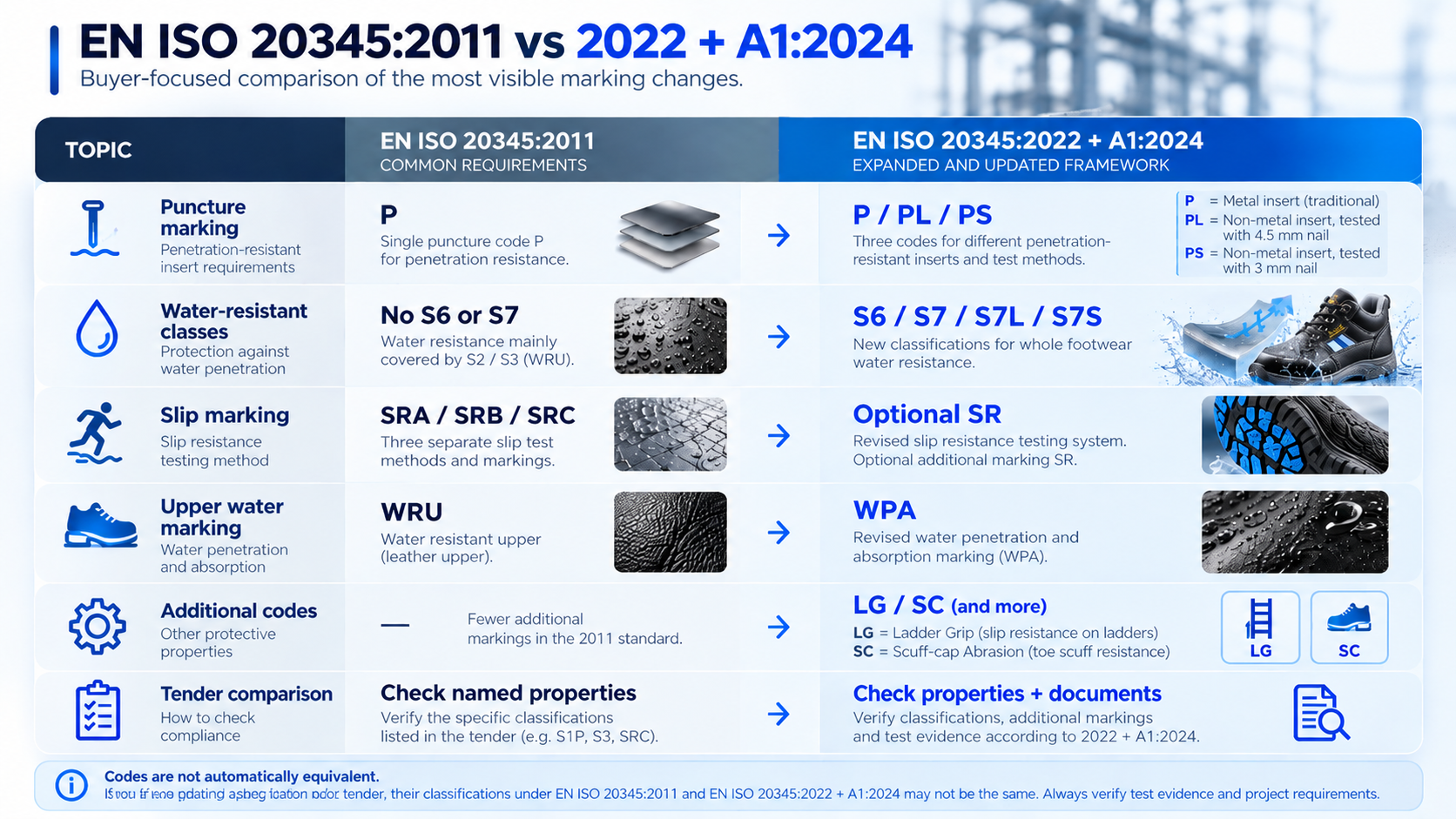
| Topic | 2011 framework | 2022 framework (with A1:2024 amendment) |
| Common categories | S1, S1P, S2, S3 | Expanded categories including S1PL/S1PS and S3L/S3S |
| Puncture resistance | P | P / PL / PS |
| Whole-footwear water-resistance categories | No S6/S7 | S6 / S7 / S7L / S7S |
| Slip marking | SRA / SRB / SRC | Revised baseline test and optional SR |
| Upper water marking | WRU | WPA |
| Additional markings | Earlier set of codes | Includes LG and SC |
| Procurement check | Markings and test documents | Exact classification, test evidence and tender acceptance |
4. Is S3 Under the 2011 Standard the Same as S3S Today?
No. Old S3 and new S3S should not be treated as identical classifications.
Under the revised system, buyers may encounter S3, S3L or S3S, depending on the specified puncture-resistant insert and associated test. In the new classification, S3S uses the PS type of non-metallic puncture protection, while S3L uses PL. The 2011-era S3 marking does not provide the same differentiation.
Similarly, S1P does not automatically equal S1PS. A procurement comparison should establish the hazard, applicable marking, material/test configuration and supporting evidence rather than merely translating old code names into new ones.
5. What Does A1:2024 Mean for Buyers?
A1:2024 amends the 2022 standard; it does not introduce an independent 2024 classification system. It includes technical changes and clarifications relating to normative references and footwear requirements, including aspects of toe-cap evaluation and upper-material testing. The precise applicability depends on the product and its conformity assessment.
Practical action: Request certification and technical documentation that identifies the relevant edition and amendment, and verify that it covers the exact model offered. Do not infer the detail of A1 changes from the marketing phrase “2024 standard.”
6. Why Does EN ISO 20345:2011 Still Appear in International Tenders?
European standards evolve, but procurement documents are not always updated at the same pace. Importers serving Middle Eastern and African markets may still encounter specifications written around the 2011 edition. Common reasons include long-lived tender templates, previously approved product lists, multi-year projects and different local acceptance practices.
This does not mean that every buyer in these regions uses an older standard. Tender wording and target-market rules should be checked individually.
7. Can a 2022+A1:2024 Product Be Offered Against a 2011 Tender?
Possibly—but never assume automatic acceptance. A newer edition does not automatically override an older edition expressly stated in a contract or tender.
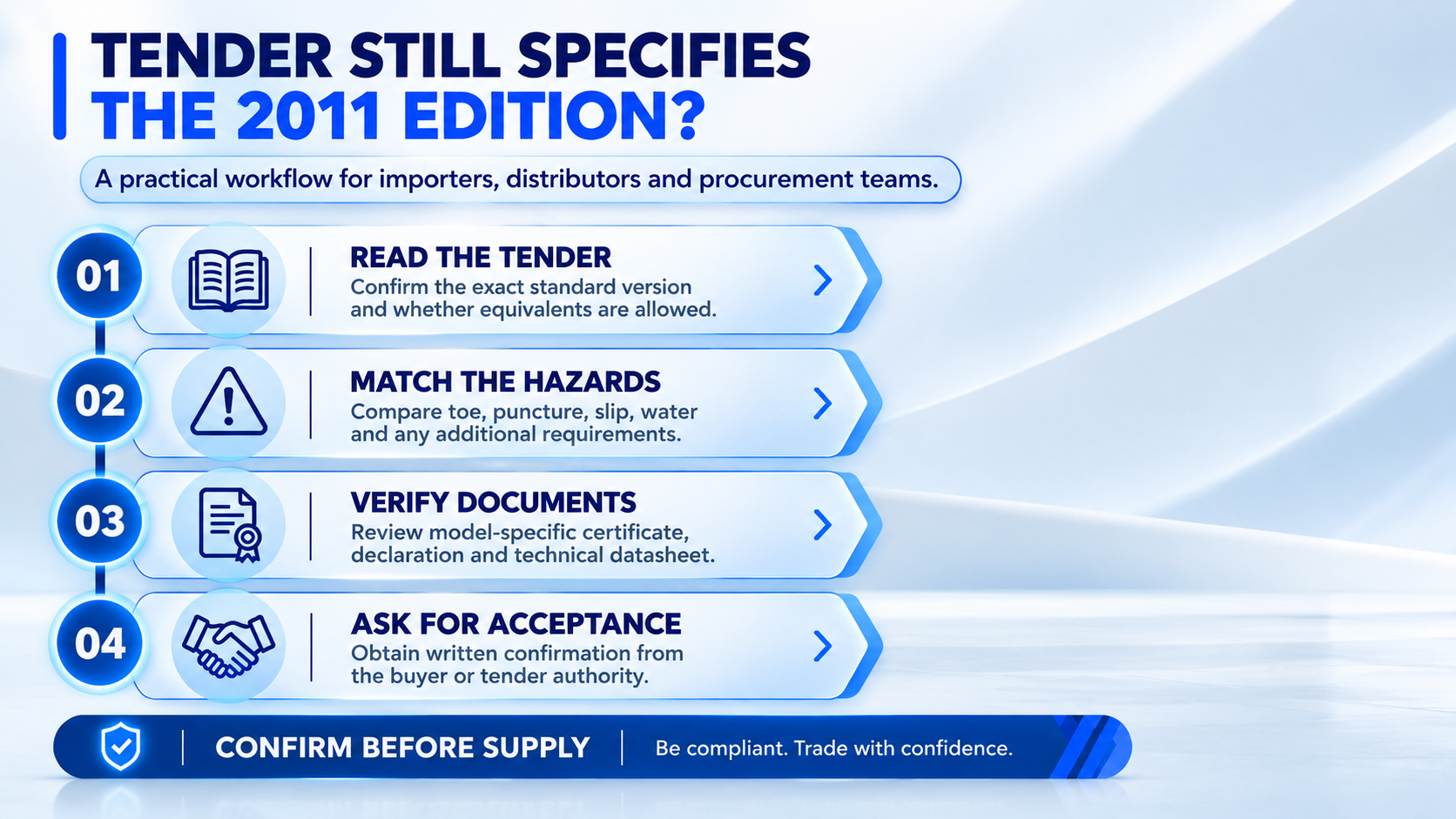
1) Read the exact wording. Does the tender say EN ISO 20345:2011 only, or “EN ISO 20345:2011 or equivalent”?
2) Identify required performance. Check the specified class and features, such as puncture protection, slip resistance, cold insulation (CI) or hot-contact resistance (HRO).
3) Compare the exact product. Review the latest model-specific certificate, EU Declaration of Conformity (where applicable) and technical datasheet.
4) Request written acceptance. Where the tender wording is unclear, obtain the buyer's or tender authority's decision before supply.
8. Can a Certificate Referencing the 2011 Edition Still Be Used?
There is no reliable universal yes-or-no answer based only on the year printed on a certificate. Withdrawal of a standard, validity of a certificate and acceptance by a particular tender are different questions.
For European CE-related supply, check the certificate's actual status, applicable conformity-assessment obligations, the current published harmonised-standard references and the relevant PPE requirements. For non-European supply, verify local regulations as well as the purchaser's acceptance criteria. Consult the issuing notified body or qualified compliance team if the certificate's status is uncertain.
9. Which Edition Should Buyers Specify for New Projects?
For new European procurement, specify applicable current legal and technical requirements and verify the current harmonised-standard framework. The current British consolidated standard is published as BS EN ISO 20345:2022+A1:2024.
For other markets, avoid copying either a 2011 or 2022 reference without checking local law, tender conditions, the end user's risk assessment and accepted evidence. A technically suitable shoe is not automatically a contractually accepted shoe.
10. A Practical Checklist for Importers and PPE Buyers
Before confirming an order, verify:
Applicable standard edition and amendment
Exact safety category (for example S3, S3L, S3S or S7S)
Additional markings required for the work hazards
Exact model identification and product marking
Certificate and its current status
Declaration of Conformity, where applicable
Technical datasheet and test evidence
Local regulatory and tender requirements
Written buyer acceptance where equivalence is in question
The takeaway: Do not compare safety footwear by standard year alone. Compare actual protection requirements, model-specific evidence and acceptance criteria for the target market.
Frequently Asked Questions
1. What is the latest version of EN ISO 20345?
The consolidated European framework is EN ISO 20345:2022 with Amendment A1:2024. Check the latest national publication and EU harmonised-standard references where relevant.
2. Is EN ISO 20345:2011 still the current European standard?
No. It has been superseded in the European standards system, although older tender documents may continue to reference it.
3. Are S3 (2011) and S3S (2022) equivalent?
Not automatically. They refer to different classification frameworks; inspect puncture resistance, test evidence and any other specified protection.
4. Can I supply a newer-standard product against an older tender?
Only when the tender requirements, relevant market rules and buyer or tender authority permit it. Seek written confirmation if equivalence is uncertain.
5. Is EN ISO 20345:2024 a separate standard?
No. The 2024 change is Amendment A1:2024 to EN ISO 20345:2022.
Need Help Comparing Safety Footwear for Your Market?
Safetoe works with international PPE buyers who need to compare safety footwear markings and procurement specifications. Share your intended market, required classification and tender wording with our team so the available model-specific documentation can be reviewed before selection.
Explore Safety Footwear | Contact Safetoe

 English


