Forestry and logging workers face chainsaw contact, falling timber, sharp branches, mud and uneven ground. For professional chainsaw work, footwear selection therefore requires more than a protective toe and rugged outsole. Buyers should evaluate certified chainsaw-cut resistance, the appropriate EN ISO 17249 class, impact and puncture protection, outdoor traction and the actual work environment. A regular safety boot is not automatically a chainsaw protective boot.
Quick Answer: Chainsaw operators should use footwear certified to EN ISO 17249 for the required protection class. Toe protection, puncture resistance, waterproofing and traction remain important, but they do not replace chainsaw-specific certification.
Related resource: Forestry & Logging Safety Footwear Solutions
What Are the Main Foot Hazards in Forestry & Logging?
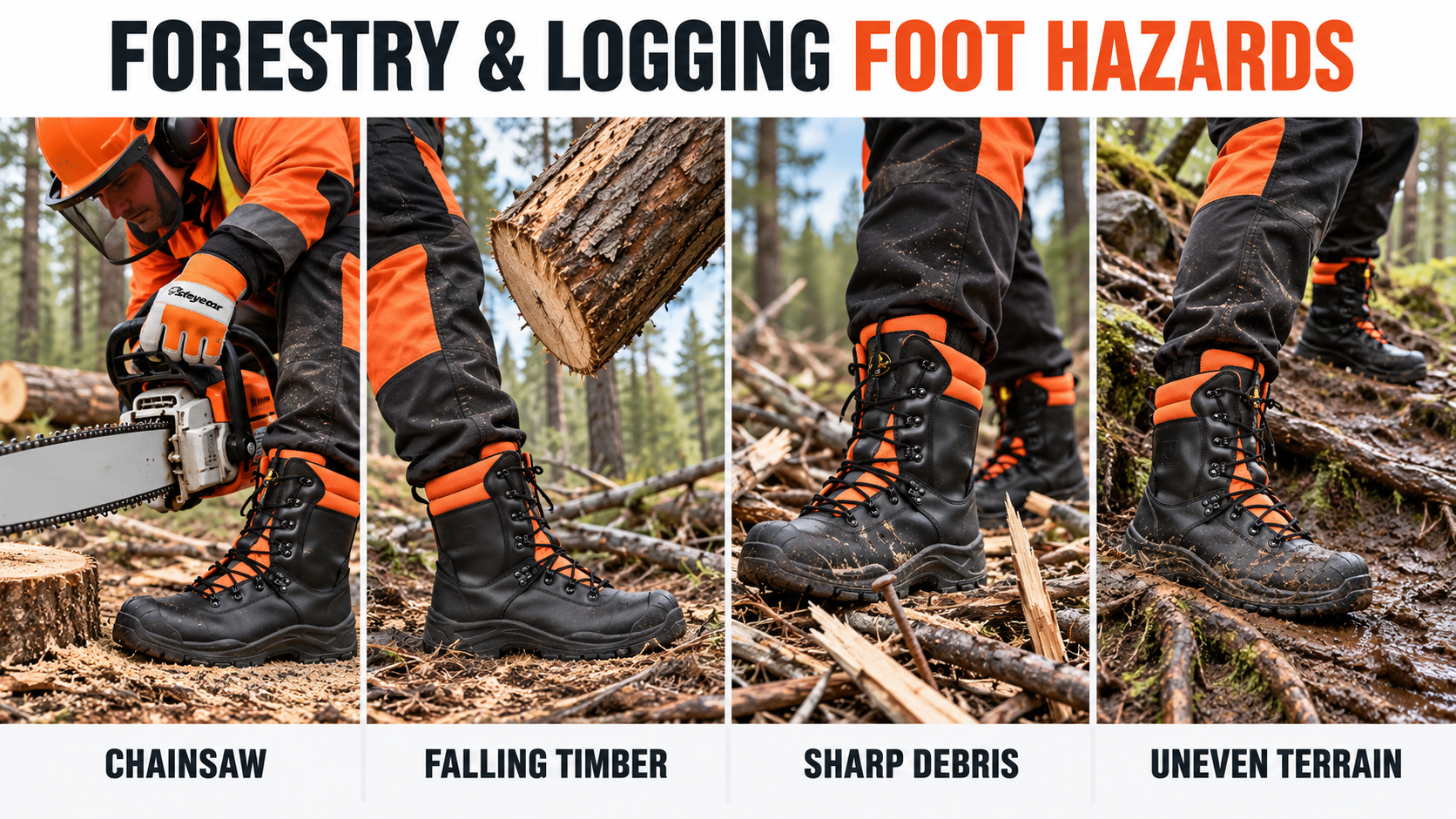
The risk profile changes by task, but four hazards appear repeatedly in professional forestry work:
· Chainsaw contact - accidental contact with a moving chain can create severe cutting injuries.
· Falling timber and branches - logs, limbs and tools can create impact and compression hazards.
· Sharp branches and forest debris - broken timber, nails and pointed debris may create puncture risks.
· Wet, muddy and uneven terrain - roots, slopes, loose soil and wet vegetation can reduce stability.
Because these risks can occur together, footwear selection should start with the actual task rather than with a generic label such as “forestry boot.”
Why Ordinary Safety Boots Are Not Enough for Chainsaw Work
An ordinary safety boot may provide toe protection, puncture resistance, slip resistance and other model-specific features. Those properties matter in forestry, but they do not automatically provide chainsaw-cut protection. A protective toe cap is designed for impact and compression hazards; it is not a substitute for certified resistance to a moving chainsaw chain. Likewise, full-grain leather, a high-cut upper or an S3/S7 classification should not be interpreted as EN ISO 17249 protection. Professional chainsaw operators should verify that the exact footwear model has been tested and certified for chainsaw cutting.
What Is EN ISO 17249?
EN ISO 17249 is the safety-footwear standard for resistance to chain-saw cutting. It adds chainsaw-specific requirements to the protection expected from safety footwear and classifies products according to defined chain speeds used during standardized testing. Certification must be checked on the exact model: the product label, technical datasheet and certificate should identify the correct standard and protection class. Chainsaw-resistant footwear is a last line of defense and does not replace training, safe cutting technique or other forestry PPE.
Learn more: EN ISO 17249 Chainsaw Protective Footwear
Chainsaw Protection Classes: What Do They Mean?
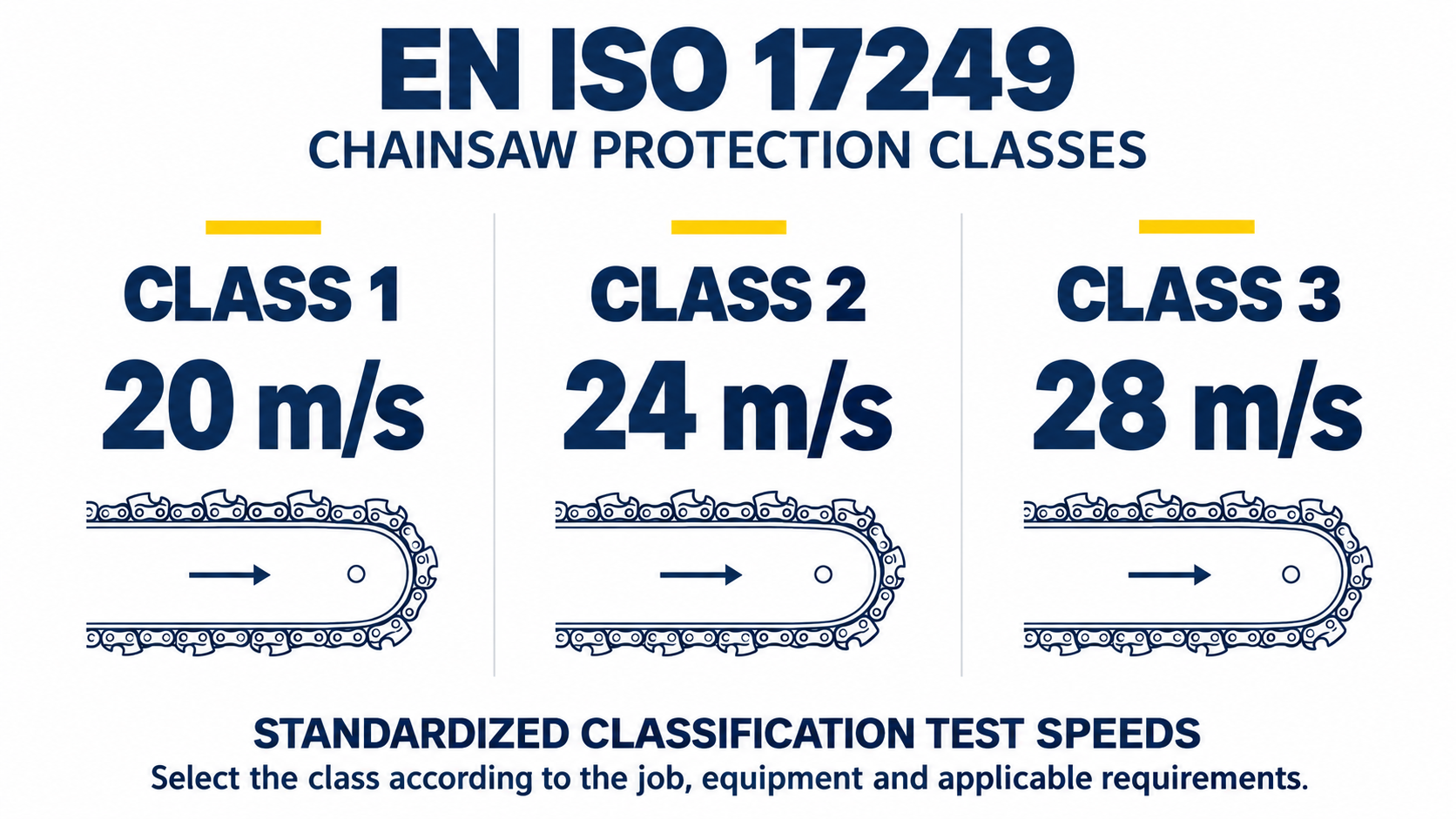
EN ISO 17249 classes indicate the chain speed used for standardized classification testing. The class should be selected according to the equipment, job, employer requirements and applicable safety rules.
Protection Class | Chain Speed Used for Classification |
Class 1 | 20 m/s |
Class 2 | 24 m/s |
Class 3 | 28 m/s |
The class refers to the chain speed used under standardized test conditions. It is not a guarantee that injury cannot occur at or below that speed. A higher class is also not automatically the best choice for every worker because weight, flexibility, chainsaw application and job requirements still matter.
How Does Chainsaw Cut Protection Work?
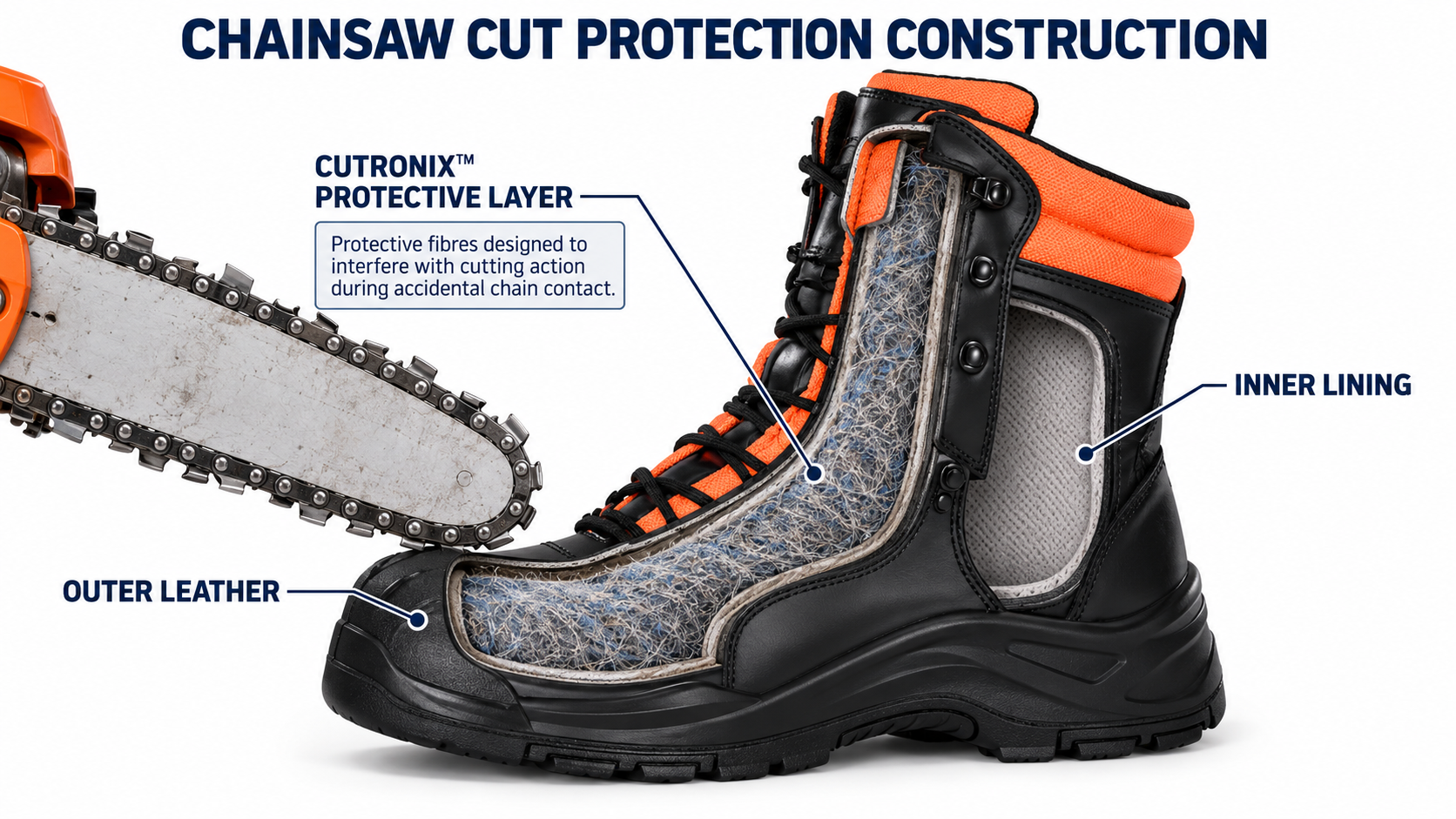
Safetoe's Cutronix™ system uses high-strength cut-resistant fibers positioned in critical areas of the boot. During accidental chainsaw contact, the fibers are designed to be pulled into the saw's drive mechanism, helping interfere with and slow the cutting action.
This should be described as chainsaw protection or chainsaw cut resistance—not “chainsaw-proof.”
Technology: Cutronix™ Chainsaw Protection Technology
Toe and Puncture Protection Still Matter
Forestry work also includes impact and puncture hazards from logs, branches, tools, nails and sharp debris. Buyers should check the required toe and puncture protection in addition to EN ISO 17249. On applicable Safetoe models, VortiGard™ addresses toe impact and FlexBarrier™ provides puncture-resistant textile midsole protection. These features complement chainsaw protection; they do not replace it.
VortiGard™ Toe Protection | FlexBarrier™ Puncture Protection
Traction Matters on Mud, Roots and Uneven Terrain
Mud, wet leaves, roots, slopes and loose soil challenge traction differently from flat industrial floors. Buyers should consider outsole geometry, lug depth, compound, debris release and stability. Slip-resistance results are useful, but they do not fully describe performance on every forest surface. On applicable Safetoe models, PlumaShield™ is used as the outsole platform; evaluate the exact model and terrain.
Technology: PlumaShield™ Slip Resistant Outsole
Waterproofing and Outdoor Conditions
Rain, wet vegetation, mud and snow can make waterproof construction important in forestry. Waterproofing is separate from chainsaw protection, so do not assume every forestry or chainsaw boot includes a membrane. Verify the exact model and, where applicable, its Sanvlar-Tex™ or other stated waterproof system.
Technology: Sanvlar-Tex™ Waterproof Technology
Match Forestry Footwear to the Actual Job
The same forestry site may require different footwear depending on the task. Use the risk profile as the starting point:
Forestry Work | Main Risk | Footwear Priority |
Chainsaw operation | Chainsaw contact | EN ISO 17249 protection |
Tree felling | Chainsaw + falling timber | Chainsaw + impact protection |
Logging | Timber + terrain | Impact + outdoor traction |
Delimbing | Chainsaw + branches | Chainsaw + puncture protection |
Arborist ground work | Terrain + cutting tools | Traction + task-specific protection |
Timber handling | Falling / rolling logs | Toe + metatarsal where required |
Winter forestry | Cold + wet + terrain | Insulation + waterproofing + traction |
Actual protection requirements should follow the workplace risk assessment, chainsaw task, local rules and the exact certification of the footwear selected.
Recommended Safetoe Forestry & Chainsaw Safety Boots
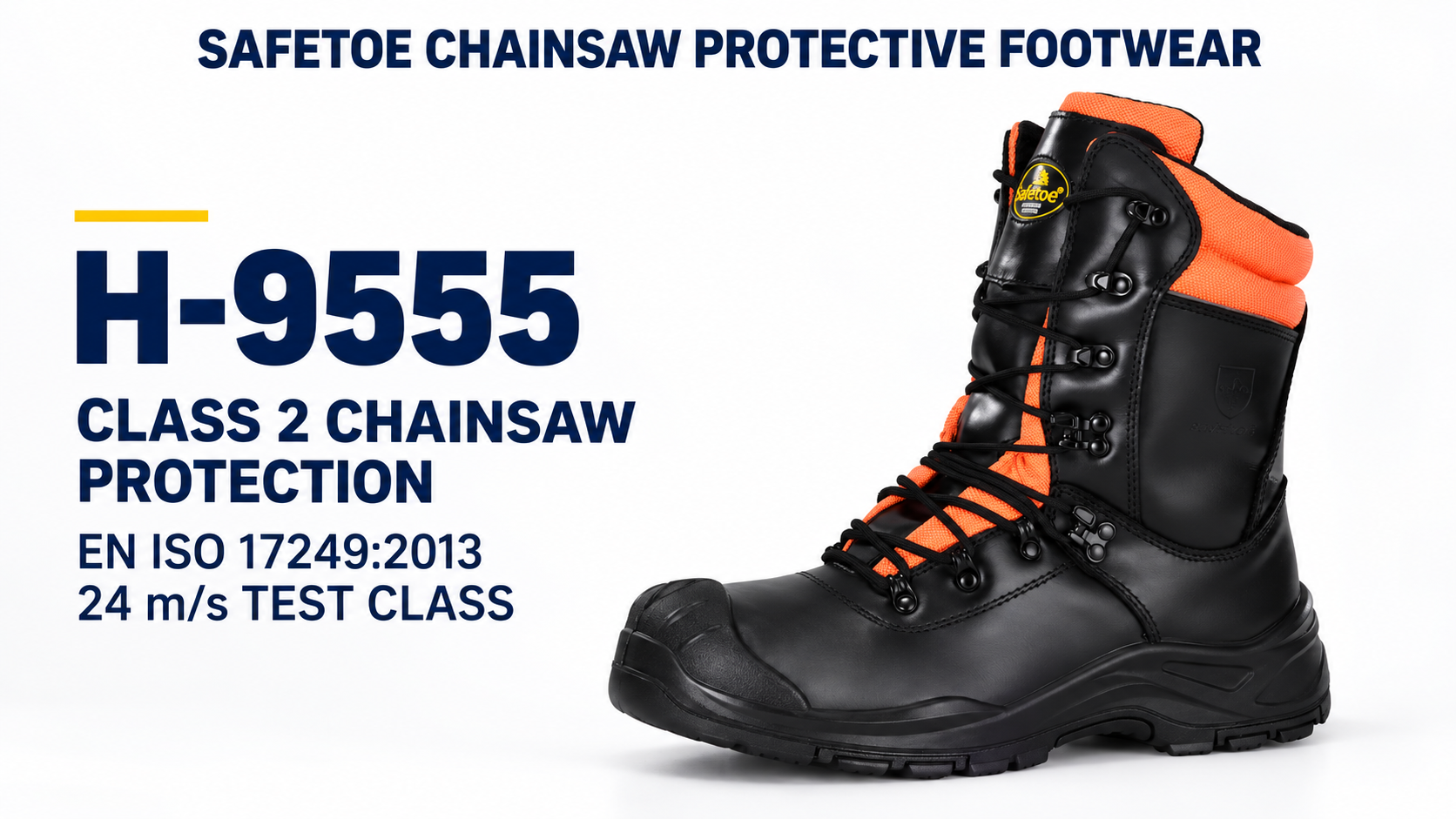
H-9555 is the primary certified chainsaw-protection example in the current Safetoe range. Its published specification lists EN ISO 20345:2022 S3 SR and EN ISO 17249:2013 Class 2, plus Cutronix™ protection at the 24 m/s Class 2 test level, a VortiGard™ steel toe, FlexBarrier™ puncture-resistant textile midsole and PlumaShield™ PU/nitrile outsole.
View H-9555 Chainsaw Safety Boots
Chainsaw Safety Boots Buying Checklist
· Identify whether the worker operates a chainsaw.
· Verify EN ISO 17249 certification on the exact model.
· Select the required chainsaw protection class.
· Confirm toe protection for falling or rolling materials.
· Assess puncture hazards from sharp debris.
· Evaluate mud, roots, slopes and outdoor traction.
· Determine whether waterproofing is required.
· Consider cold-weather and seasonal conditions.
· Check fit, boot height and mobility.
· Review the certificate, technical datasheet and product marking before purchase.
FAQ
What boots should chainsaw operators wear?
Chainsaw operators should use certified chainsaw protective footwear selected through the workplace risk assessment and applicable requirements. The exact EN ISO 17249 class should match the job and equipment requirements.
Can ordinary safety boots be used for chainsaw work?
Ordinary safety boots do not automatically provide chainsaw-cut protection. Toe protection, puncture resistance or an S3/S7 marking should not be treated as a substitute for EN ISO 17249 certification.
What is EN ISO 17249?
EN ISO 17249 is the safety-footwear standard for resistance to chain-saw cutting. It uses defined test requirements and protection classes for chainsaw protective footwear.
What is the difference between Class 1, Class 2 and Class 3 chainsaw boots?
The classes correspond to standardized chain speeds used for classification testing: Class 1 at 20 m/s, Class 2 at 24 m/s and Class 3 at 28 m/s. They should not be read as a guarantee that injury cannot occur.
Are chainsaw safety boots waterproof?
Not necessarily. Chainsaw-cut protection and waterproofing are separate properties. Check the exact model for waterproof construction or a stated waterproof membrane system.
Conclusion
Choosing chainsaw safety boots for forestry and logging starts with the chainsaw hazard, not with a generic “outdoor boot” label. Verify EN ISO 17249, select the appropriate protection class and then assess impact, puncture, terrain, moisture and fit. Certified chainsaw protection is an important last line of defense, but it must be combined with safe operating procedures, training and the rest of the required forestry PPE.

 English


