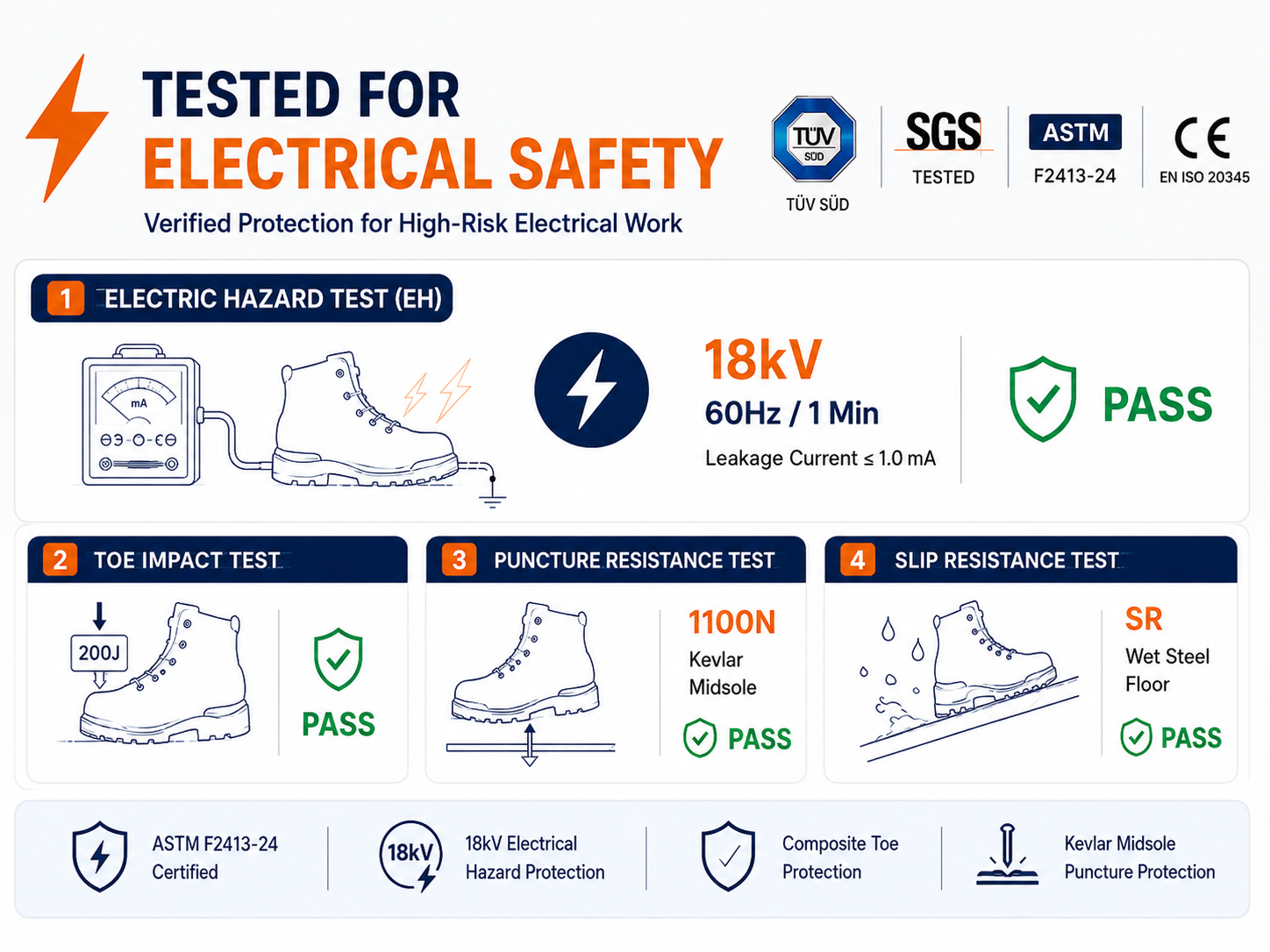
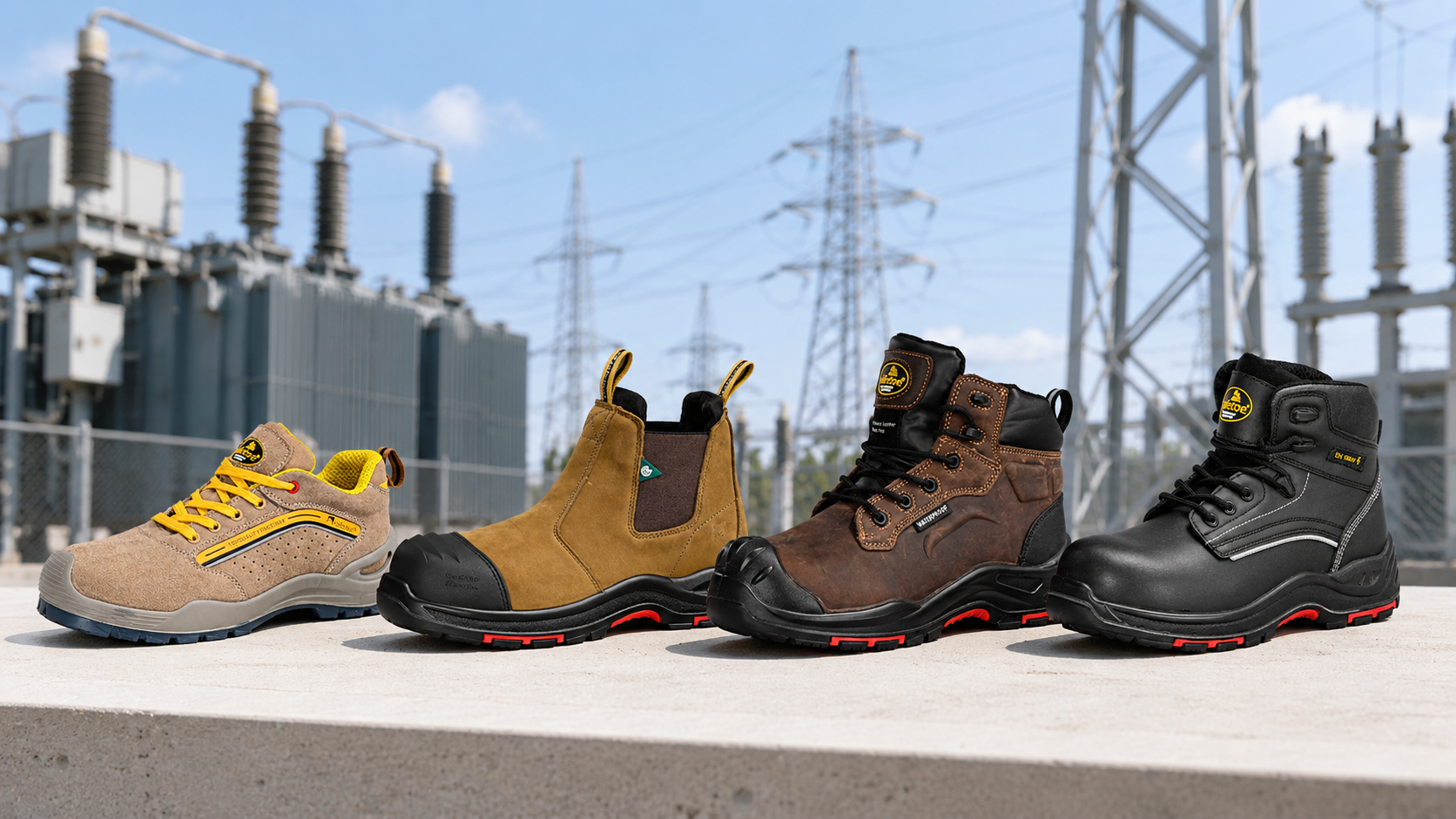
Electrical workers may operate around energised equipment, substations, industrial machinery and outdoor utility systems. EH footwear can provide secondary protection against accidental electrical contact, but it must be selected according to the exact job, certification and working conditions.
Explore SAFETOE’s Electrical Safety Boots for utility, power-distribution and industrial maintenance applications.
Start with the Electrical Work Environment
Utility and power distribution: Workers may need a durable mid-cut boot with EH protection, puncture resistance and stable traction.
Substations and industrial maintenance: Oil, dust, cables and smooth floors make slip resistance and underfoot protection important.
Outdoor electrical work: Rain, mud and uneven terrain may require waterproof construction, but EH performance should not be relied upon when footwear is wet.
Warm indoor environments: A breathable, lightweight EH shoe may be more practical for technicians who walk and stand for long periods.
OSHA requires electrical footwear to be used as part of a broader hazard-control system after other necessary protective measures have been taken.
What Makes a Good EH Safety Boot?
Buyers should evaluate the complete footwear rather than looking only for a non-metallic toe.
Certified EH marking: Confirm the standard edition, model and electrical-hazard code.
Composite toe protection:VortiGard™ provides lightweight impact and compression protection.
Puncture-resistant midsole: Protects against wires, nails and sharp maintenance debris.
Slip resistance:PlumaShield™ supports traction on smooth, oily or damp surfaces.
Water protection: Waterproofing can support outdoor comfort, but wet footwear may have reduced electrical resistance.
Long-shift cushioning:Zorbtion™ helps reduce discomfort during prolonged standing and walking.
Composite components can support a metal-free design, but composite toes alone do not prove EH performance. The complete footwear must have appropriate testing and marking under standards such as ASTM F2413.
Recommended EH Safety Boots
M-8356RB: ASTM F2413-24 EH-rated boot for utilities, substations and power distribution.
M-8552EH Pro: metal-free industrial EH boot for manufacturing, mining and heavy maintenance.
M-8025NB EH: slip-on Chelsea boot for maintenance, workshops and Canadian industrial applications.
L-7296EH: lightweight, breathable EH shoe for warm climates and daily electrical work.
The published product pages list ASTM F2413 EH protection for all four models, with different constructions for heavy-duty, industrial, slip-on and breathable applications.
EH Testing and Certification
Important requirements may include:
ASTM F2413-24: uses the EH marking for electric-shock-resistant safety footwear.
CSA Z195:14 (R2025): uses the white label with an orange omega symbol for electric-shock-resistant footwear.
AS 2210.3:2019: covers general-purpose safety footwear in Australia but should not be treated as a direct substitute for ASTM EH testing.
CSA guidance warns that electric-shock resistance deteriorates through wear and wet conditions.
Frequently Asked Questions
Can EH safety boots be used for direct contact with live conductors? No. EH footwear provides secondary protection and cannot replace de-energisation, insulated gloves, voltage-rated tools or approved electrical work procedures.
Are composite-toe boots automatically EH rated? No. EH protection must be confirmed through the footwear marking and supporting test documentation.

 English