Deep, aggressive outsole patterns can provide useful traction in many construction environments, particularly on mud, loose soil and uneven terrain.
Asphalt paving, however, presents a different set of surface conditions.
Paving crews work around loose stone, asphalt aggregate, road debris and newly laid surfaces. These materials can interact differently with deep outsole channels, making tread geometry an important consideration when selecting asphalt paving safety boots.
For this reason, paving footwear should not be selected according to tread depth alone.
Deeper tread does not automatically mean better footwear for every work environment.
For asphalt paving, outsole geometry should be considered alongside heat resistance, toe protection, puncture resistance and the actual conditions of the worksite.
1. Why Deep Treads Can Be a Problem in Asphalt Paving
Deep lug patterns are widely used in industrial and construction footwear for a reason.
They can provide valuable traction on:
But paving work creates a different surface interaction.
Asphalt paving crews frequently work around:
When outsole channels are deep and open, loose material may enter the tread pattern during repeated walking and standing.
The issue is not that deep tread is inherently poor.
The issue is that:
Different worksites require different tread designs.
A sole designed primarily for muddy ground may not be optimized for a paving surface where loose aggregate and tread buildup are more relevant concerns.
The selection question should therefore change from:
“Which boot has the deepest tread?”
to:
“Which outsole geometry is best suited to the surface conditions of this job?”
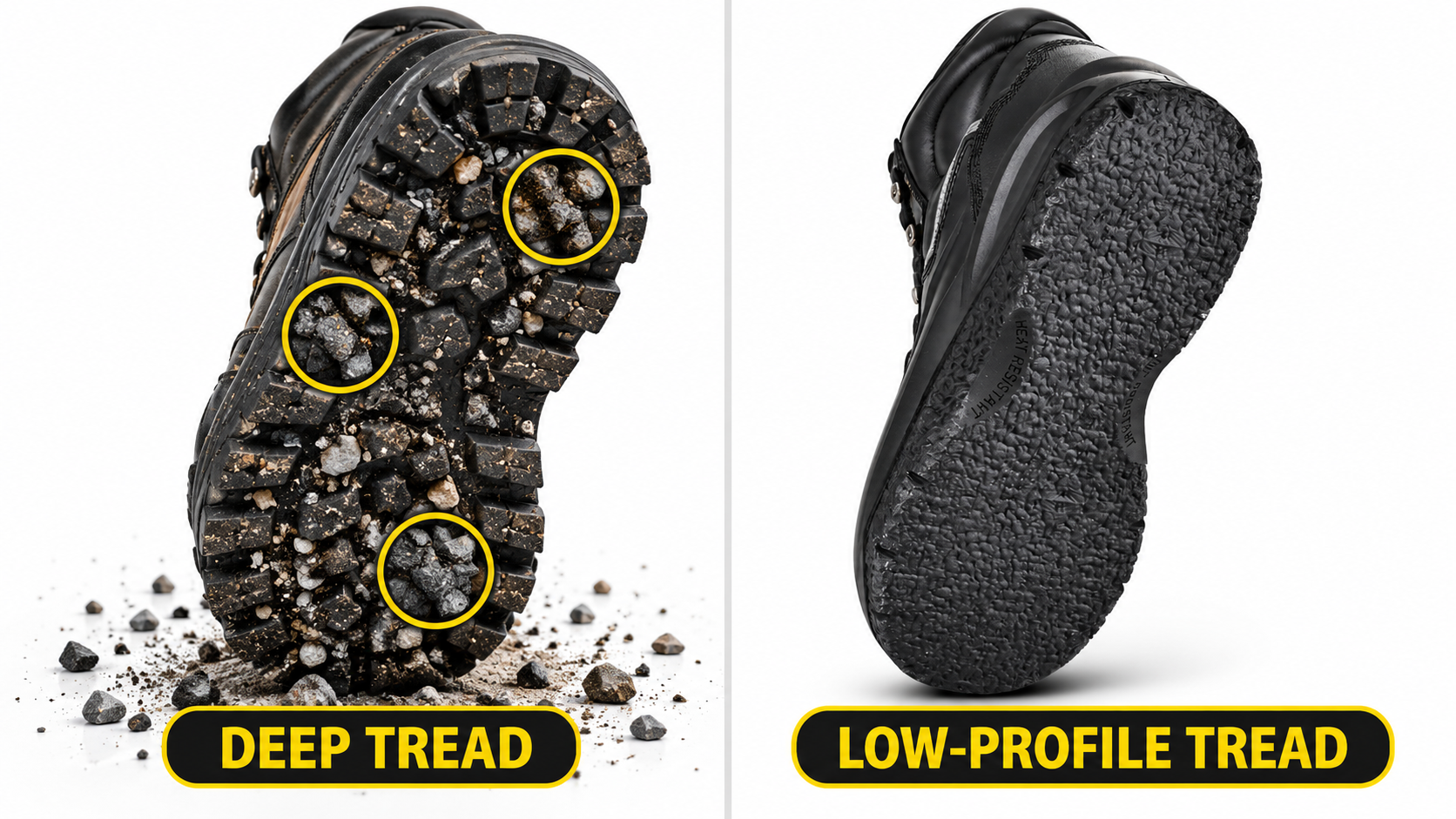
2. What Is a Paving-Specific Low-Profile Tread?
A paving-specific low-profile tread is designed around the surface conditions encountered during asphalt work rather than simply maximizing tread depth.
The design principle typically focuses on:
Shallower tread geometry
Fewer deep channels
Reduced space for loose aggregate to enter the outsole
A broad surface contact area suited to paving applications
Outsole geometry developed around roadwork conditions
This does not mean that a paving boot must have a completely smooth sole.
The goal is instead to reduce unnecessary deep tread cavities while maintaining the outsole performance required for the application.
Safetoe's Asphalt Paving Safety Boots solution describes this approach as a Paving-Specific Flat Tread Design designed to help reduce loose aggregate trapping.
That distinction is important.
A paving-specific outsole is not designed to be “flatter” simply for appearance. Its geometry is developed around the interaction between the boot and the paving surface.
For PPE buyers and contractors, this means outsole design should be evaluated as a functional feature rather than a visual styling choice.
3. Tread Design and Heat Resistance Work Together
Tread geometry is only one part of an asphalt paving outsole.
Paving crews may also work on surfaces exposed to elevated temperatures, so outsole material and tread geometry solve different problems.
Tread Geometry
Primarily affects:
Heat-Resistant Outsole Material
Primarily addresses:
Hot asphalt
Elevated surface temperatures
Outsole stability under heat exposure
Durability in demanding paving environments
This leads to an important purchasing principle:
A paving outsole should not be evaluated by tread pattern alone.
Heat resistance and tread geometry address different challenges and should be considered together.
Safetoe's HeatVanta™ Heat Resistant Outsole Technology is designed for safety footwear used around hot surfaces and elevated industrial temperatures.
For asphalt paving, this heat-resistant outsole performance complements the paving-specific tread design rather than replacing it.
4. M-8565PV: Outsole Designed for Asphalt Paving
The Safetoe M-8565PV Asphalt Paving Safety Boots are designed specifically for road construction and paving applications.
For this article, the most important feature is not simply the overall safety specification.
It is the outsole design.
Paving-Specific Low-Profile Tread
The outsole is designed around asphalt paving surfaces rather than relying on a conventional aggressive construction tread.
Reduced Aggregate Trapping
The lower-profile tread geometry helps reduce the amount of loose aggregate that can become trapped in deep outsole channels.
Heat-Resistant Outsole
M-8565PV also uses an HRO-rated PU/nitrile rubber outsole designed for demanding hot-surface environments.
Certified Safety Protection
The boot additionally incorporates composite toe protection and puncture resistance for common road-construction hazards.
Its current specification includes:
These additional features are important, but in the context of asphalt paving, tread geometry remains one of the key elements that distinguishes the boot from general-purpose construction footwear.
5. Choose Tread Design for the Work Environment
There is no single outsole pattern that is ideal for every industrial workplace.
A suitable tread design depends on the surface conditions workers actually encounter.
| Work Environment | Typical Outsole Consideration |
| Mud / Loose Soil | Deeper tread for terrain traction |
| General Construction | Multi-purpose industrial tread |
| Asphalt Paving | Low-profile tread designed around paving surfaces |
This is why asphalt paving footwear should not be selected simply by comparing how “aggressive” the outsole looks.
For road construction crews, buyers should consider:
The correct outsole is the one designed for the actual working environment.
Frequently Asked Questions
1. Why do asphalt paving boots have flatter tread patterns?
Low-profile or paving-specific tread patterns can help reduce the amount of loose stone and asphalt aggregate that becomes trapped in deep tread channels during paving work.
The design is intended around the surface conditions of asphalt paving rather than simply maximizing tread depth.
2. Is deeper tread always better for safety boots?
No.
Tread design should match the working environment.
Deep tread can be useful for mud, loose soil and uneven outdoor terrain, while asphalt paving may benefit from a lower-profile tread designed around paving surfaces and loose aggregate.
A deeper outsole pattern is therefore not automatically better for every workplace.
3. Is tread design the only important feature in asphalt paving boots?
No.
Asphalt paving safety footwear should also be selected according to heat exposure, toe-impact hazards, puncture risks, slip performance and applicable safety standards.
Tread geometry and heat-resistant outsole performance solve different problems and should be evaluated together.
Conclusion
Asphalt paving creates a different outsole challenge from many general construction environments.
Deep tread can be highly suitable for mud and uneven terrain, but paving crews may encounter loose aggregate that can enter deeper outsole channels.
For this reason, paving-specific footwear should be evaluated according to outsole geometry as well as outsole material.
A low-profile paving tread can help reduce aggregate trapping, while a heat-resistant outsole addresses exposure to elevated paving-surface temperatures.
The key selection principle is simple:
Choose the tread design for the actual work environment—not according to tread depth alone.
See footwear technologies and protection features developed for hot surfaces, loose aggregate and demanding road construction environments.
Explore Safetoe's paving-specific safety boot with heat-resistant outsole, low-profile tread, composite toe protection and puncture resistance.

 English


