Tactical safety boots combine military-inspired design with workplace protection, but appearance alone does not make footwear suitable for industrial use. For security, outdoor and maintenance teams, buyers should match the boot to the actual hazards, required certification, terrain, closure system and shift demands. Tactical style describes the design; workplace protection depends on the certified performance of the exact model.
Quick Answer: Tactical-style design does not automatically make a boot safety footwear. Start with the workplace hazards and required certification, then compare high-cut coverage, lace-up or side-zip closure, traction, comfort and the exact model specification.
What Are Tactical Safety Boots?
Tactical safety boots use high-cut uppers, rugged construction, secure lacing and sometimes side zippers, while adding workplace safety features where applicable. A general tactical boot may be intended mainly for outdoor or security use; a tactical safety boot should be verified for model-specific protection such as toe, puncture and slip performance.
Not every tactical boot is a safety boot.
Who Are Tactical Safety Boots Designed For?
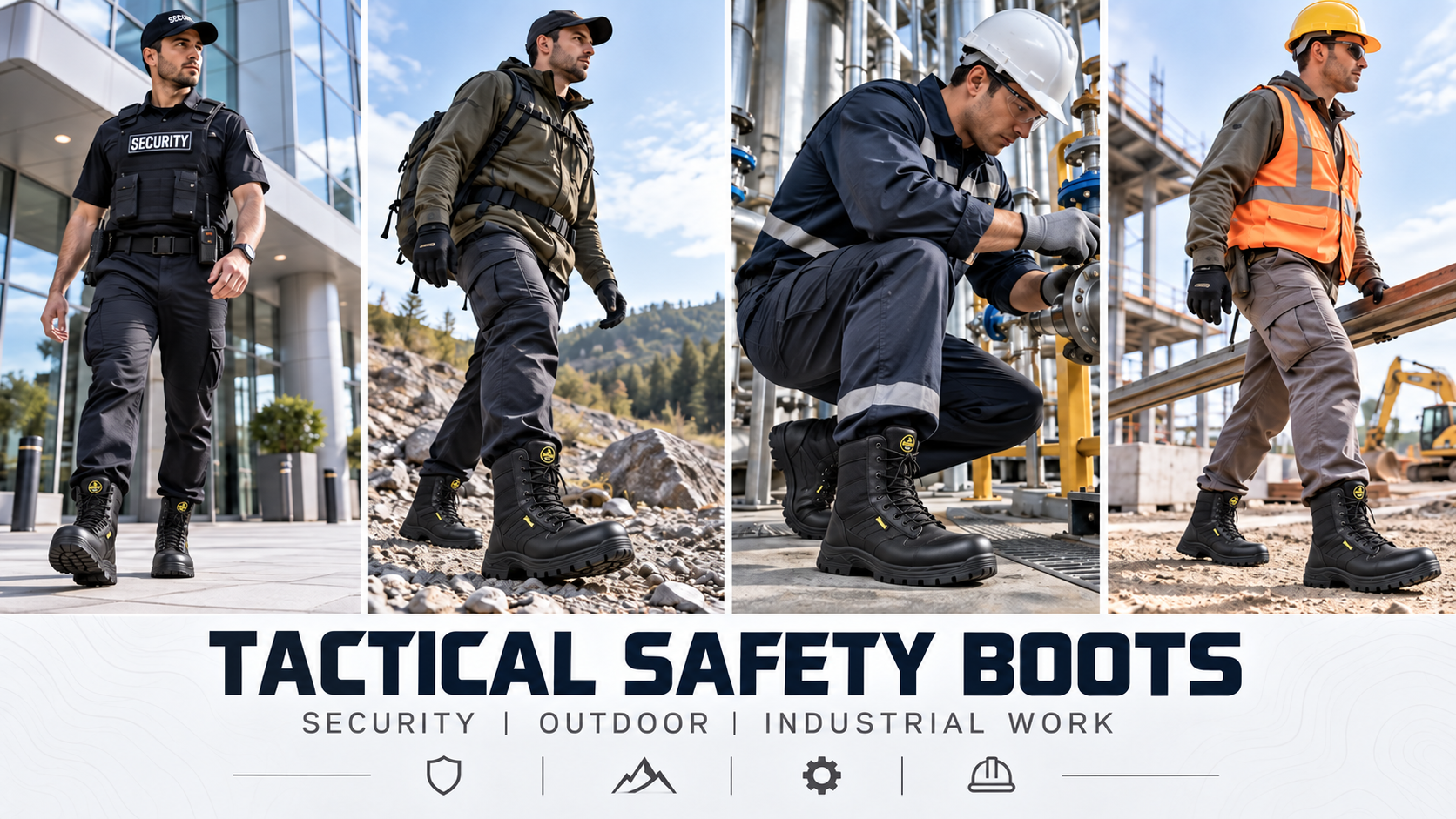
Relevant users include security and guard teams, rescue support staff, industrial maintenance workers, outdoor professionals, airport and logistics operations, and field crews. These jobs can involve long walking periods, mixed indoor and outdoor surfaces and the need for a secure high-cut fit. Military or police applications may exist, but they are not the only target.
Start with Certified Workplace Protection
Start with the hazard, not the styling. Falling objects may require toe protection, sharp debris may require puncture resistance, and wet floors may require verified slip performance. Model-specific technologies such as VortiGard™, FlexBarrier™ and PlumaShield™ can explain protection functions, but the exact certificate and technical datasheet remain the deciding evidence.
For European safety footwear, verify the exact model against EN ISO 20345 certification and its current technical documentation.
Military-inspired styling does not replace safety certification.
Why High-Cut Design Matters
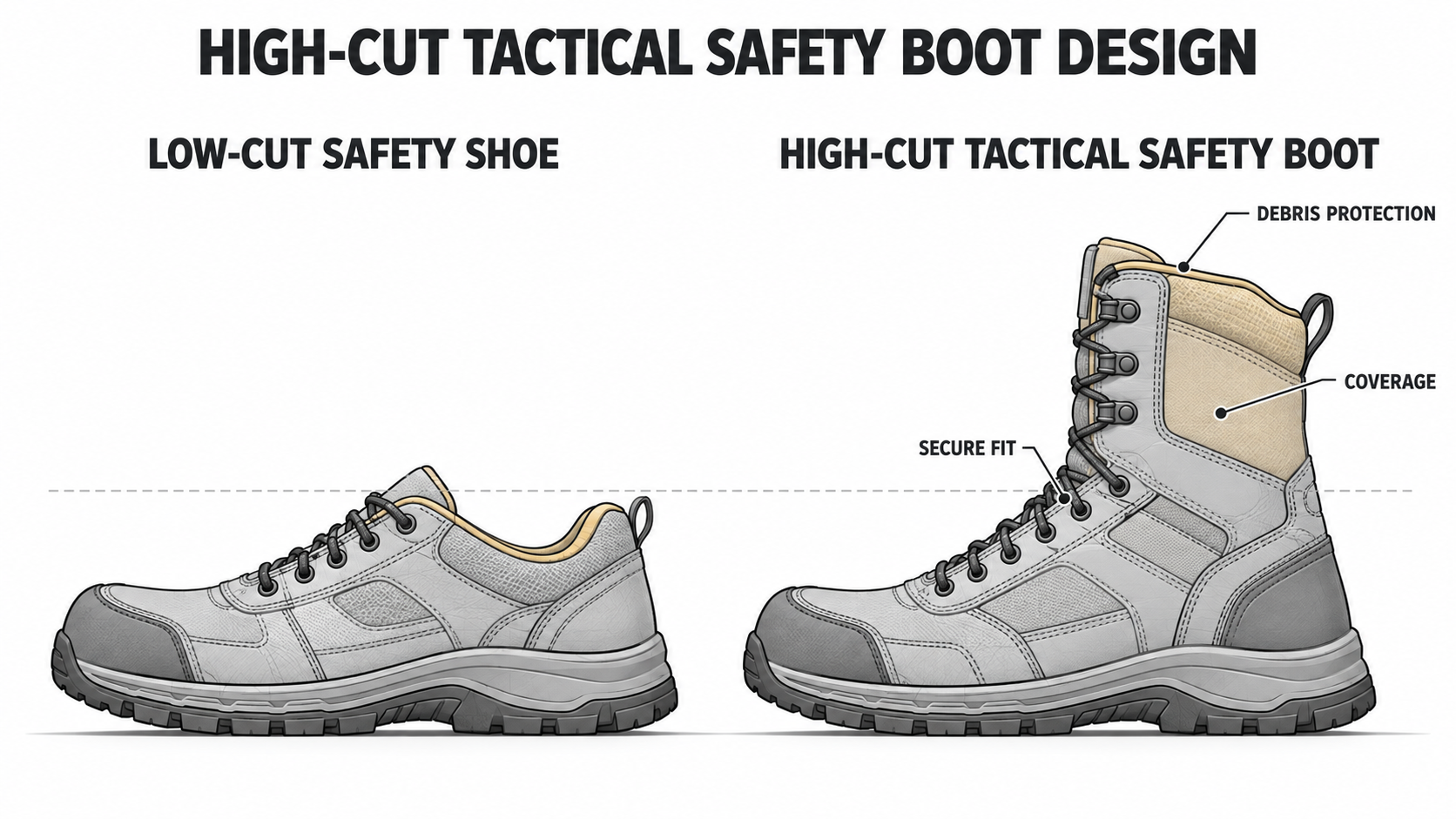
A high-cut structure is a defining tactical feature. Compared with many low-cut safety shoes, it can provide greater coverage, a more secure wrapped fit and better resistance to small gravel or debris entering from the top. It may feel more stable on uneven ground, but it should not be marketed as preventing ankle injuries without specific evidence.
Lace-Up vs Side-Zip Tactical Safety Boots
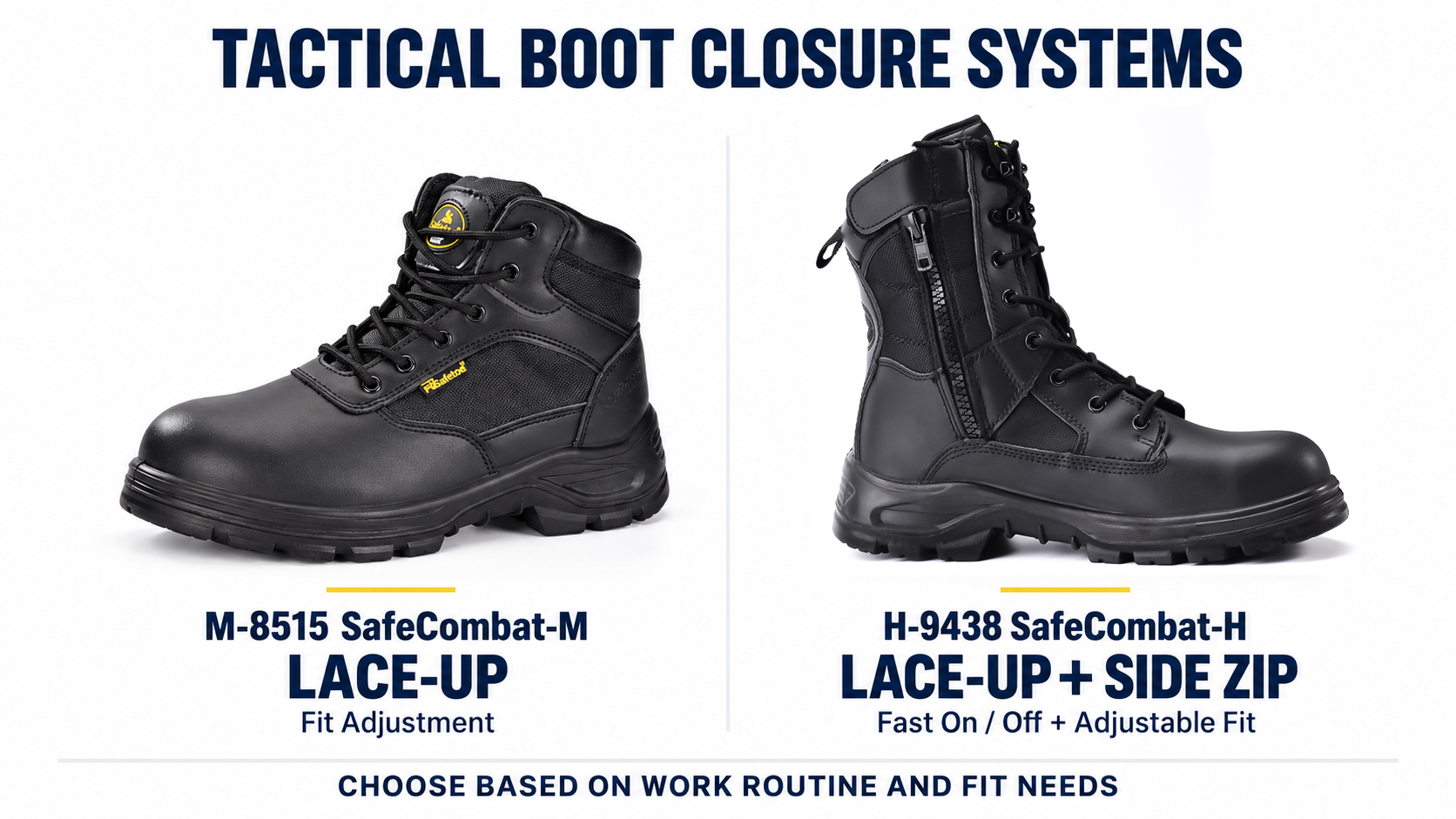
Closure design is one of the most practical differences between tactical boot models. A traditional lace-up system provides extensive fit adjustment and a classic tactical structure. A lace-up plus side-zip design preserves lace adjustment while allowing faster on/off for workers who change footwear frequently or need quicker access during patrol, response or shift changes.
| Feature | Lace-Up | Lace-Up + Side Zip |
| Fit Adjustment | Fully adjustable by lacing | Fully adjustable by lacing |
| On / Off | Requires re-lacing or loosening | Faster access through side zip |
| Closure Structure | Simpler closure system | Lace adjustment + additional zipper |
| Daily Routine | Suitable for continuous wear | Useful for frequent footwear changes |
| Typical Application | Field / industrial work | Security / patrol / rapid-response routines |
Neither design is universally better. The right choice depends on how often workers need to put on or remove their footwear and how much fit adjustment they require.
Related reading: Military-Style Zip Safety Boots
Traction and Outsole Design for Mixed Terrain
Tactical-style work footwear may move between concrete, gravel, workshops, wet areas and mixed outdoor surfaces. Review tread geometry, outsole compound, verified slip performance, durability and debris release. Laboratory slip results are useful evidence, but they do not describe every outdoor terrain condition.
Leather, Breathability and Durability
H-9438 and M-8515 use full-grain smooth cow leather, while H-9438 also uses a YKK™ side zip. Buyers should also review lining, stitching, flex points and overall construction for long-term work use. Do not automatically apply a branded leather-technology claim unless the exact model documentation supports it.
Comfort Matters for Patrol and Long Shifts
Security, patrol and maintenance work can involve long standing and walking periods. Consider cushioning, weight, fit and breathability. H-9438, for example, is specified with Super Memory Foam insoles, which can be described as designed to improve underfoot comfort during extended wear without making unsupported injury-prevention claims.
Tactical Safety Boots vs Regular Safety Boots
Tactical design changes the footwear’s structure and usability, not the meaning of certified protection.
| Feature | H-9438 SafeCombat-H | H-9438 OB |
| Category | Safety Footwear | Occupational Footwear |
| Standard | EN ISO 20345 | EN ISO 20347 |
| Toe Protection | Yes | No |
| Puncture Protection | Yes | No |
| Tactical High-Cut Design | Yes | Yes |
| Side Zip | Yes | Yes |
| Selection Basis | Workplace hazards requiring safety protection | Professional use without safety-toe / puncture requirements |
The tactical design changes fit, coverage and usability; certified protection still depends on the exact model.
Similar appearance does not mean equivalent protection. Always verify the exact model category and certification.
Check the Safety Standard, Not the Appearance
Similar-looking tactical footwear can belong to different protection categories. H-9438 SafeCombat-H is currently specified as EN ISO 20345:2022 S3 SR HRO safety footwear, while M-8515 is positioned as an S3 tactical safety boot. Safetoe also lists an H-9438 OB occupational tactical option. Keep safety and occupational footwear clearly separated by exact model, category and documentation.
Match Tactical Footwear to the Job
Job / Environment | Priority | Footwear Direction |
Security patrol | Fast on/off + comfort | Side-zip tactical boots |
Guard duty | Secure fit + long wear | Tactical safety boots |
Outdoor field work | Coverage + traction | High-cut tactical boots |
Industrial maintenance | Toe + puncture + grip | Certified tactical safety boots |
Airport operations | Mobility + protection | Lightweight tactical safety footwear |
Rapid response | Quick on/off | Side-zip tactical boots |
Non-safety occupational use | Comfort + rugged design | Occupational tactical boots |
Recommended Safetoe Tactical Safety Boots
H-9438 SafeCombat-H — Side-Zip Tactical Safety Boots
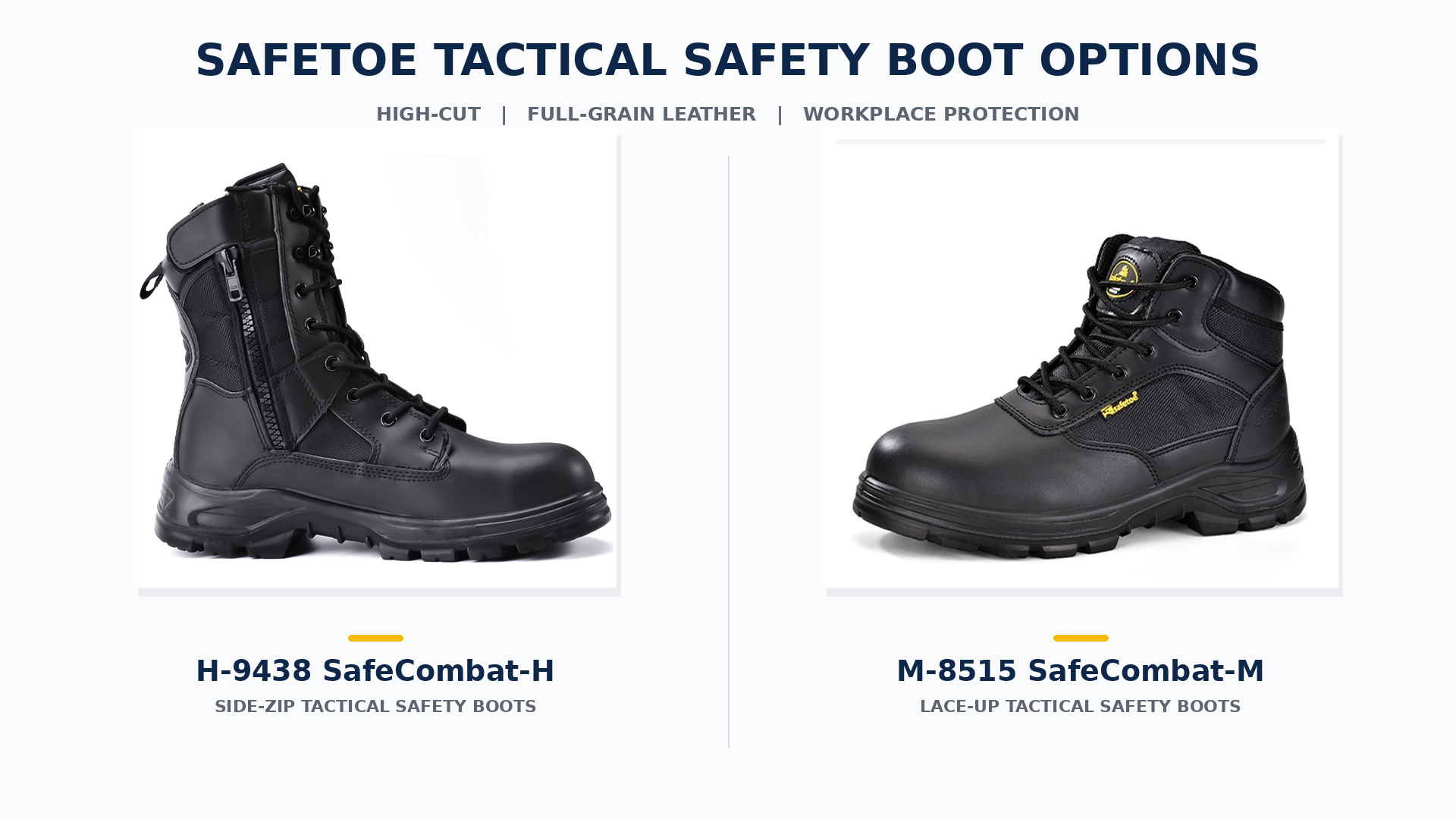
H-9438 combines a high-cut full-grain leather upper, lace adjustment and a side zipper with certified workplace protection. Its design is particularly relevant for security, patrol, rapid on/off and industrial applications where users value both a tactical profile and a practical closure system.
View H-9438 SafeCombat-H
M-8515 SafeCombat-M — Lace-Up Tactical Safety Boots
M-8515 represents the more traditional lace-up route, using a high-cut full-grain leather construction and S3 safety protection. It is a useful option for buyers who prioritize classic lace adjustment and a rugged tactical-style profile for field or industrial use.
View M-8515 SafeCombat-M
H-9438 OB — Occupational Tactical Option
For applications that do not require the same safety-toe category, an occupational tactical option can be evaluated separately. The key is to keep occupational footwear and safety footwear clearly distinguished in procurement specifications.
FAQ
What are tactical safety boots?
They are tactical-style work boots that also include model-specific workplace safety features and certification where applicable. High-cut styling, lacing or side zips do not determine safety status by themselves.
Are tactical boots the same as military boots?
No. Tactical-style safety boots borrow design cues from military or tactical footwear, but they are not automatically military-issued combat boots.
Are side-zip tactical boots better than lace-up boots?
Not universally. Side zips favor faster on/off, while traditional lace-up systems emphasize fit adjustment and a classic closure. Choose according to the worker’s routine and job demands.
Do tactical safety boots have steel toes?
Some do, but not all. Toe construction is model-specific. Buyers should check the exact product specification rather than assume a tactical-looking boot has a steel or composite safety toe.
What is the difference between tactical safety boots and occupational tactical boots?
Tactical safety boots are selected under an applicable safety-footwear category. Occupational tactical boots belong to a different category and should not be assumed to provide the same protective-toe performance simply because they look similar.
Conclusion
The right tactical safety boot is the model whose certified protection, high-cut structure, closure system, traction and comfort match the job. Start with workplace hazards and documentation, then choose lace-up, side-zip or occupational options according to use.

 English


