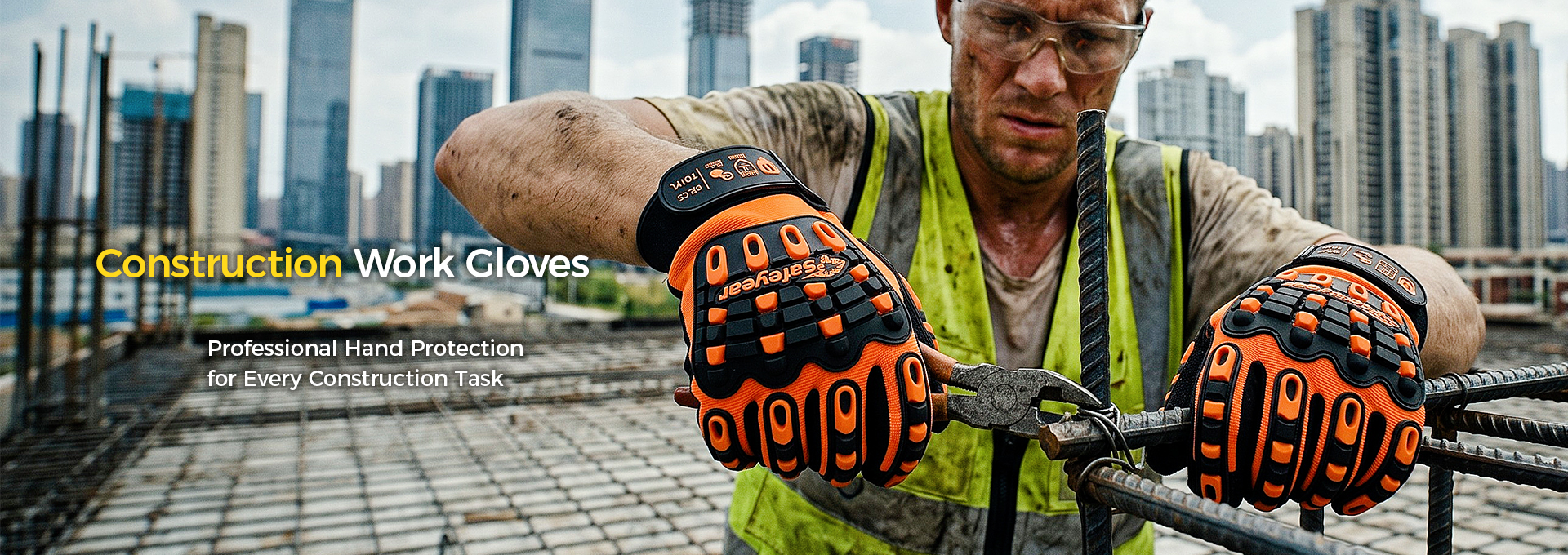
Construction workers handle sharp metal, rough concrete, timber, tools, machinery and heavy building materials every day. Because these tasks expose the hands to very different hazards, choosing construction work gloves should involve more than selecting the thickest or most durable-looking pair.
The right glove depends on the actual task, hand hazards and level of protection required. A worker handling sheet metal may need substantial cut resistance, while someone installing fixtures may benefit more from dexterity, grip and abrasion protection.
This guide explains the most common construction hand hazards, how to match gloves to different tasks, how to understand EN 388 ratings and what buyers should check before selecting protective gloves for construction work.
→ Construction Work Gloves
What Are the Most Common Hand Hazards in Construction?
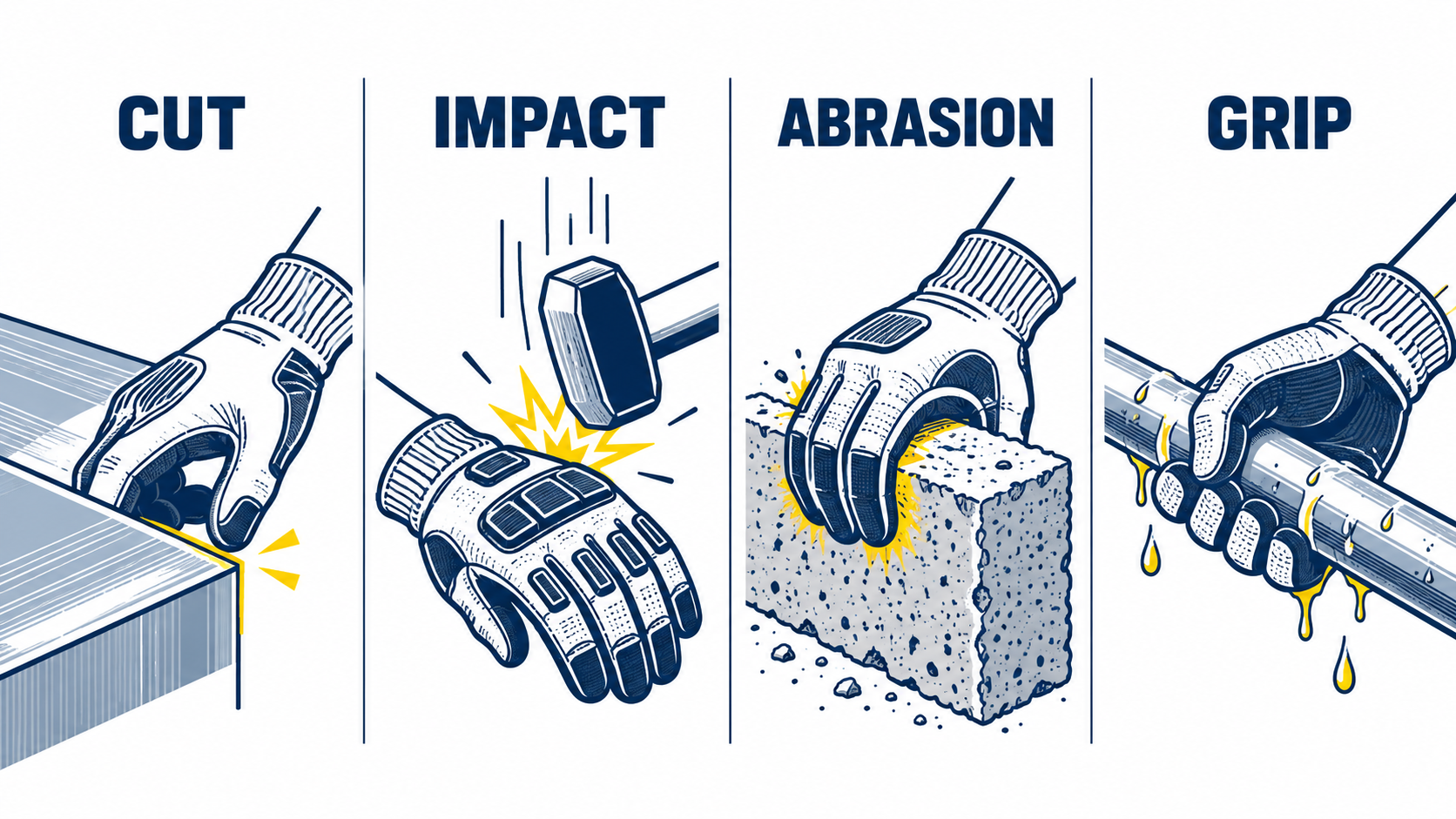
Construction jobs expose workers to several types of mechanical hazards, often within the same shift. Before selecting a glove, buyers should identify what the worker handles, how the hand may be injured and how much hand control the task requires.
Safeyear's Construction Work Gloves solution currently groups common construction risks around sharp materials, heavy handling, rough surfaces and wet or oily conditions.
Cuts and Sharp Edges
Sheet metal, steel profiles, cable trays, glass, sharp fasteners and unfinished building components can expose workers to cutting hazards.
For these tasks, glove selection should consider:
Higher cut resistance can be valuable for sharper materials, but the highest possible cut level is not automatically necessary for every construction task.
VarioNova™ Cut Protection Technology
Impact and Crushing Hazards
Hands can also be exposed to knocks and blows when workers handle heavy materials, power tools, machinery, pipework or structural components.
Protection may therefore be needed across the back of the hand, knuckles and fingers, particularly in heavy construction, demolition, mechanical installation and material handling.
Impact-protection structures such as TPR guards can provide an additional layer of protection, but buyers should distinguish between the presence of physical TPR protection and a glove that actually carries the optional EN 388 impact “P” marking.
TravMora™ Impact Protection Technology
Abrasion and Rough Materials
Brick, concrete, timber, masonry, steel and repeated material handling can gradually wear through glove coatings and palm materials.
Abrasion resistance becomes especially important when workers repeatedly:
Move rough building materials
Handle concrete products
Carry timber or steel
Use tools for long periods
Work against abrasive surfaces
DuralVanta™ is positioned as Safeyear's abrasion-resistant glove technology. Its current technology page describes the system as using optimized coating density, surface structure and liner construction to help reduce coating wear while maintaining grip and flexibility.
DuralVanta™ Durability Technology
Grip and Handling Risks
Insufficient grip can reduce handling control and require workers to apply more force when holding tools or materials.
Construction gloves may need dependable grip when handling:
Tools
Pipes
Metal components
Damp building materials
Repetitive loads
GripVanta™ uses a micro-textured surface and foam nitrile coating and is designed for grip in dry, wet and light oily conditions while maintaining flexibility.
GripVanta™ Grip Technology
How to Choose Construction Gloves by Task
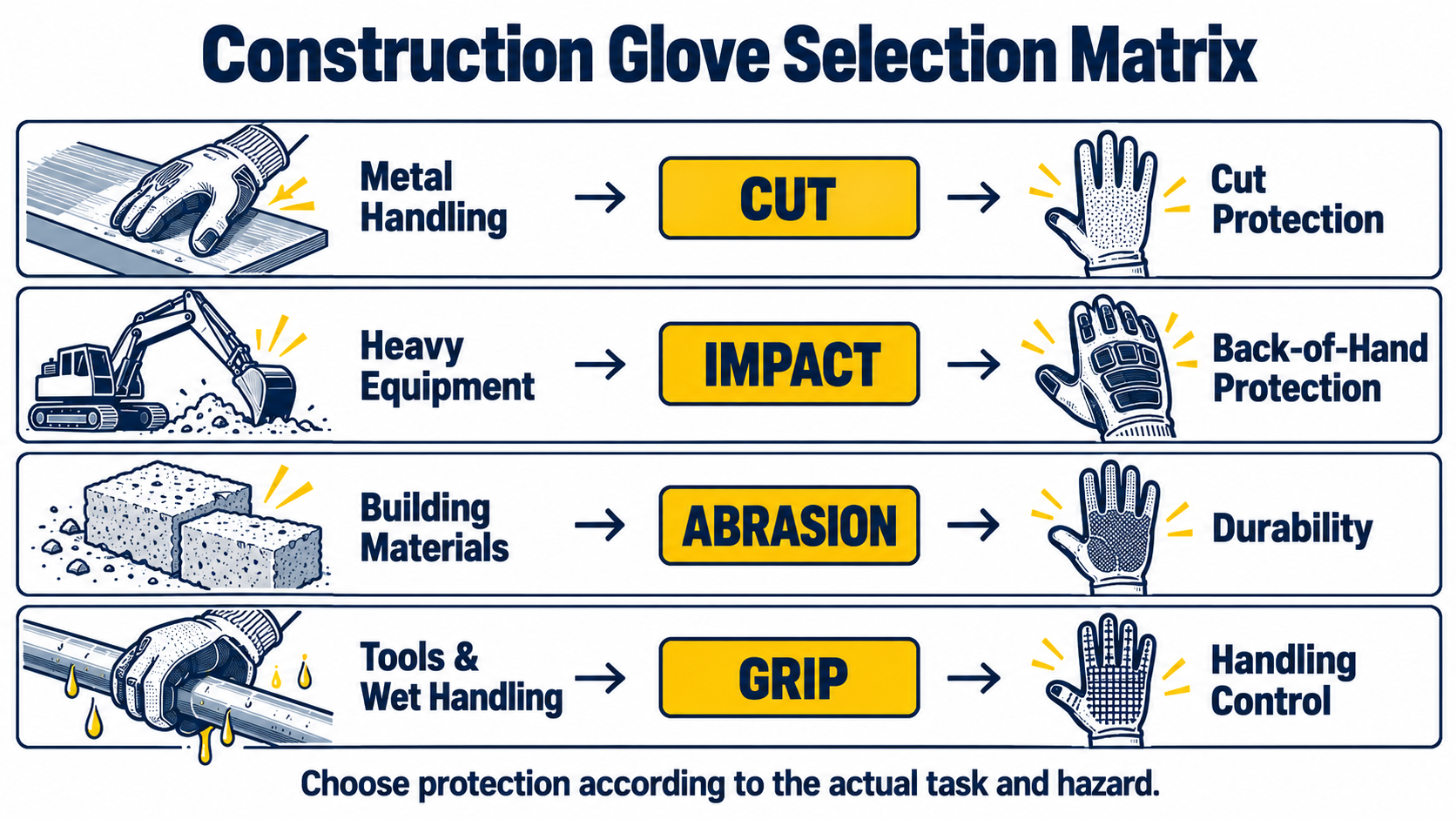
There is no single “best construction glove” for every jobsite task.
A glove that works well for handling steel may be unnecessarily heavy for installation work, while a lightweight assembly glove may not provide enough protection for demolition or heavy material handling.
The most practical approach is to start with the task and then identify the corresponding hazard.
Construction Task | Main Hazard | What to Look For |
Steel & Sheet Metal Handling | Cut / abrasion | Cut resistance + durable palm |
Material Handling | Abrasion / grip | Durable coating + secure grip |
Tool & Equipment Work | Impact / grip | Back-of-hand protection + handling control |
General Installation | Dexterity / abrasion | Flexible glove + mechanical protection |
Heavy Construction | Cut / impact / abrasion | Multi-hazard protection |
For example, workers handling steel reinforcement may need both cut and abrasion protection, while workers performing installation or fastening work may require greater finger movement and precision.
The goal is therefore not to maximize every rating. It is to find an appropriate balance between protection, grip, durability and dexterity for the task.
What Does EN 388 Mean for Construction Work Gloves?
EN 388 is one of the most important standards for evaluating protective gloves used against mechanical risks.
The current Safeyear EN 388 guide identifies EN 388:2016+A1:2018 as the European standard used to evaluate abrasion, blade-cut, tear and puncture resistance, together with additional cut and optional impact testing where applicable.
A typical EN 388 marking may look like:
4 X 4 4 D P
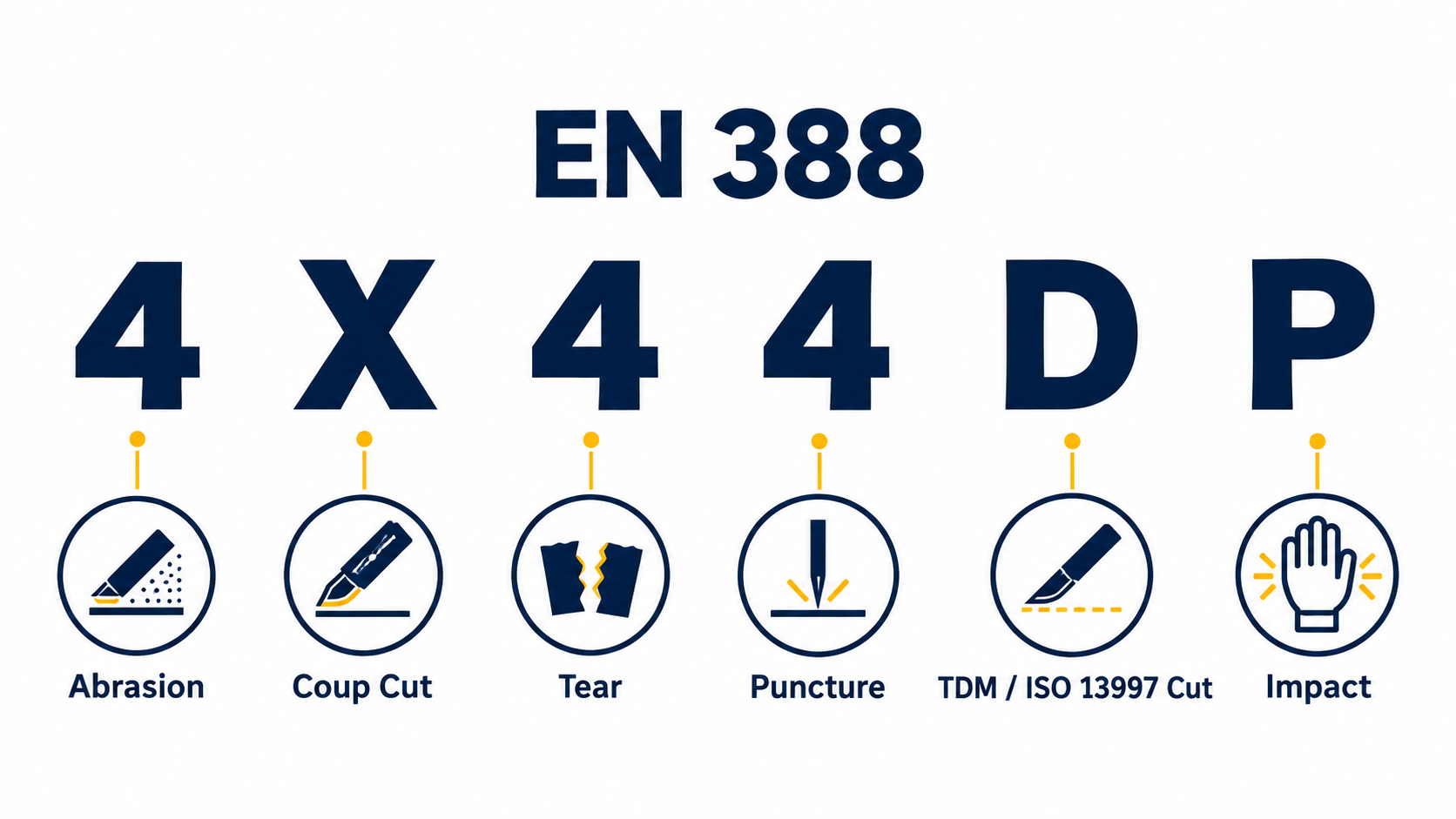
The positions represent:
Abrasion | Coup Cut | Tear | Puncture | ISO 13997 Cut | Impact
For a construction buyer, the important question is not simply:
Which glove has the highest code?
The better question is:
Which EN 388 performances correspond to the hazards in this task?
For example, a worker repeatedly handling rough masonry may place greater importance on abrasion resistance, while a steel-handling application may require substantially more cut protection.
The Safeyear EN 388 guide also points out that higher protection is not automatically better if the additional protection unnecessarily affects flexibility, weight or dexterity.
Read our complete EN 388 glove ratings guide
How Much Cut Protection Do Construction Workers Need?
The appropriate cut-protection level depends on the task and workplace risk assessment.
Construction is not a single hazard environment. Workers installing drywall, handling cable trays and moving sharp sheet metal may all be considered construction workers, but their cut exposure can be very different.
In general:
Lower cut exposure may be associated with lighter handling tasks where sharp-edge contact is limited.
Higher cut exposure may occur when workers handle sheet metal, sharp steel components, glass, structural materials or other edges capable of producing more serious cuts.
However:
A higher cut level is not automatically a better construction glove if it unnecessarily reduces dexterity or handling performance.
Glove selection should therefore balance:
Cut hazard
Frequency of exposure
Grip
Dexterity
Coating durability
Other mechanical hazards
VarioNova™ Cut Protection Technology
When Do Construction Workers Need Impact Protection?
Impact protection becomes relevant when the worker's hands may be struck, trapped or repeatedly knocked against tools, machinery or heavy materials.
Typical examples include:
Heavy construction
Demolition
Mechanical installation
Structural steel work
Equipment maintenance
Heavy material handling
Power-tool operation
Back-of-hand structures can help protect the knuckles, fingers and metacarpal area without completely restricting movement.
However, buyers should make one important distinction:
A glove with visible TPR protection does not automatically carry the EN 388 impact “P” marking.
The “P” should only be presented where the glove has passed the applicable optional impact test.
For example, the construction article specification you supplied identifies TPR9004 as an EN 388 4X44DP glove, with Cut Level D and impact marking P.
TravMora™ Impact Protection Technology
Grip, Durability or Dexterity: What Matters Most?
Construction glove selection often involves a trade-off between several performance requirements.
Grip
Grip is especially important when workers handle tools, pipes, wet materials or components that require continuous hand control.
Insufficient grip can cause workers to squeeze harder, increasing fatigue and reducing handling efficiency.
GripVanta™ Grip Technology
Durability
Durability becomes more important when the glove is repeatedly exposed to:
Concrete
Brick
Timber
Metal
Abrasive surfaces
High-frequency handling
A durable glove may reduce replacement frequency, but durability should not come at the cost of excessive stiffness.
DuralVanta™ Durability Technology
Dexterity
Some construction tasks depend more heavily on finger control.
Examples include:
For these applications, bulky hand protection may make the task harder.
Protection should not unnecessarily compromise the hand control required for the task.
This is why construction glove selection should be based on the task as a whole, rather than one isolated rating.
Recommended Safeyear Gloves for Construction Work
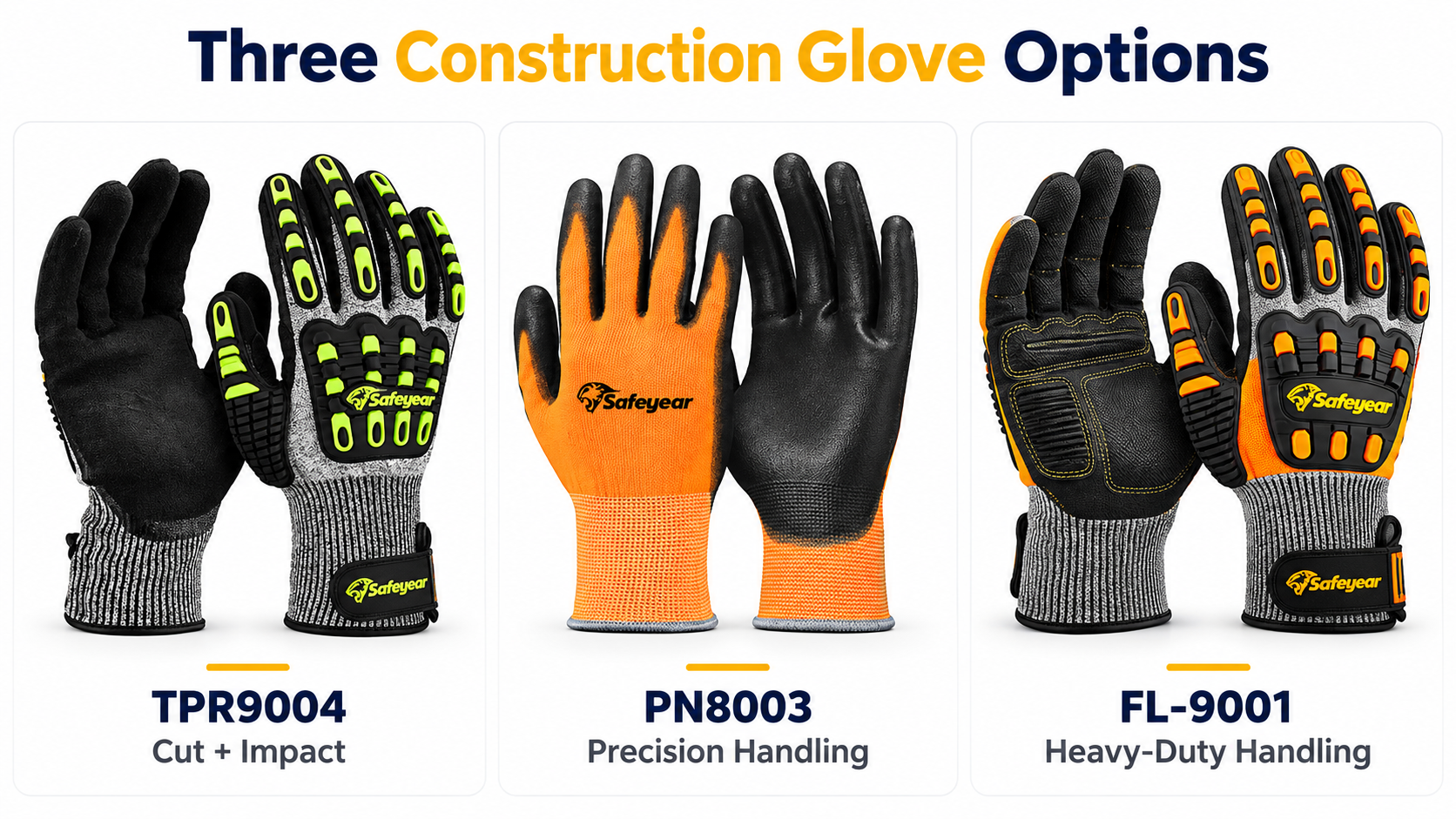
Once the hazards and tasks have been identified, individual glove models can be compared against those requirements.
These three glove options represent different protection priorities for construction work.
TPR9004 — Heavy-Duty Cut & Impact Protection
Suitable for applications such as:
Key evidence:
Role:
Protection
PN8003 — Precision & General Construction Work
Suitable for:
Key characteristics::
EN 388: 3121X
Dexterity Level 5
PU-coated palm
PN8003 is better suited to precision handling and general construction tasks where dexterity is more important than heavy-duty impact protection.
Its role is different:
Precision + Dexterity
FL-9001 — Heavy-Duty Handling with TPR Protection
Suitable for:
Material handling
Tool use
General heavy-duty work
Key construction points:
Its role is:
Heavy-Duty Handling
Construction Work Glove Selection Checklist
Before selecting construction work gloves, check:
☐ What are the main hand hazards?
☐ Is cut protection required?
☐ Is back-of-hand impact protection needed?
☐ How abrasive are the materials being handled?
☐ Are wet or slippery surfaces involved?
☐ How much dexterity is required?
☐ What EN 388 performance is appropriate?
☐ Does the glove fit the worker and task?
The final selection should reflect the complete work environment rather than a single rating or glove feature.
Frequently Asked Questions
1. What are the best gloves for construction work?
There is no single best glove for every construction task. The right construction work glove depends on the hazards involved, such as cuts, abrasion, impact or slippery materials, as well as the amount of dexterity required. Gloves should be selected according to the actual task and workplace risk assessment rather than job title alone.
2. What EN 388 rating is best for construction gloves?
There is no single EN 388 rating that is best for all construction work. EN 388 evaluates different mechanical risks, so buyers should identify which performances matter most for the task. Steel handling may require greater cut resistance, while masonry handling may place more emphasis on abrasion resistance and grip.
3. Do construction workers need cut-resistant gloves?
Many construction tasks involve sharp materials such as sheet metal, steel edges, glass, cable trays and unfinished components. Cut-resistant gloves may therefore be appropriate where a risk assessment identifies cutting hazards. The required cut level should match the severity and frequency of exposure.
4. When should construction work gloves be replaced?
Construction gloves should be inspected regularly and replaced when wear, cuts, punctures, damaged seams, worn coatings or reduced grip may compromise protection. Replacement should be based on glove condition and the manufacturer's instructions rather than a single fixed replacement interval.
Conclusion
The right construction work glove is the one that matches the actual hazard and task.
Cut resistance, impact protection, abrasion resistance, grip and dexterity should be evaluated together rather than selecting gloves based on a single performance rating.
Construction buyers should begin with a workplace hazard assessment, identify the type of hand protection required, review relevant EN 388 performance and then compare glove designs that provide the necessary balance of protection and usability.
Safeyear offers construction glove solutions supported by different grip, durability, cut and impact protection technologies for a range of jobsite applications.

 English


