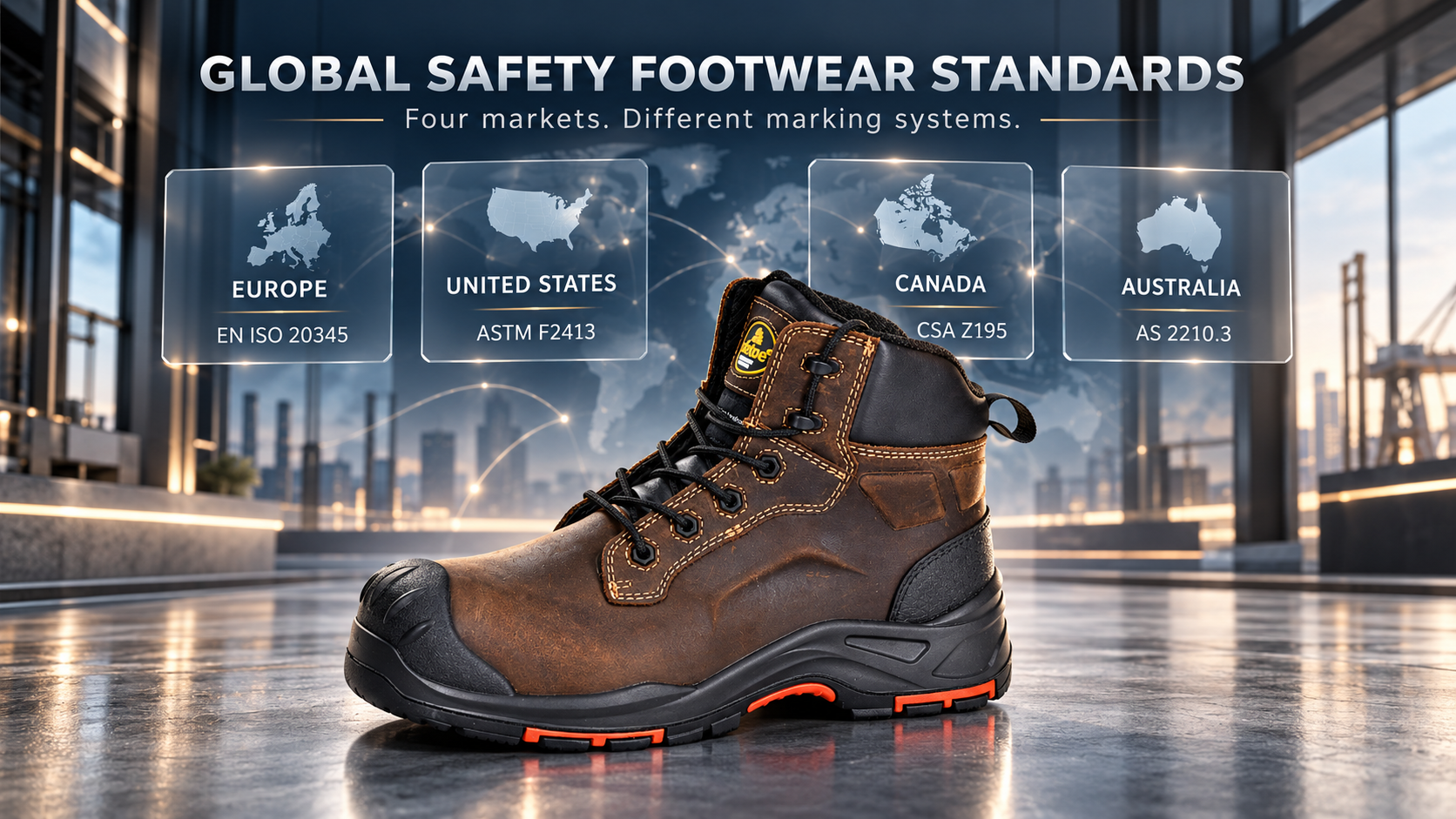
Safety footwear standards help protect workers from similar workplace hazards, but they do not use a single global classification system. A boot labeled S3S in Europe, PR in the United States or with a Green Triangle in Canada may address overlapping risks—but these markings are not direct one-to-one equivalents.
For international PPE distributors and procurement teams, the right approach is to compare the target market's requirements, the actual workplace hazards and the documentation for the exact footwear model.
Why Are Global Safety Footwear Standards Difficult to Compare?
Europe, the United States, Canada and Australia all specify performance requirements for protective footwear. However, the standards differ in how they organize protection, express markings and demonstrate conformity. The same workplace hazard may therefore be described in different ways. Buyers should avoid relying on a simple conversion chart.
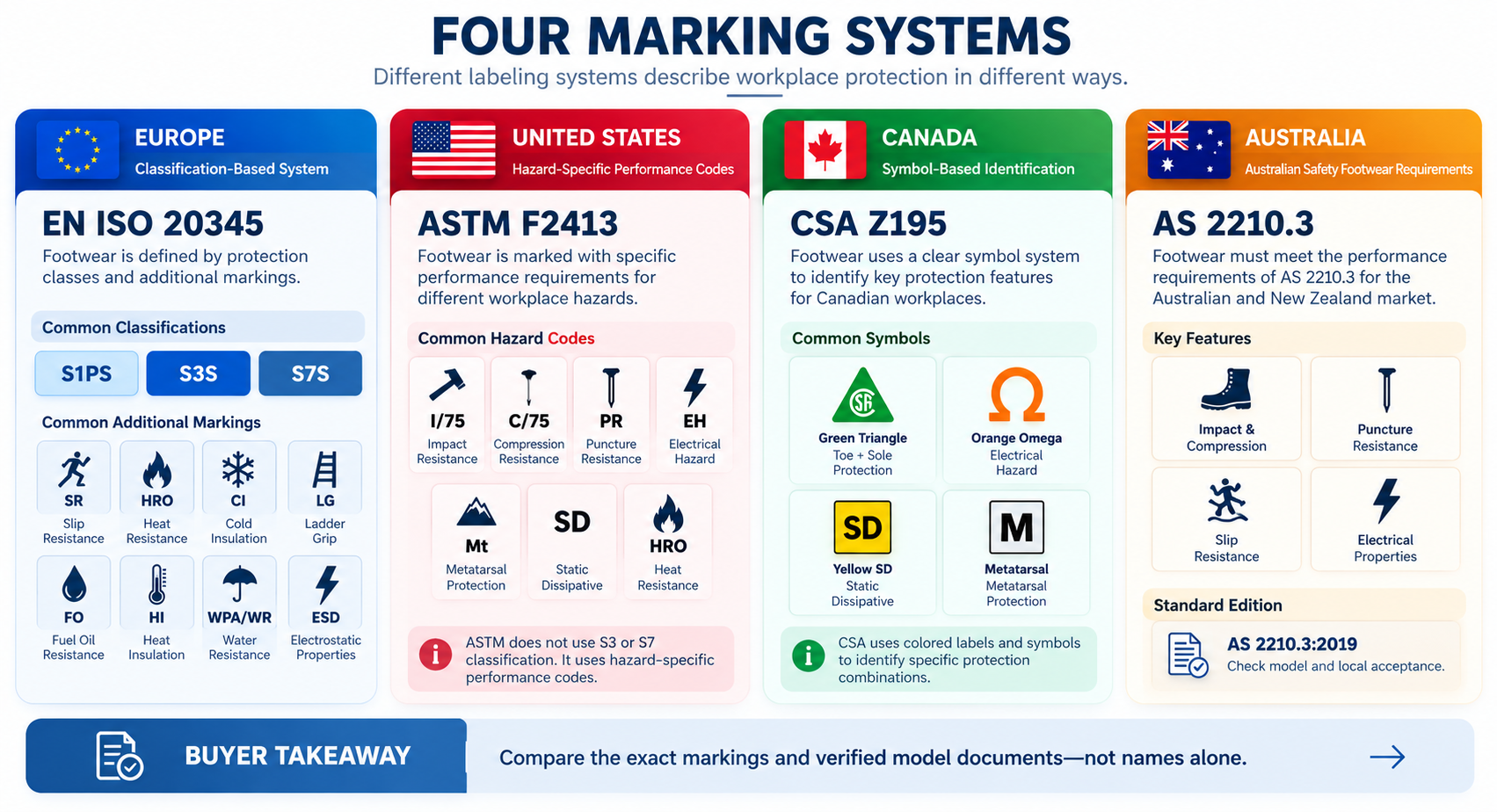
1. EN ISO 20345: Classification-Based Protection
EN ISO 20345:2022+A1:2024 uses footwear categories such as S1PS, S3S and S7S, alongside additional properties including SR (additional slip-resistance testing), HRO (outsole heat-contact resistance), CI (cold insulation) and LG (ladder grip). The complete marking—not just the S-category—helps determine whether a model matches the job.
Learn more: Safetoe EN ISO 20345 Certification.
2. ASTM F2413: Hazard-Specific Performance Codes
In the United States, ASTM F2413-24 uses markings to identify tested protective properties rather than European S3 or S7 classifications. Common examples include I/75 (impact), C/75 (compression), PR (puncture resistance), EH (electrical hazard), Mt (metatarsal protection) and SD (static dissipation). Slip resistance follows an associated ASTM testing and performance framework; do not assume it is covered by every F2413 label.
An ASTM PR designation identifies a specific protective property. It does not automatically establish compliance with the broader EN S3S classification.
Learn more: Safetoe ASTM F2413 Certification.
3. CSA Z195: Canadian Protection Symbols
Canada uses CSA Z195:14 (R2025) and a recognizable protection-label system. Common identifiers include the Green Triangle (Grade 1 protective toe and puncture-resistant sole), orange Omega (electric-shock resistance), SD (static dissipation) and M (metatarsal protection).
These symbols communicate distinct properties and should not be treated as interchangeable. In particular, the CSA Green Triangle is not simply “Canadian S3S.” Electrical protection should be checked separately when required.
Read: Safetoe CSA Z195 Safety Footwear Labels Guide.
4. AS 2210.3: Australian Safety Footwear Requirements
AS 2210.3:2019 establishes general safety footwear performance requirements for Australia. It is a modified adoption of the older ISO 20345:2011 framework, so buyers should not copy a European 2022 classification into an Australian specification and assume automatic acceptance.
For Australian tenders, confirm the required edition, additional properties and evidence accepted by the purchaser or local authority. A CE or ASTM document alone does not establish compliance with AS 2210.3.
EN ISO 20345 vs ASTM F2413 vs CSA Z195 vs AS 2210.3
| Comparison | EN ISO 20345 | ASTM F2413 | CSA Z195 | AS 2210.3 |
| Primary market | Europe / international | United States | Canada | Australia |
| Main approach | Combined footwear classes plus additional marks | Hazard-specific performance codes | Protection labels, symbols and grades | Performance and classification requirements under Australian edition |
| Typical identifiers | S1PS, S3S, S7S; SR, HRO, CI | I/75, C/75, PR, EH, Mt, SD | Green Triangle, Omega, SD, M | Edition and model-specific performance markings |
| Puncture protection | P, PL or PS as applicable | PR when marked | Green Triangle identifies relevant sole protection | Verify applicable model requirements and documentation |
| Electrical properties | Additional property framework; not the same as EH | EH or SD where applicable | Omega or SD as applicable | Verify required properties against the specific standard |
| Buyer verification | Full class and extra codes + EU documentation | Codes and test documentation | Symbols and model certification | Edition, model compliance and local buyer acceptance |
Important: This table compares how standards communicate protection; it does not certify equivalent performance.
Is S3S Equivalent to ASTM PR or CSA Green Triangle?
No. S3S is a combined European category that incorporates a set of required footwear properties. ASTM PR is one hazard-specific designation, while the CSA Green Triangle refers to a particular Canadian combination of toe and sole protection. Their protection scopes overlap in some respects, but their testing, labels and conformity processes differ.
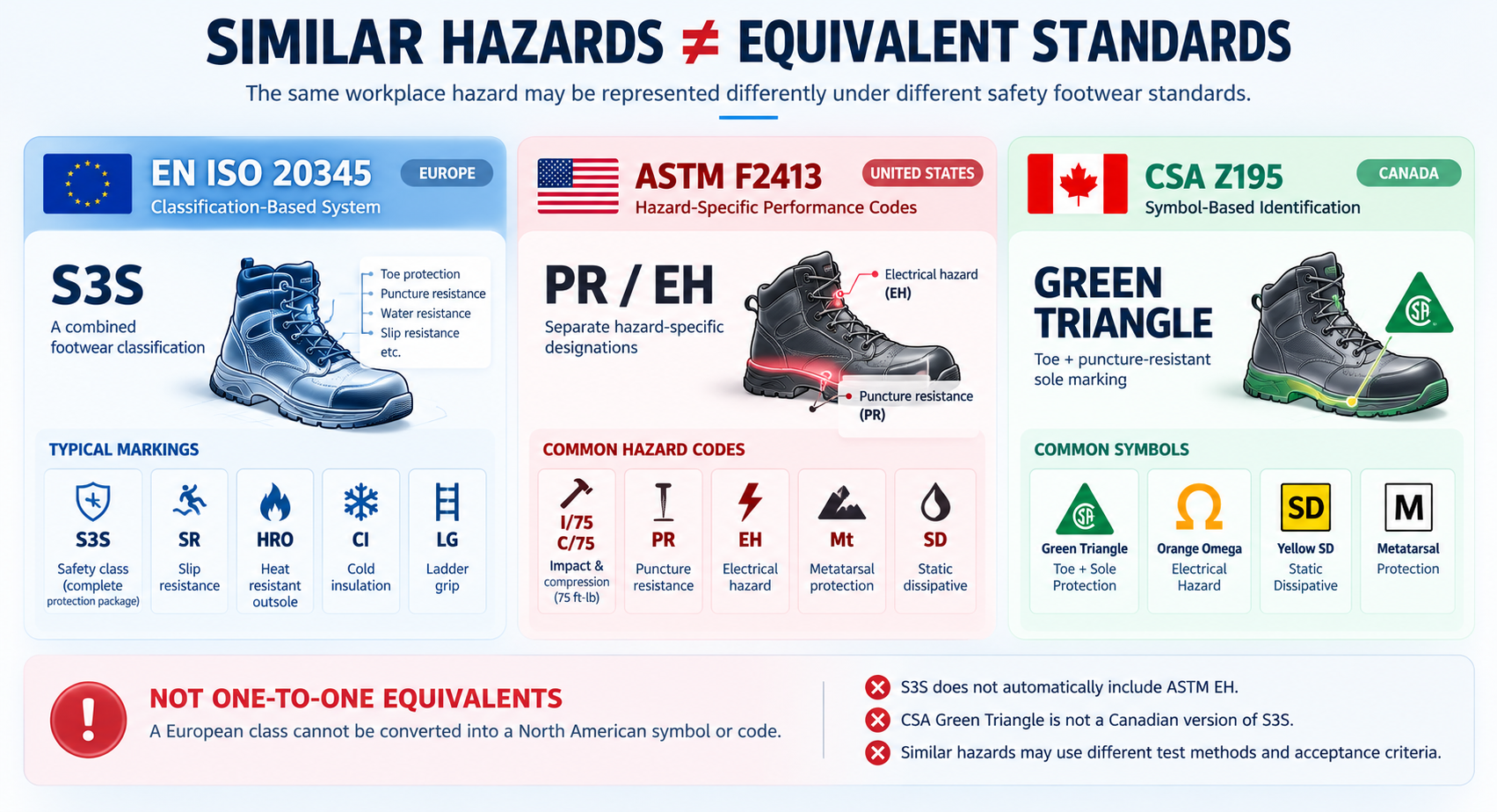
For example, S3S does not automatically mean ASTM EH, and ASTM PR does not automatically mean S3S. Never write “S3S = PR + EH = Green Triangle” in a tender or product specification.
Can One Safety Boot Meet Multiple Standards?
Yes—provided the exact model has supporting evidence for each claimed standard. Multi-standard compliance is model-specific, not a blanket claim covering every product from a manufacturer.
For example, Safetoe's M-8025 safety boot product page lists an EN ISO 20345 certificate, an ASTM F2413-24 test document and a CSA Z195 certificate. Buyers should check the exact model number, standard edition, protection markings, current documentation and any construction variations before placing an order.
Which Standard Should International Buyers Specify?
As a starting point, European buyers normally evaluate EN ISO 20345; U.S. buyers ASTM F2413; Canadian buyers CSA Z195; and Australian buyers AS 2210.3. However, the binding specification is determined by the applicable local regulations, project tender and workplace risk assessment—not by the country name alone.
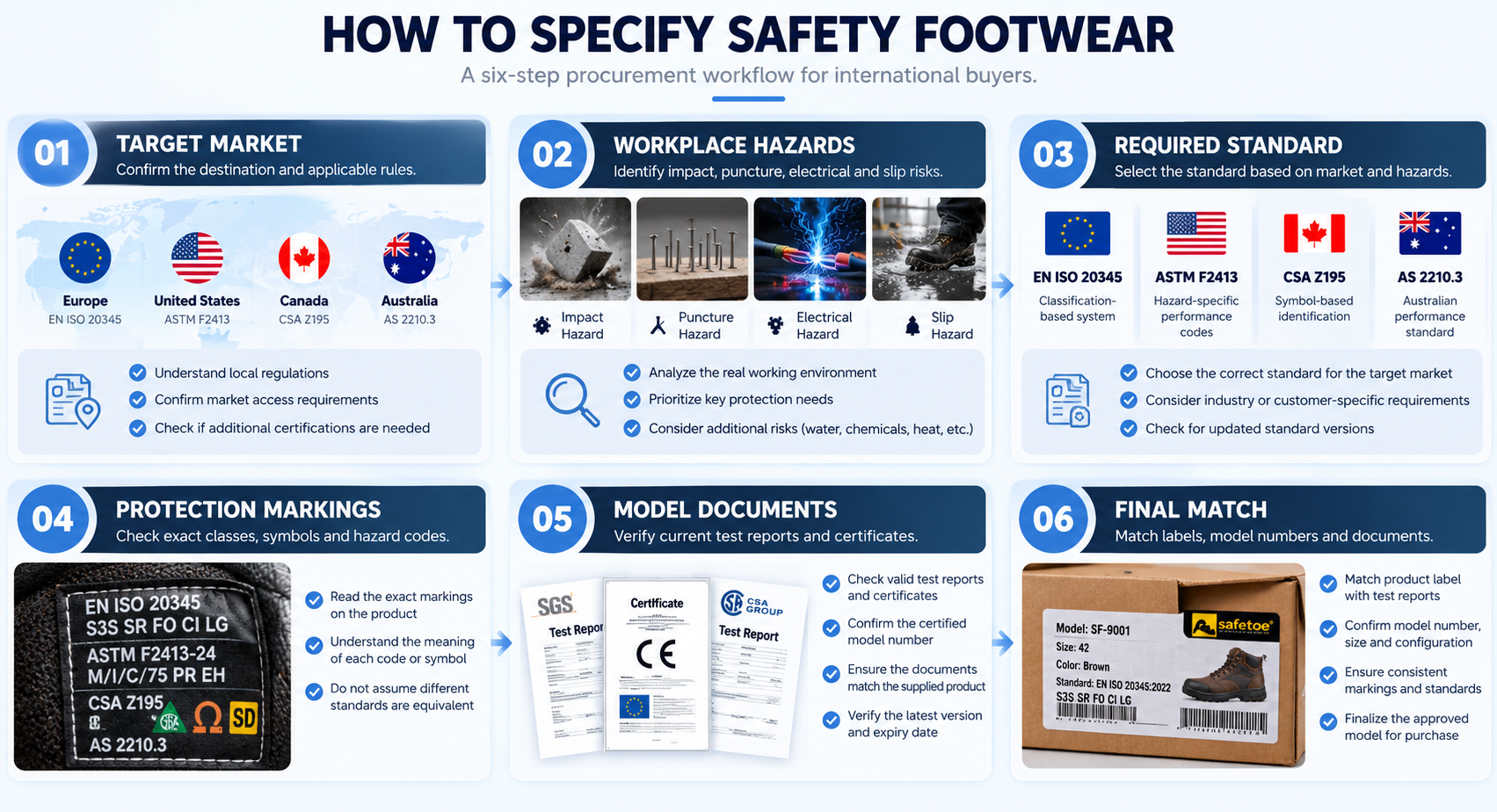
Six-Step Safety Footwear Procurement Checklist
1. Confirm the target market and destination-specific requirements.
2. Identify workplace hazards: impact, puncture, electrical, slip, heat, cold and moisture exposure.
3. Specify the required standard and edition stated in the tender or local guidance.
4. Compare the full protection markings, not a single headline rating.
5. Verify documentation for the exact model, including certificates or test reports as appropriate.
6. Match the product label, model number and supplied documents before purchase.
Frequently Asked Questions
1. Is ASTM F2413 equivalent to EN ISO 20345?
No. Both address occupational foot protection, but the performance requirements, markings and conformity frameworks are different.
2. Is CSA Z195 the same as ASTM F2413?
No. Both are used in North America, but CSA's protection symbols and ASTM's hazard-specific codes are not interchangeable.
3. Is S3S equivalent to ASTM PR?
No. S3S is a combined footwear classification, while PR identifies puncture resistance under ASTM.
4. Can one safety boot have CE, ASTM and CSA documentation?
Yes, when the exact model has been evaluated against each applicable requirement and the manufacturer can provide the relevant evidence.
5. Which standard should an international PPE buyer use?
Use the edition and protective properties required by local regulations, the customer's tender and the site's documented risks.
Select Safety Footwear With Confidence
Global safety footwear procurement is not about finding a convenient conversion between labels. It is about matching verified protection to the correct workplace and market.
Explore Safetoe EN ISO 20345 and ASTM F2413 guidance, review Canadian CSA labels, or contact Safetoe to discuss model-specific documentation for your procurement project.

 English


