Introduction
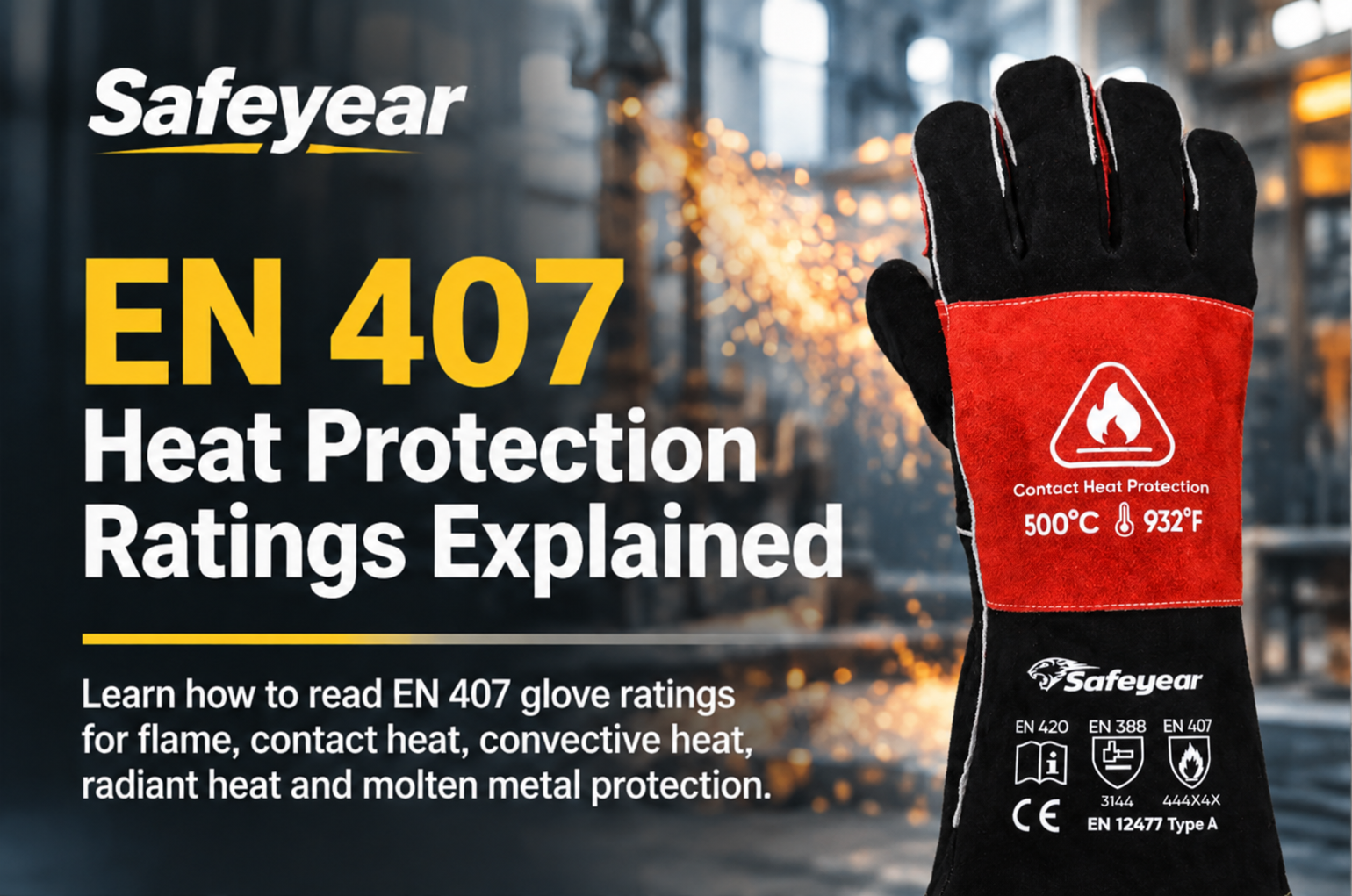
If you see a marking such as 444X4X on a protective glove, each number and letter represents performance against a different thermal hazard.
Many people think “heat resistant gloves” provide one simple level of protection. However, heat exposure in industrial environments can come from different sources, including flame, direct contact with hot objects, radiant heat, and molten metal.
Understanding EN 407 glove ratings helps safety professionals choose the right protection based on the actual workplace hazard instead of relying on general heat-resistant claims.
What Is EN 407?
EN 407:2020 is the European standard used to evaluate protective gloves against thermal risks.
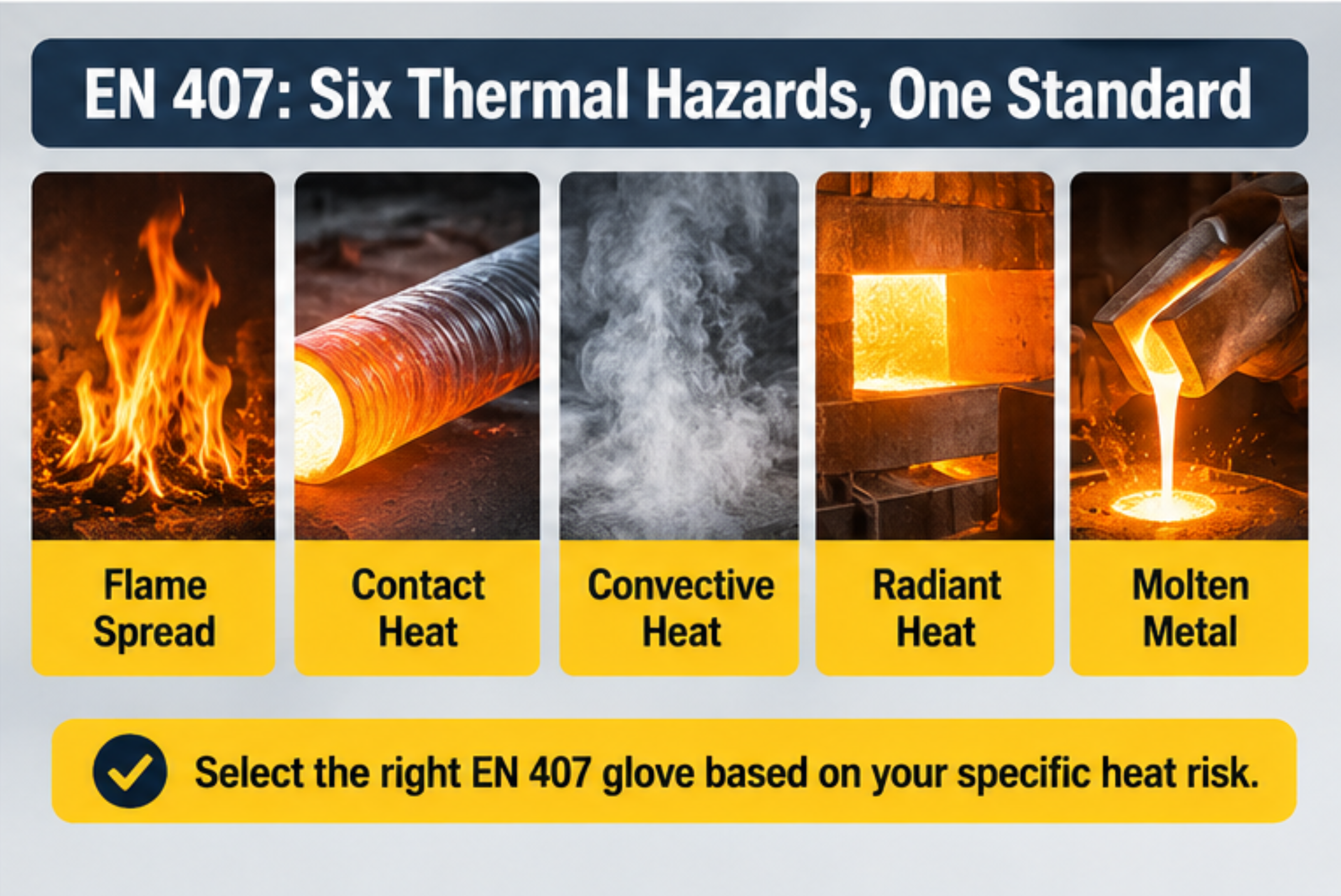
Unlike a single temperature rating, EN 407 separates thermal protection into different test categories:
This means a glove can perform differently against each type of heat.
A higher EN 407 rating does not automatically mean a glove is suitable for every hot environment. The correct glove should match the specific thermal hazard of the job.
How Do You Read an EN 407 Glove Rating?
An EN 407 marking contains six positions: 4 4 4 X 4 X
| Position | Thermal Performance |
| 1 | Limited Flame Spread |
| 2 | Contact Heat |
| 3 | Convective Heat |
| 4 | Radiant Heat |
| 5 | Small Splashes of Molten Metal |
| 6 | Large Quantities of Molten Metal |
Each position represents a separate thermal performance test.
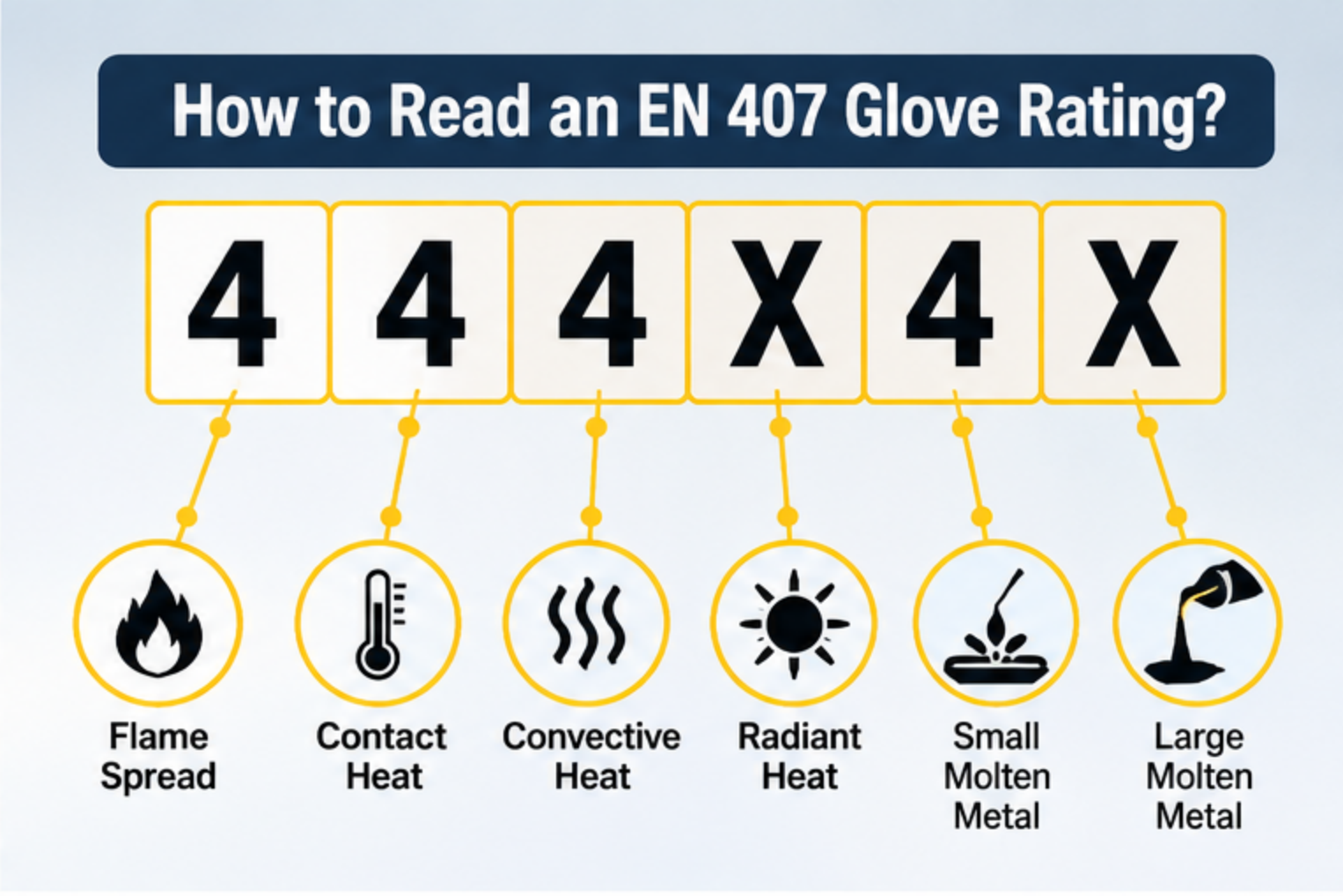
For example, 444X4X should not be understood as one overall “heat protection level”.
Instead, each number must be interpreted individually according to the type of heat exposure.
What Do EN 407 Contact Heat Levels Mean?
Among all EN 407 tests, Contact Heat is one of the most commonly misunderstood.
Contact Heat measures how well a glove protects against direct contact with heated objects, such as:
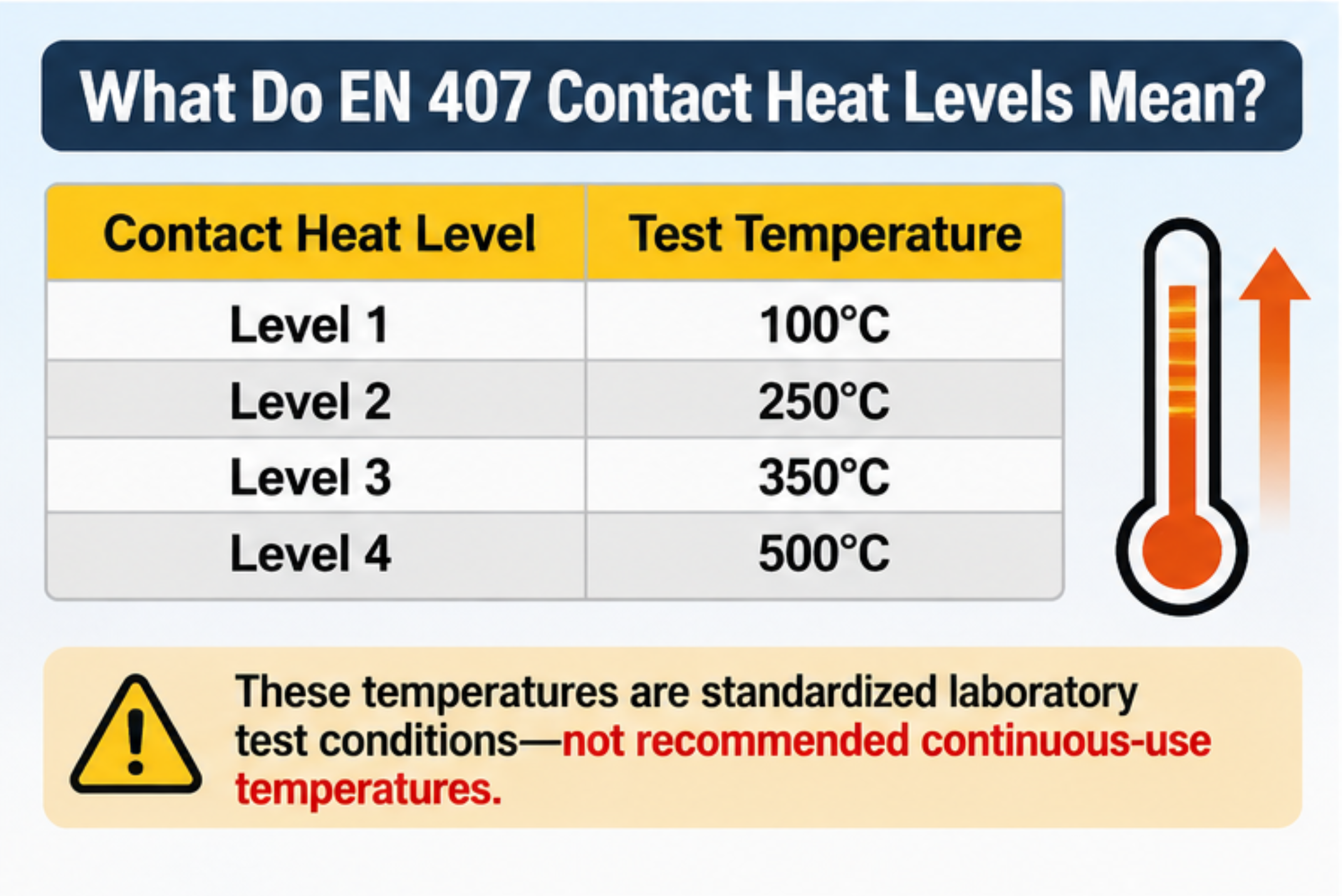
The Contact Heat performance levels are:
| Contact Heat Level | Test Temperature |
| Level 1 | 100°C |
| Level 2 | 250°C |
| Level 3 | 350°C |
| Level 4 | 500°C |
However, an important point must be clearly understood:
EN 407 Contact Heat Level does not mean the glove can be continuously used at that temperature.
These temperatures represent standardized laboratory test conditions.
For example, Contact Heat Level 4 tested at 500°C means the glove achieved the required performance during the EN 407 contact heat test. It does not mean the glove is designed for unlimited exposure to a 500°C surface.
Contact Heat vs Convective Heat vs Radiant Heat
Different heat sources require different protection.
Contact Heat
Occurs when a glove directly touches a hot object.
Examples:
Convective Heat
Comes from surrounding hot air or gases.
Examples:
Radiant Heat
Comes from a high-temperature heat source without direct contact.
Examples:
A glove that performs well in one heat category may not provide the same protection in another. This is why EN 407 evaluates different thermal risks separately.
What Does “X” Mean in an EN 407 Rating?
In an EN 407 marking, the letter X means that a performance level is not reported for that specific test position.
For example:
444X4X
means:
Flame Spread: Level 4
Contact Heat: Level 4
Convective Heat: Level 4
Radiant Heat: Not reported
Small Molten Metal Splash: Level 4
Large Molten Metal: Not reported
X does not automatically mean failure.
Users should always review the complete certification information and technical documentation before selecting a glove.
How to Choose Heat Protection Gloves Using EN 407 Ratings?
The right glove should be selected based on the actual workplace hazard.
| Workplace Task | EN 407 Performance to Review |
| Handling hot components | Contact Heat |
| Welding and hot work | Multiple thermal properties |
| Working near heat sources | Radiant / Convective Heat |
| Molten metal handling | Molten Metal Protection |
| Metal fabrication | Thermal + Mechanical Protection |
The selection process should start with:
What type of heat exposure exists?
Then identify which EN 407 performance level is relevant.
Choosing the highest rating available is not always the best solution. A glove must also provide suitable dexterity, comfort, and mechanical protection for the task.
EN 407 Rating Example: Safetoe FL-1023
A practical example is the Safetoe FL-1023 heat protection glove, certified according to:
EN 407:2020 — 444X4X
The rating represents:
4 — Limited Flame Spread
4 — Contact Heat
4 — Convective Heat
X — Radiant Heat result not reported
4 — Small Splashes of Molten Metal
X — Large Quantities of Molten Metal result not reported
The most important evidence is:
Contact Heat Level 4 — tested at 500°C
This means FL-1023 achieved Level 4 performance under the standardized EN 407 contact heat test.
The correct technical description is:
“FL-1023 achieved EN 407 Contact Heat Level 4 under the standardized 500°C contact heat test.”
It should not be described as:
“FL-1023 withstands continuous 500°C heat.”
The difference is important for professional safety communication.
EN 407 vs EN 12477: What's the Difference?
EN 407 focuses on thermal protection performance.
EN 12477 focuses specifically on protective gloves for welders.
Therefore:
EN 407 heat performance alone does not automatically mean a glove is a certified welding glove.
For welding applications, users should consider additional requirements such as:
A welding glove may require multiple standards to provide complete protection.
Does a Higher EN 407 Rating Always Mean a Better Glove?
No. The best glove is not always the one with the highest number.
For example:
Precision work may require better flexibility and dexterity.
Hot metal handling may require higher Contact Heat protection.
Welding applications may require EN 12477 certification.
The correct choice depends on matching tested performance with the actual workplace hazard.
EN 407 Selection Checklist
Before selecting heat protection gloves, consider:
☐ What type of heat exposure is present?
☐ Is direct contact with hot objects expected?
☐ Are flame, radiant, or convective heat hazards involved?
☐ Is molten metal splash possible?
☐ Which EN 407 performance levels are required?
☐ Are mechanical hazards also present?
☐ Is welding-specific EN 12477 protection required?
EN 407 FAQ
1. What is EN 407?
EN 407 is a standard that evaluates protective gloves against different thermal hazards, including flame, contact heat, convective heat, radiant heat, and molten metal risks.
2. How do I read an EN 407 glove rating?
The six positions represent different thermal tests. Each position should be evaluated separately according to the workplace hazard.
3. What does EN 407 Contact Heat Level 4 mean?
It means the glove achieved Level 4 performance during the standardized 500°C contact heat test. It does not mean continuous use at 500°C.
4. What does X mean in an EN 407 rating?
X means that a performance level is not reported for that test position. It does not automatically indicate failure.
5. What is the difference between EN 407 and EN 12477?
EN 407 evaluates thermal protection, while EN 12477 focuses on gloves designed specifically for welding applications.
Conclusion
EN 407 provides a structured way to understand heat protection performance in industrial gloves.
Instead of looking at heat resistance as a single value, users should analyze each thermal hazard separately and select gloves according to the actual working environment.
A marking such as 444X4X provides valuable information—but only when each position is correctly understood.
For professional heat protection, the right glove is the one that matches the real hazard, task requirements, and relevant safety standards.

 English


