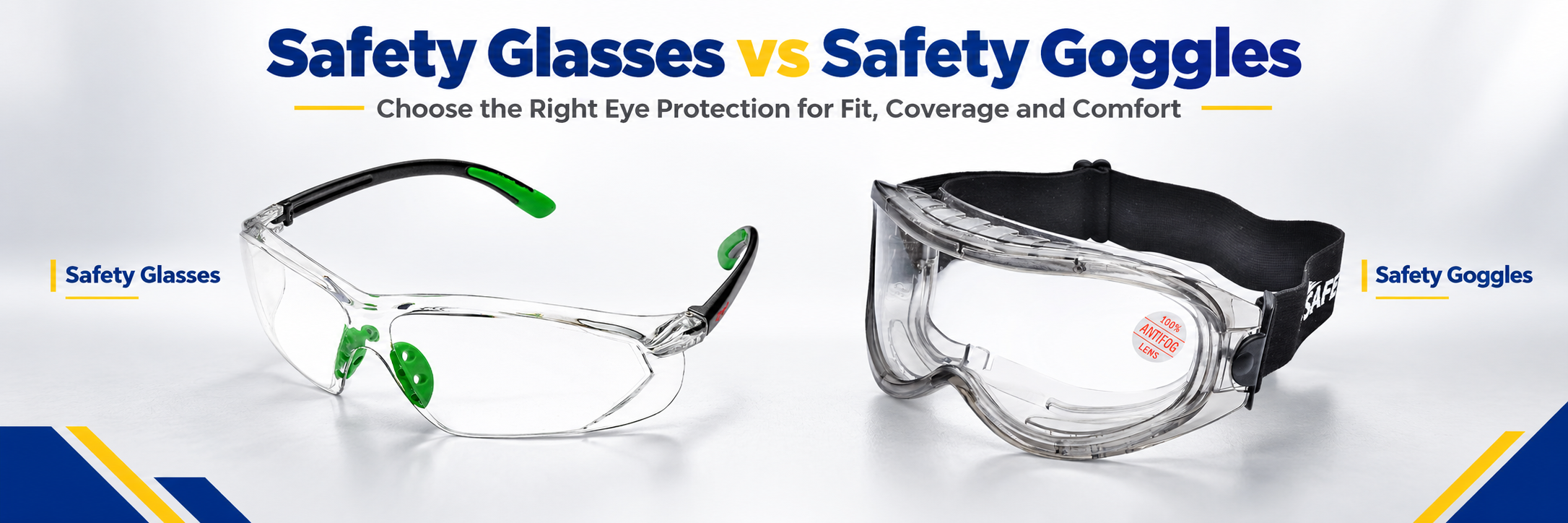
Safety Glasses vs Safety Goggles: Which Eye Protection Should You Choose for Work?
Both Safety Glasses and Safety Goggles can provide certified workplace eye protection. The difference is mainly in coverage, enclosure, fit, ventilation and application. The right choice should depend on the actual hazard assessment—not simply on which product looks more protective. Safety glasses are not automatically"low protection" and goggles are not automatically better for every job.
1.What Are Safety Glasses?
Safety glasses are protective spectacles designed to help shield the eyes from flying particles and impact hazards at work. They typically feature a lightweight, open or semi-open frame that allows airflow around the lenses. Depending on the design, side shields or wraparound lenses extend coverage toward the sides of the face. This combination of protection, ventilation and ease of wear makes safety glasses a practical choice for manufacturing, warehousing, construction, inspection, assembly and other industrial tasks. They are particularly useful for long shifts when the selected model matches the assessed hazards and fits comfortably with other PPE.
For example, Safeyear SG003 illustrates the lightweight safety glasses format for everyday industrial use. Buyers should assess coverage, fit and verified impact performance when selecting a model for their workforce.
2.What Are Safety Goggles?
Safety goggles are protective eyewear designed to fit closely around the eyes, providing greater enclosure than standard safety glasses. They typically use an adjustable head strap to maintain their position and reduce open gaps between the frame and the face. Depending on the frame, ventilation design and certified performance, goggles may be better suited to dusty workplaces or tasks involving greater exposure to particles and debris. Their closer fit can support more complete eye-area coverage, while comfort and compatibility with other PPE remain important selection factors.
The exact protection level depends on the specific product and applicable certification. Chemical splash protection must be confirmed through relevant testing and product markings. Safeyear SG007 is an example of the safety goggle format for buyers considering closer coverage and strap retention.
3.What Is the Main Difference Between Safety Glasses and Goggles?
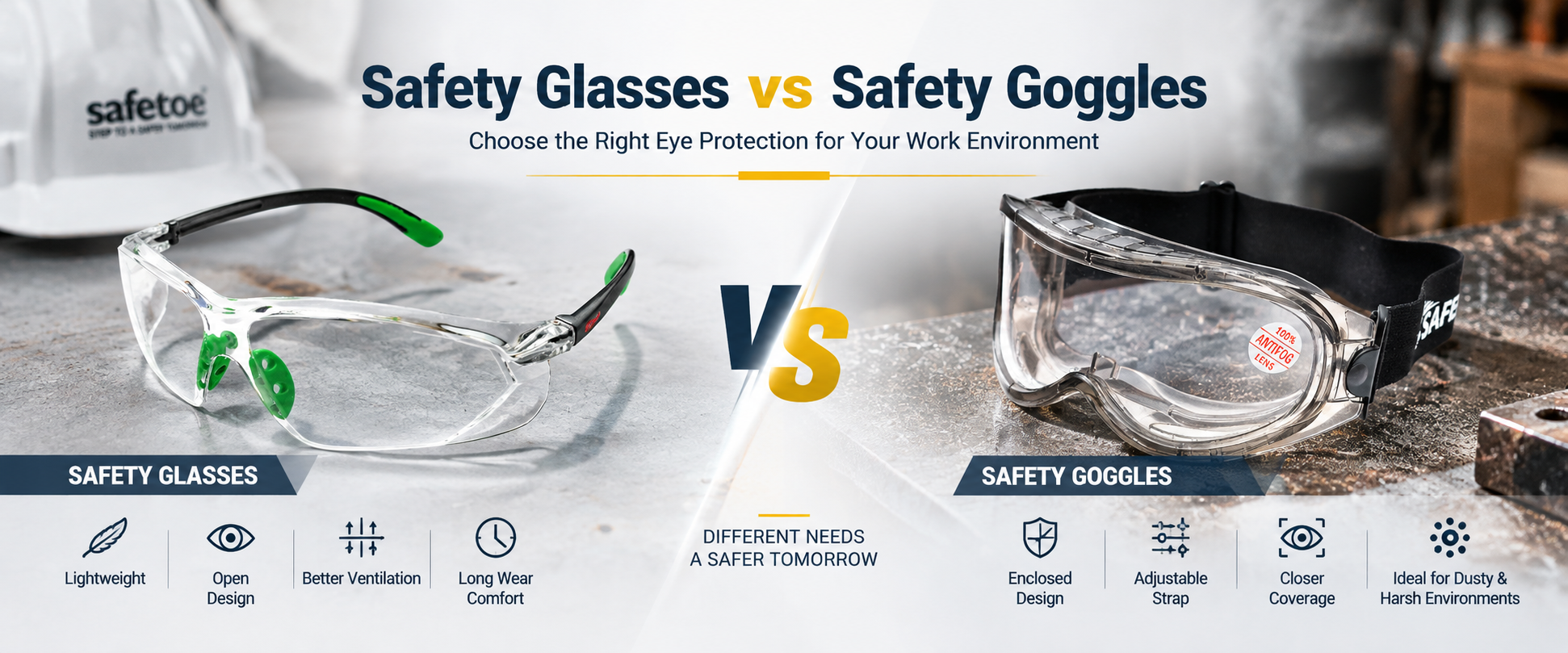
The main difference is how closely the eyewear encloses the eye area. Safety glasses generally use an open frame with side or wraparound coverage, while goggles provide closer coverage with fewer open gaps.
Feature
| Safety Glasses | Safety Goggles |
| Coverage | Open / wraparound | More enclosed |
| Ventilation | Generally better | More limited depending on design |
| Weight | Usually lighter | Usually heavier |
| Long-shift comfort | Often better | Depends on fit/design |
| Dust / debris gaps | More open | Reduced gaps |
| Strap | Usually no | Usually yes |
| Typical use | General industrial work | Dustier / higher-debris work |
4.Where Do Foam-Lined Safety Glasses Fit?
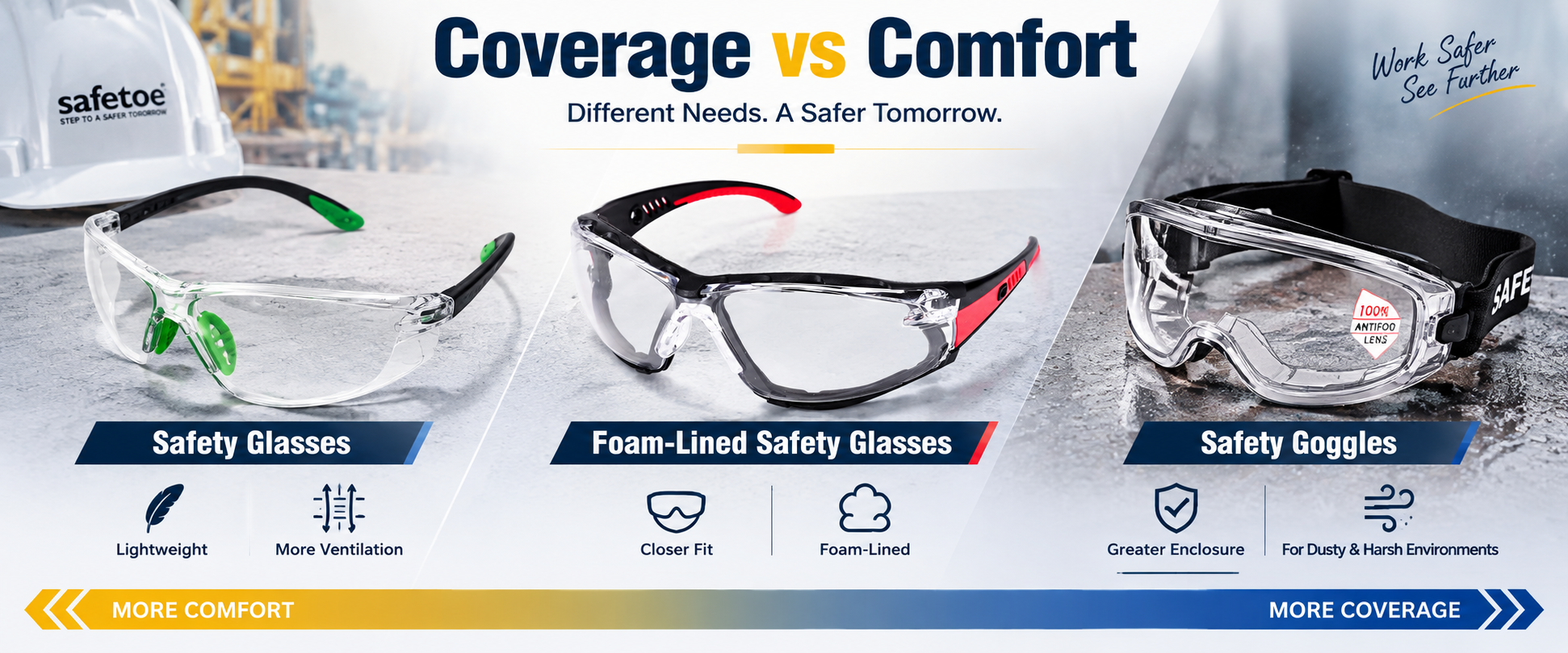
Foam-lined safety glasses can provide a closer fit around the eyes while retaining a spectacle-style design. A foam or cushioned insert helps reduce gaps between the frame and face, offering an option for workers who need closer coverage than standard safety glasses.
In terms of typical enclosure, the formats can be viewed as:
Standard Safety Glasses → Foam-Lined Safety Glasses → Safety Goggles
This progression describes increasing enclosure rather than a formal ranking of protection levels. Actual protection depends on the individual product, facial fit and applicable certification. Safeyear SG002 and SG037 are examples of cushioned or foam-lined safety glasses. Buyers should evaluate facial contact, ventilation, comfort and compatibility with other PPE to determine whether this format meets their workplace requirements.
5.When Are Safety Glasses the Better Choice?
Safety glasses are often a practical choice when their verified protection matches the task and workers need lightweight, ventilated eyewear.
✔ Long-Duration Wear
In warehousing, manufacturing and inspection, lightweight frames and good airflow can support comfortable wear throughout long shifts.
✔General Industrial Impact Risks
For flying particles and impact hazards, safety glasses may be appropriate when the workplace assessment confirms that the selected model provides the required coverage and performance.
✔ Frequent Movement
Workers moving between workstations or operating equipment may prefer a lightweight frame. A secure fit helps keep the eyewear in position during movement.
✔Warm Indoor Environments
Open frames generally allow more airflow, which may reduce heat buildup and fogging. Humidity and other PPE can still affect lens clarity.
For further guidance, see How to Choose Safety Glasses by Work Environment.
6.When Are Safety Goggles the Better Choice?
Safety goggles are worth considering when a task requires closer coverage or strap retention, provided the selected model meets the assessed protection requirements.
✔Higher Dust Exposure
In dusty construction or some mining work, closer-fitting eyewear can reduce open gaps. Dust protection still depends on the ventilation design, facial fit and verified performance.
✔Higher Particle or Debris Exposure
For grinding and other tasks that generate flying debris, consider goggles with impact performance and coverage appropriate to the assessed hazards.
✔When More Eye-Area Enclosure Is Needed
Goggles may suit tasks requiring closer coverage around the eyes. For industrial cleaning, any required chemical splash protection must be verified for the specific model.
✔When a Secure Strap Fit Is Preferred
An adjustable strap can help keep goggles in position during movement. Check that the fit remains comfortable and compatible with other PPE.
For grinding applications, explore the Grinding Safety Glasses Solution and read Safety Glasses for Grinding for further selection guidance.
7.What About Fogging and Comfort?
Closer-fitting eyewear may reduce airflow and retain warm, humid air around the lenses. Fogging risk depends on the environment, ventilation design and combination of PPE. Frame contact and strap tension can also affect comfort during long shifts.
Evaluate these factors alongside eye-area coverage:
Ventilation: Match the ventilation design to the assessed workplace hazards.
Anti-fog performance: Consider the lens treatment, working conditions and manufacturer’s care instructions.
Fit: Check for stable positioning and comfortable contact around the eyes.
Strap pressure: Look for secure retention without excessive pressure on the face.
Respirator compatibility: Check that the eyewear and respirator fit together without interfering with either item’s correct positioning or seal.
A wear trial during representative work tasks can help assess visibility, comfort and compatibility with other PPE.
For further guidance, explore Veratopium™ Anti-Fog Technology and read Why Do Safety Glasses Fog Up?
8.Quick Guide: Which Eyewear Type Fits Each Work Environment?
The table below outlines eyewear types to evaluate for common work environments.
Work Environment
| Common Need | Eyewear Direction |
| Warehouse | Lightweight, long wear | Safety Glasses |
| Manufacturing | General impact / workstation-specific hazards | Safety Glasses / Foam-Lined |
| Construction | Dust + flying debris | Wraparound / Foam-Lined |
| Grinding | High-speed particles + debris | Foam-Lined / Goggles |
| Mining | Dust + debris + harsh environment | Foam-Lined / Goggles |
| Inspection / Visitors | Lightweight general protection | Safety Glasses |
This table provides direction only. The final choice should always follow a workplace hazard assessment.
9.Recommended Safetoe Safety Glasses & Goggles
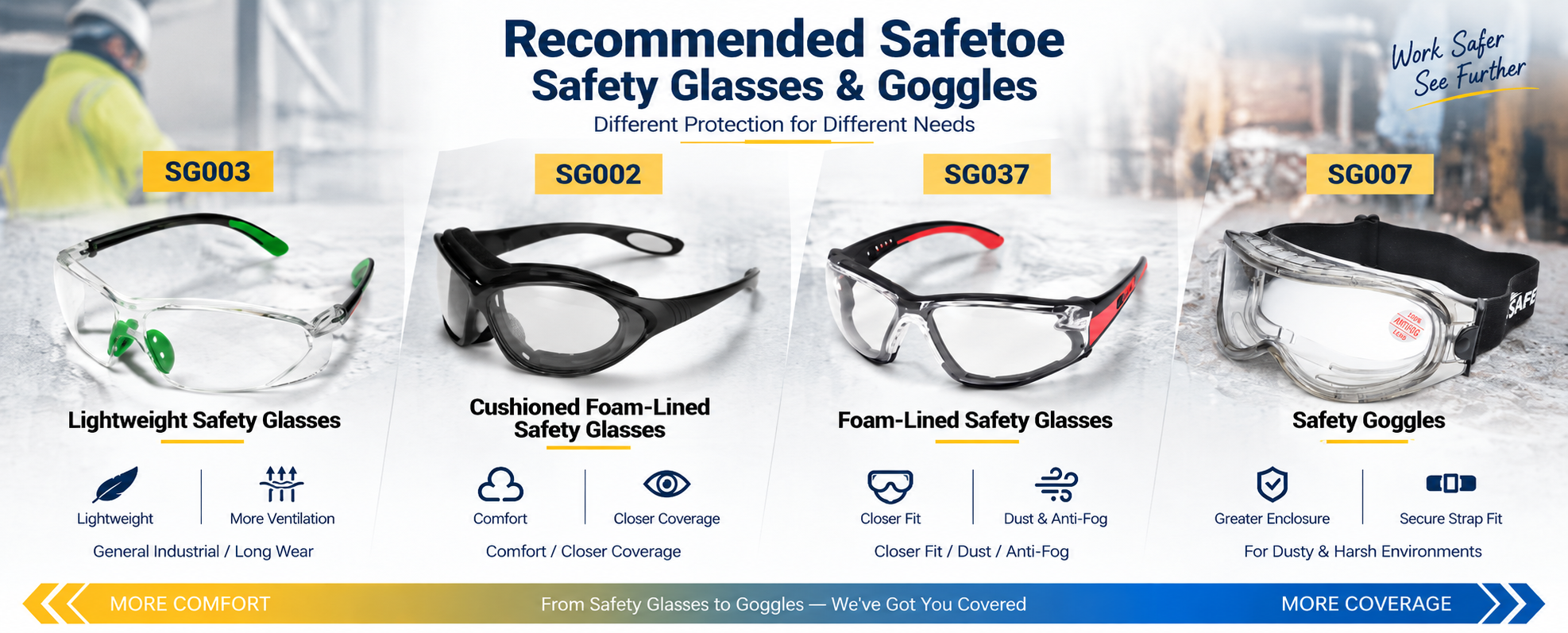
Safetoe offers eyewear formats across the coverage spectrum:
SG003 – Lightweight safety glasses for general industrial use and long wear.
SG002 – Cushioned foam-lined safety glasses for closer coverage and comfort.
SG037 – Foam-lined anti-fog safety glasses for dusty or higher-particle tasks.
SG007 – Safety goggles with greater enclosure and a secure strap fit.
Supporting technologies include Flexentra™ Comfort System and Wrapova™ Side Protection, which help improve fit, comfort and side coverage.
10.Safety Standards Still Matter
"Safety glasses" and "safety goggles" describe product formats, not automatically verified protection levels. Before purchasing, identify the intended work hazard and confirm the applicable standard, required markings and supporting documentation for the exact model.
Standards such as EN ISO 16321 and ANSI/ISEA Z87.1provide important frameworks for evaluating protective eyewear, but applicable requirements vary by market and application. Always ensure that the product's tested performance matches the workplace hazard assessment.
Summary:
Safety glasses are often well suited to lightweight, long-duration industrial use, while safety goggles offer greater enclosure for dustier or higher-particle environments. Foam-lined safety glasses sit between these formats by providing a closer fit without becoming fully enclosed goggles. However, product format alone does not determine protection. The correct choice should always be based on the actual workplace hazards, verified product performance, facial fit and compatibility with other PPE.
Explore Safety Eyewear or View Safety Goggles to compare Safeyear options for different industrial applications.
Author: Jay Yuan, Technical Marketing Director, Safetoe
Source: Safetoe Academy




 English


