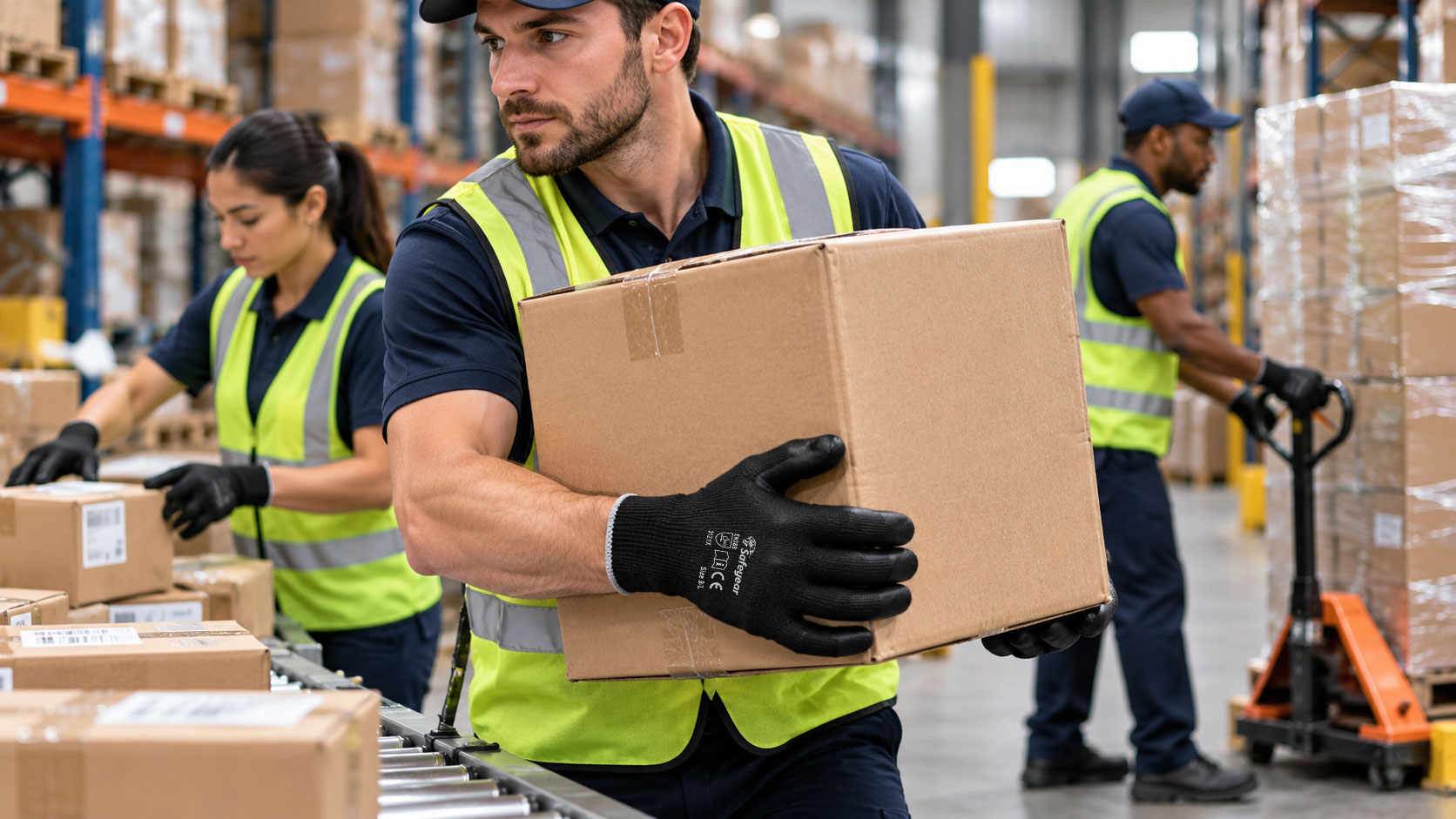
Warehouse and logistics workers repeatedly handle cartons, pallets, packages, tools and components throughout the day. These jobs may not involve the same heavy hazards found in mining or oil & gas, but rough packaging, sharp edges, slippery surfaces and repetitive handling can still affect both hand safety and working efficiency.For most warehouse operations, the best glove is not necessarily the glove with the highest protection rating.
The real goal is to balance:
Grip + Dexterity + Durability + Task-Appropriate Mechanical Protection
This guide explains how to choose warehouse work gloves for picking, packing, loading, sorting and material handling based on the actual demands of the task.
1.What Hand Hazards Do Warehouse Workers Face?
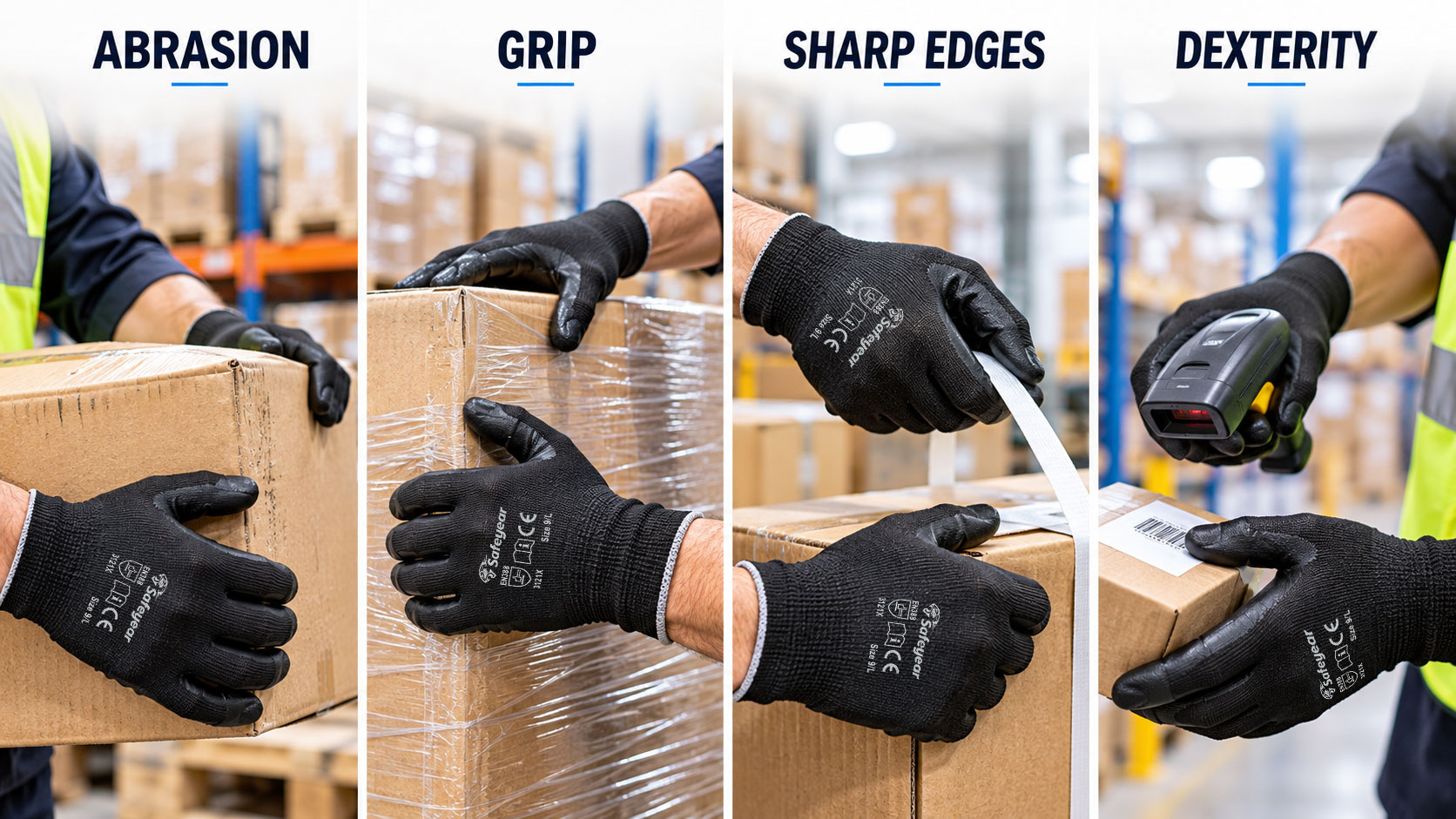
Warehouse work is often about repeated handling performance rather than extreme protection. Four factors deserve particular attention.
1.Abrasion & Repetitive Handling
Cartons, pallets, packaging and rough surfaces can repeatedly rub against the palm and fingers during a shift.Over time, this can wear down both the glove and the worker's hands.For repetitive material-handling tasks, durability matters because the glove must maintain useful performance through repeated contact.
Learn more about DuralVanta™ Durability Technology.
2.Grip Loss
Smooth cartons, plastic containers, tools or damp surfaces can become difficult to hold securely.Poor grip can increase handling effort and may make workers squeeze harder than necessary. A suitable palm coating and surface texture can help improve control during repeated handling.
Learn more about GripVanta™ Grip Technology.
3.Cuts & Sharp Edges
Some warehouse operations involve metal strapping, damaged packaging, sharp components or sheet materials.These tasks may require additional cut protection.However, cut resistance should match the actual hazard. General carton picking or packing should not automatically be treated as a high-cut-risk task.
Learn more about VarioNova™ Cut Protection Technology.
4.Reduced Dexterity
Picking, scanning, packing and handling smaller items require accurate finger movement.A glove that is unnecessarily thick or stiff may reduce control and slow repetitive warehouse tasks.
That is why dexterity is a real selection factor, not simply a comfort feature.
2.How to Choose Warehouse Gloves by Task
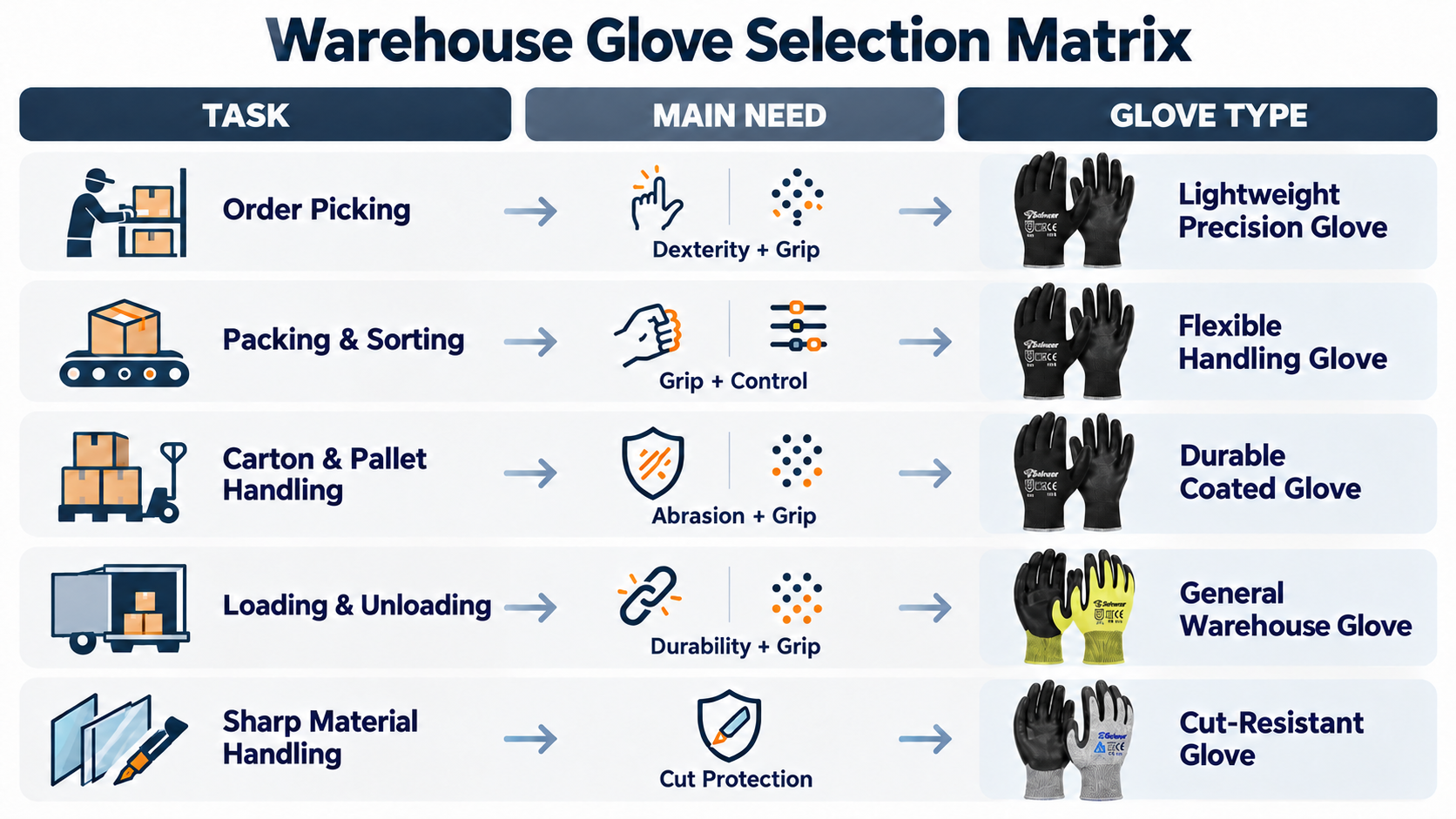
Different warehouse activities place different demands on the hands.
| Warehouse Task | Main Need | What to Look For |
| Order Picking | Grip + dexterity | Lightweight, flexible construction |
| Packing & Sorting | Dexterity + grip | Good finger control and secure handling |
| Carton & Pallet Handling | Abrasion + grip | Durable palm with reliable grip |
| Loading & Unloading | Grip + durability | Stronger mechanical protection |
| Sharp Material Handling | Cut protection | Appropriate EN 388 cut resistance |
The important point is that warehouse gloves should be selected by task rather than by one universal protection level.
A lightweight glove may be more suitable for order picking and scanning, while loading, pallet handling or repeated contact with rough materials may justify greater abrasion resistance.Where sharp metal, strapping or damaged components are present, a more protective cut-resistant glove may be appropriate.
3.Grip, Dexterity or Durability: What Matters Most?
For general warehouse work, these three factors often matter more than maximum mechanical protection.
1.Grip
Reliable grip helps workers handle cartons, plastic containers and packaged goods with greater control.
Palm coatings and grip-oriented surface technologies can be particularly useful during loading, sorting and repetitive material handling.
→ GripVanta™ Grip Technology
2.Dexterity
Order picking, barcode scanning, packing and small-item handling all depend on finger control.
A glove should provide sufficient protection without making the worker fight against the glove during every movement.
This is where a model such as PN8003, with Dexterity Level 5, becomes particularly relevant for warehouse applications.
3.Durability
Warehouse gloves may contact cartons, pallets and packaging hundreds of times during a shift.
Durable palm construction can therefore be more important than adding protection features that the task does not actually require.
→ DuralVanta™ Durability Technology
For most general warehouse tasks:
Balance is more important than maximum protection.
4.When Do Warehouse Workers Need Cut-Resistant Gloves?
Not every warehouse worker needs a high-level cut-resistant glove.
Additional cut protection becomes more relevant when workers handle:
metal strapping;
sheet metal or metal components;
broken or damaged packaging;
sharp parts;
recycling or waste materials.
By contrast, ordinary carton picking, packing and sorting may place greater emphasis on grip, dexterity and abrasion resistance.
The correct approach is to identify the actual cutting hazard first and then select an appropriate glove.
→ VarioNova™ Cut Protection Technology
For more detailed cut-level selection, this section can later link to:
How to Choose Cut-Resistant Gloves: EN 388 Cut Levels A–F Explained
5.What Does EN 388 Mean for Warehouse Gloves?
EN 388 is an important reference for mechanical protective gloves.
Depending on the product and applicable test results, it can provide information related to:
Abrasion
Cut
Tear
Puncture
Optional Impact
For warehouse buyers, the key point is not to simply choose the highest available rating.The appropriate EN 388 performance depends on the actual warehouse task.General picking and packing may not require the same mechanical protection as sharp-component handling or heavier loading operations.
Buyers should therefore review the specific glove's test results and match them to the workplace hazard.
→ EN 388 Mechanical Protection Guide
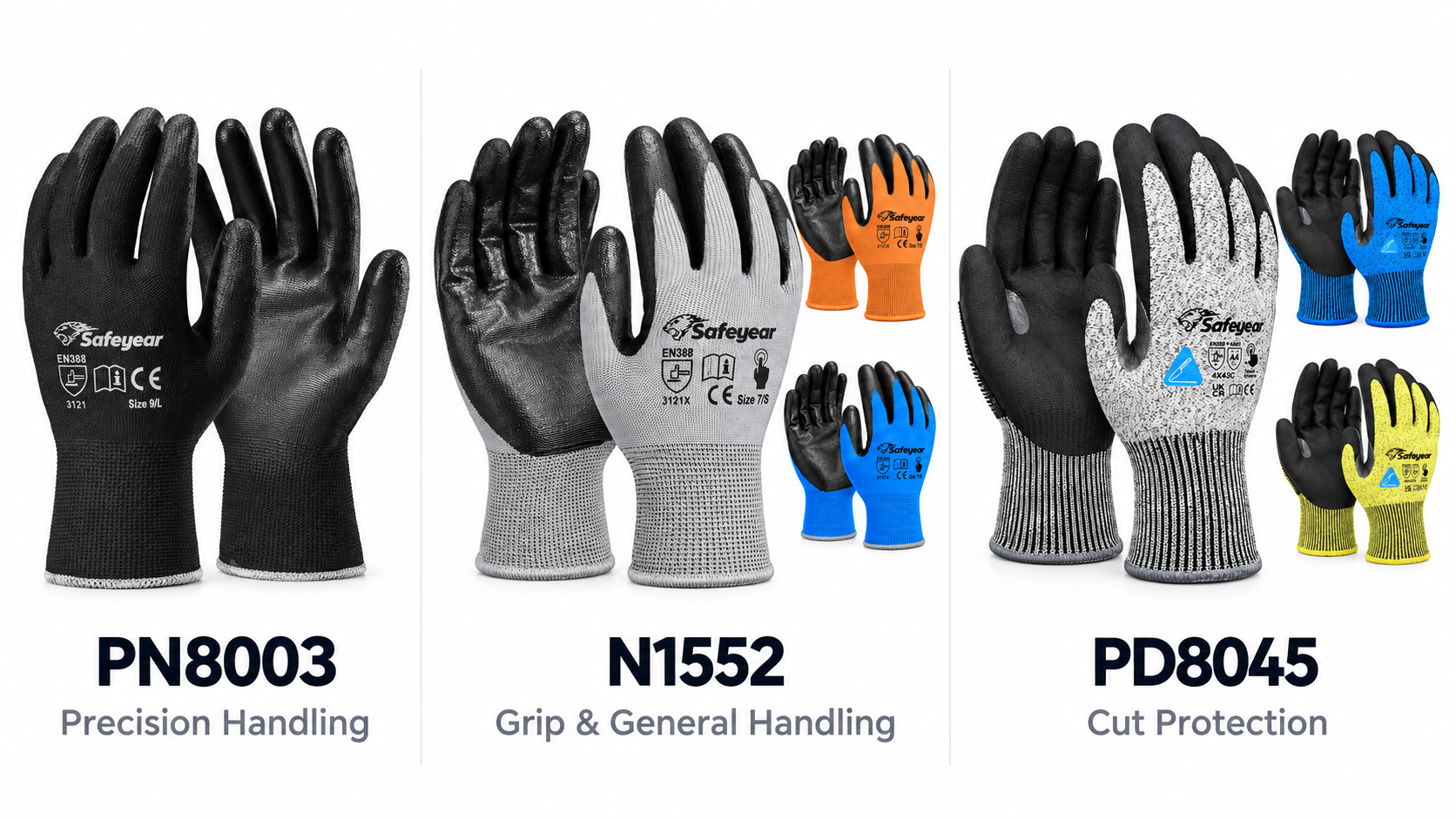
6.Recommended Safeyear Gloves for Logistics & Warehouse Work
Rather than presenting many similar models, three products can cover three clear warehouse needs.
1. PN8003 — Precision Handling
Best for: Order Picking · Packing · Assembly · General Warehouse Handling
Key evidence: EN 388 3121X · Dexterity Level 5 · PU Coated Palm
Positioning: Precision Handling
PN8003 is the primary recommendation where workers need precision, flexibility and finger control during repeated handling.
2. N1552 — Grip & General Material Handling
Best for: Carton Handling · Loading · General Logistics · Repetitive Material Handling
Key evidence: EN 388 3121X · Dexterity Level 5 · Nitrile Coating
Positioning: Grip & General Handling
N1552 is positioned around grip and everyday material handling, making it suitable for many general warehouse operations.
3. PD8045 — Cut Protection for Sharp Materials
PD8045 should be treated as a specialized option, not the default warehouse glove.
It is more suitable where warehouse workers actually handle sharp materials, metal components or cutting hazards.
Positioning: Cut Protection
This distinction is important because it prevents buyers from assuming that every warehouse task requires a cut-resistant glove.
7.Warehouse Work Glove Selection Checklist
Before placing an order, buyers should confirm:
What materials are being handled?
How much grip is required?
Is high dexterity important?
Are there sharp edges or cut hazards?
How repetitive or abrasive is the task?
What EN 388 protection level is appropriate?
The objective is to match the glove to the worker's actual handling task, not simply to select the thickest or highest-rated product available.
8.Warehouse Work Gloves FAQ
Q:What are the best gloves for warehouse work?
The best gloves depend on the task. General picking and packing usually prioritize grip and dexterity, while pallet handling may require greater durability. Sharp materials may require additional cut protection.
Q:What gloves are best for picking and packing?
Lightweight, flexible gloves with good finger dexterity and grip are usually the most practical choice for picking, scanning, packing and small-item handling.
Q:Do warehouse workers need cut-resistant gloves?
Not always. Cut-resistant gloves are more appropriate where workers handle metal strapping, sharp components, damaged packaging or other genuine cutting hazards.
Q:What EN 388 rating is suitable for warehouse gloves?
There is no single EN 388 rating suitable for every warehouse task. Buyers should match abrasion, cut, tear and puncture performance to the actual materials and handling hazards involved.
Conclusion :
Warehouse glove selection is primarily about balancing grip, dexterity and durability, while adding higher mechanical protection only where the task actually requires it.For precision picking and packing, lightweight gloves with good finger control may be the better choice. Repetitive carton and pallet handling may require stronger grip and abrasion resistance, while sharp materials can justify additional cut protection.
The most effective approach is therefore simple:
Identify the Task → Identify the Main Need → Select the Appropriate Glove
That keeps warehouse PPE practical, protective and appropriate for the work being performed.

 English


