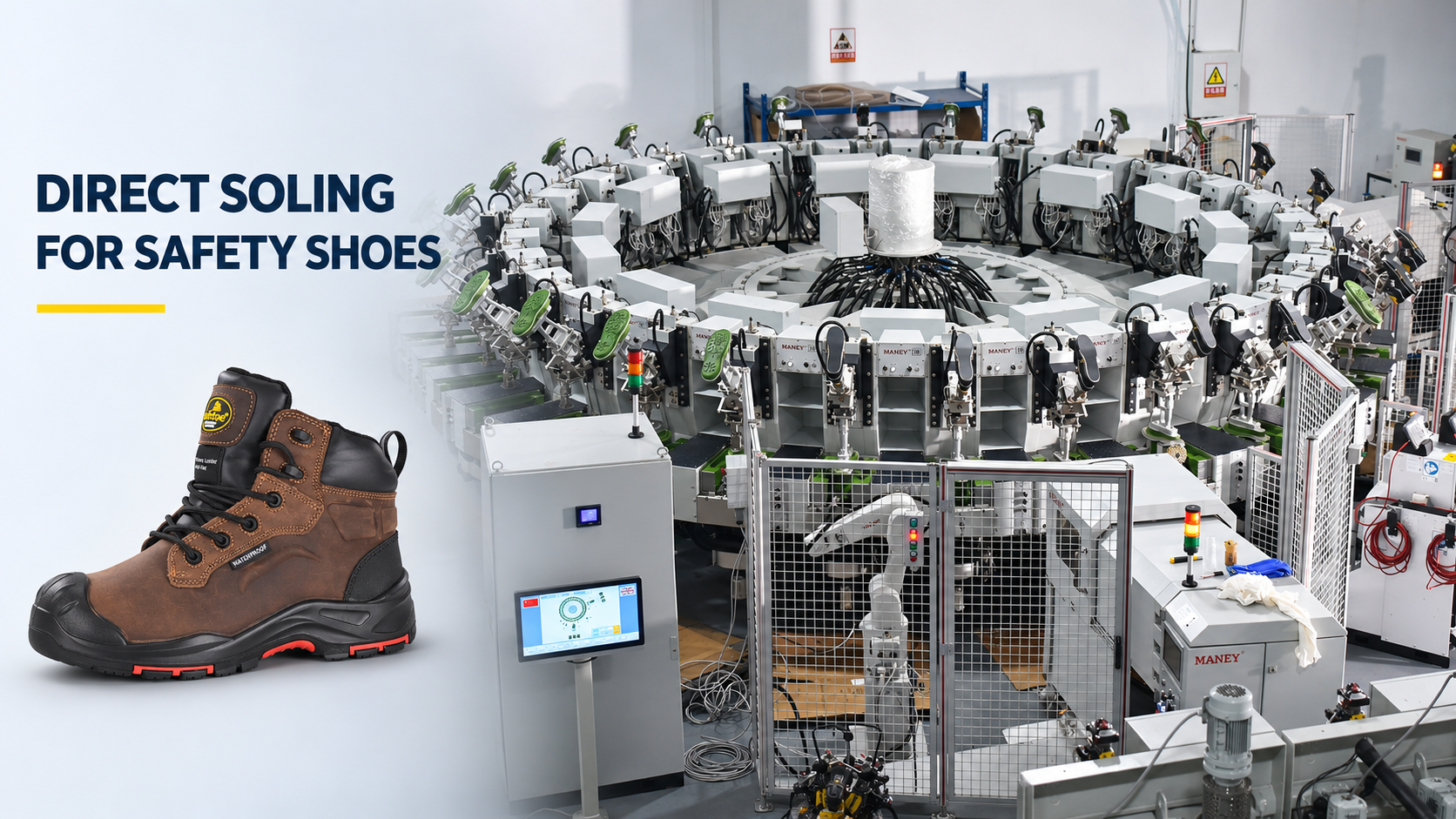
A safety shoe begins to take its final form where the upper meets the sole. This connection influences how the footwear holds together through repeated bending and everyday work. Direct injection soling forms the sole against a prepared upper inside a mould, bringing sole formation and attachment into a controlled production sequence.
At Safetoe, a 30-position direct-soling system is part of our safety-footwear manufacturing capability. For distributors, industrial buyers and private-label customers, understanding the process helps make better decisions about construction, samples and the evidence needed before placing a bulk order.
Quick answer: Direct injection soling introduces a compatible sole material into a mould around a lasted shoe upper. In PU direct soling, polyurethane forms the sole or joining layer against the prepared upper. The result depends on material compatibility, surface preparation, tooling and process settings, followed by checks on the finished footwear.
1. What Is Direct Injection Solin?
DESMA manufactures direct-soling equipment used in footwear production. The process is often referred to as the Direct Injection Process, or DIP. Instead of attaching a completed sole unit as a separate assembly operation, direct soling forms the relevant sole material against the upper within a mould.
The exact construction varies. In some designs, PU forms the sole itself. In others, a moulded PU layer connects the upper to another sole component. A product description should therefore identify the actual construction rather than treating every injection-made shoe as the same.
2. Inside Safetoe's 30-Position Production System
A rotary direct-soling line arranges multiple moulding positions around a rotating platform. The positions allow work to move through a repeated sequence while different shoes are at different stages of production.
The term “30-position” describes the layout of the system. They do not establish a fixed output per hour, or mean that 30 pairs are completed at once. Production planning also depends on the selected article, material reaction cycle, available moulds, staffing and changeovers.
For buyers reviewing this production system, the key questions are which sole constructions it supports, which sizes have available tooling and how the selected article moves through the moulding sequence. These details help connect the equipment layout to a specific footwear project.
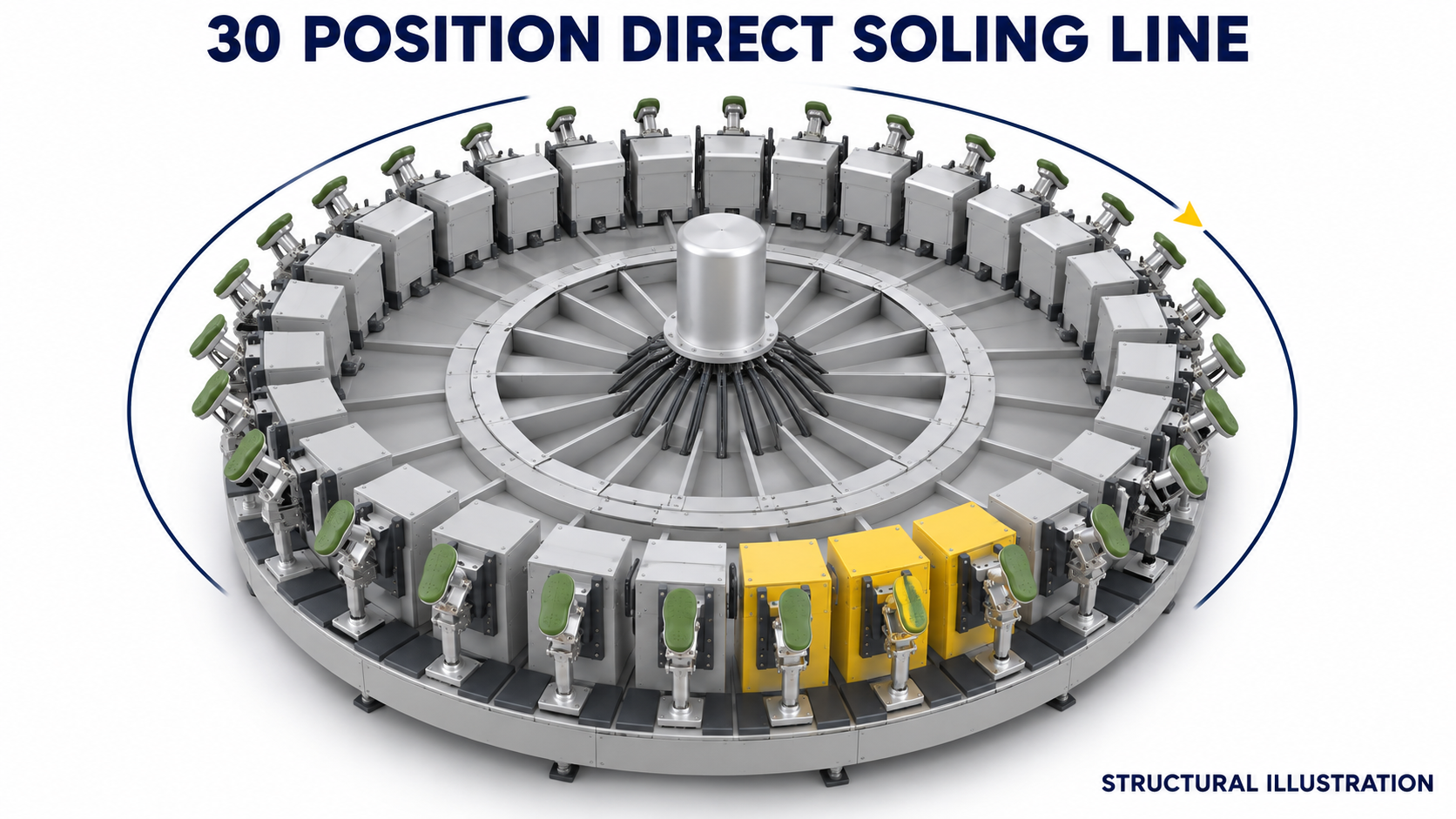
Structural illustration of a rotary direct-soling system. Equipment details vary by machine configuration.
3. How PU Direct Injection Soling Works
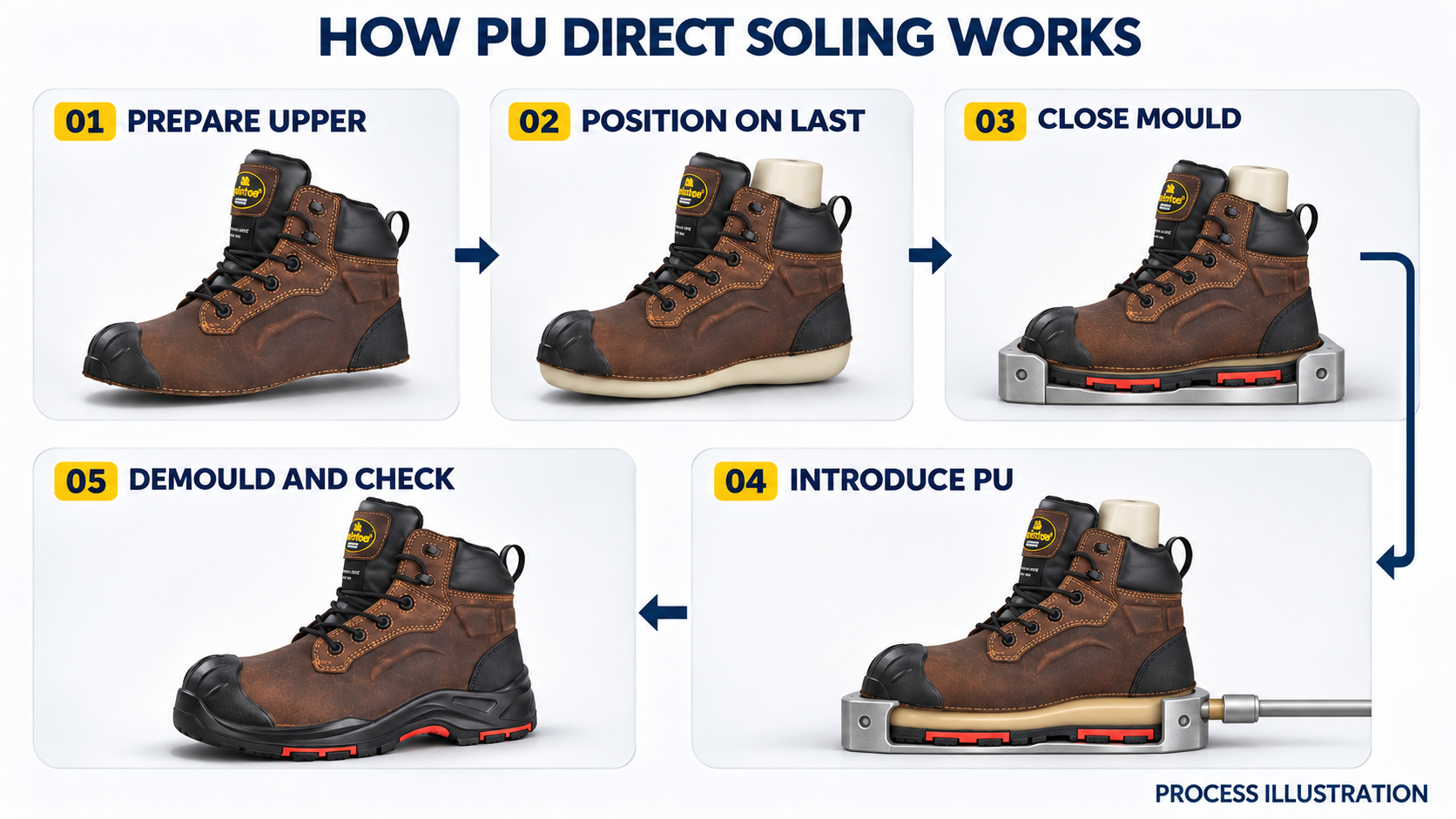
The following five stages explain the basic sequence. The working instructions for a particular shoe must suit its materials, tooling and production setup.
Step 01 Prepare the Upper
Complete the upper and prepare the area that will contact the soling material. Depending on the upper and process, this can involve controlled surface preparation and other specified treatments. Contamination or inconsistent preparation can interfere with the finished connection.
Step 02 Position the Upper on the Last
The last supports the upper and defines its shape during moulding. The upper must sit correctly relative to the sole mould so that the finished sidewall and joining area follow the intended design.
Step 03 Close the Mould
The mould closes around the lower part of the upper. Its geometry defines the relevant sole shape and details. Where a separate outsole component is used, its preparation and placement are part of the specified construction sequence.
Step 04 Dose and Introduce the PU
The PU components are metered, mixed and introduced into the mould. The material reacts and forms against the prepared upper and any compatible sole component used in the design. Settings must follow the selected material system and process instructions.
Step 05 Demould and Check
After the required reaction and demoulding cycle, the shoe is removed for finishing and inspection. Any additional conditioning and testing must follow the production specification before the footwear is accepted for shipment.
Why preparation matters: Consistent preparation of the upper contact area helps the selected soling material join to the upper as intended. Material compatibility, surface condition and positioning should be controlled together throughout the moulding process.
4. What Direct Soling Can Offer Buyers
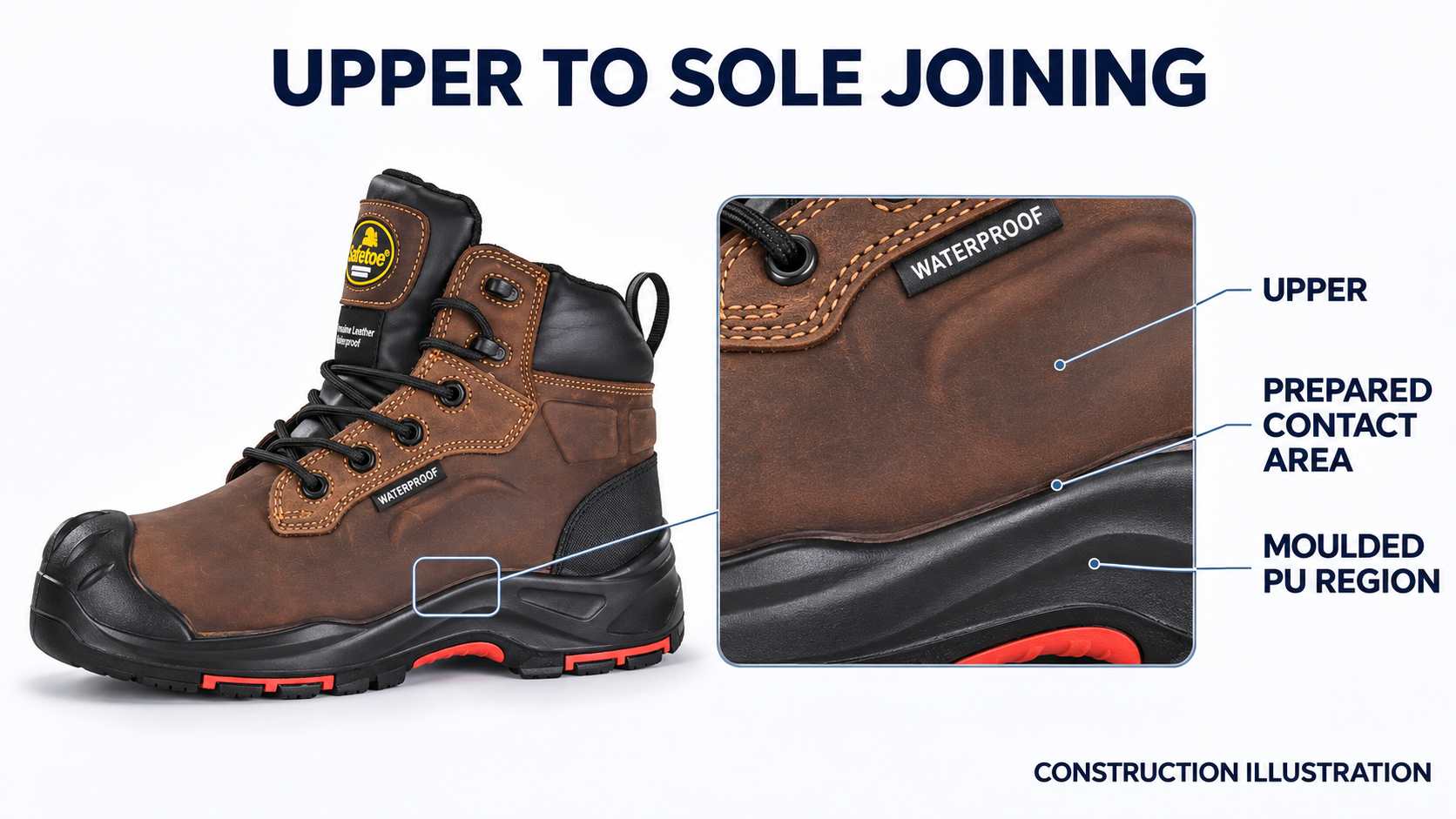
Upper-to-Sole Integratio
Direct soling forms compatible soling material against the prepared upper within the mould. This brings sole formation and attachment into one manufacturing sequence. The finished connection depends on the upper material, contact-area preparation and the selected soling system.
Consistency Across Repeat Orders
Specified materials, tooling and process settings give production teams a basis for controlling variation. An approved sample and agreed inspection criteria help translate those settings into a clear purchasing specification.
Moulded Sole Design Options
Moulds define sidewall forms, tread features and other moulded details. New shapes, size extensions or branding changes may require tooling work. Buyers should review feasibility before treating a design change as a simple cosmetic adjustment.
Material choice PU can be formulated for properties such as cushioning and flexibility. Oil resistance, hydrolysis behaviour, heat performance and slip resistance should be checked for the particular material system and finished footwear model.
5. Quality Checks Beyond the Machine
Supplier evaluation should follow the shoe from component preparation through finished-product assessment. The table below gives buyers a practical framework for discussing inspection requirements with a manufacturer.
Stage | What to review |
Before moulding | Upper preparation, component identity, material specification and correct tooling. |
During moulding | Upper positioning, material dosing and process settings for the selected construction. |
After demoulding | Visible voids, flash, sole finish and the condition of the joining area. |
Finished footwear | Relevant construction tests, protective-performance evidence and model identification. |
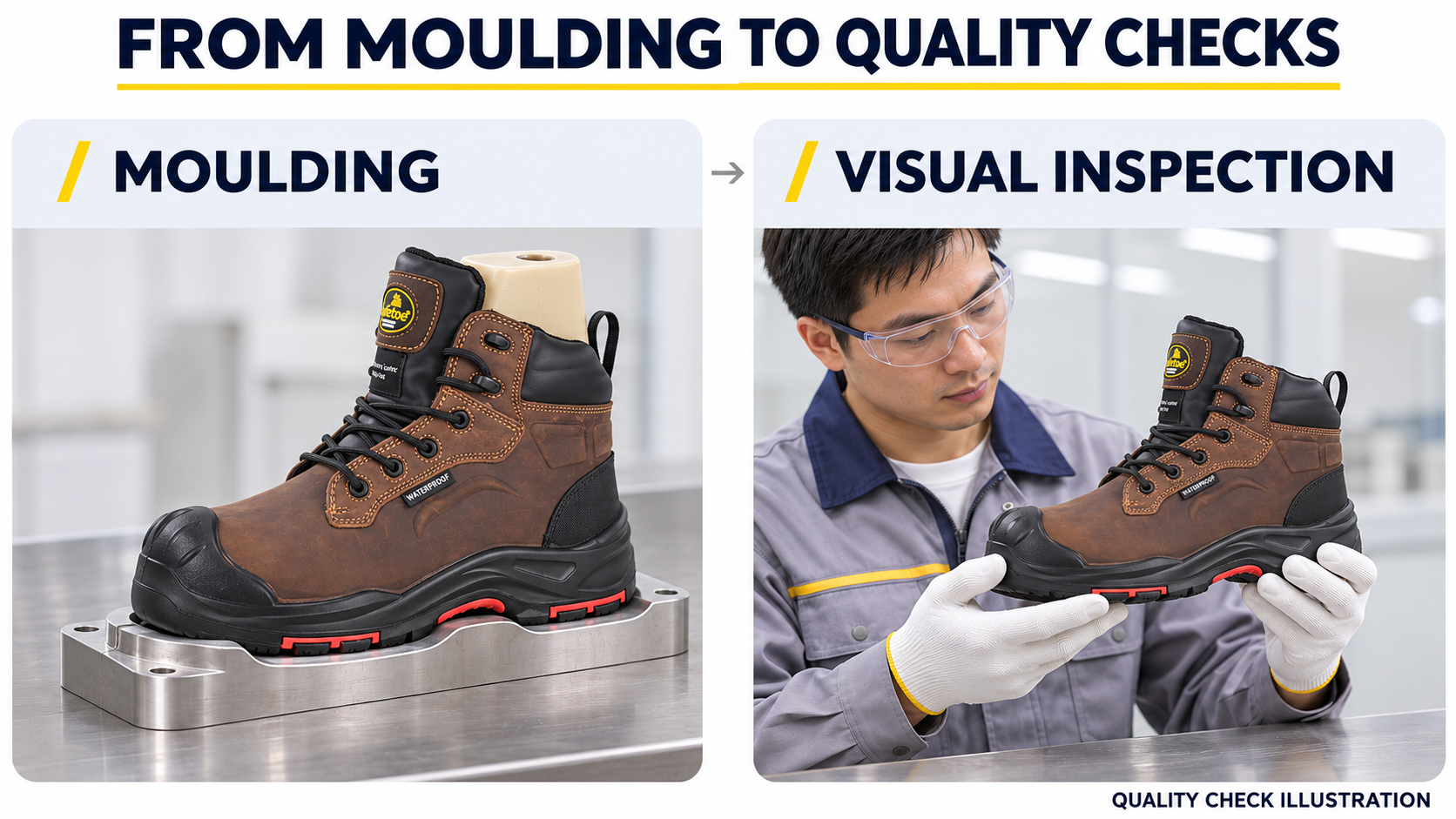
Appearance inspection and performance testing answer different questions. A clean sole finish does not establish bond strength, flexing durability, toe protection or slip performance. Review the relevant evidence for the exact model and intended market.
Production equipment supports manufacturing capability. Safety markings, test reports and any required conformity documents must refer to the finished footwear being supplied.
Explore Safetoe certifications and compliance
6. Direct Injection vs Cemented Construction
Both methods can be used in footwear production. Their main difference is how the upper and sole are assembled. A purchasing decision should consider the construction and finished results together.
Comparison | Direct injection | Cemented construction |
Assembly route | Soling material forms against the upper in a mould. | A pre-made sole unit is attached during assembly. |
Critical preparation | Prepare the upper and any sole component for the selected moulding system. | Prepare bonding surfaces for the selected adhesive system. |
Process control | Positioning, dosing, mould condition and reaction cycle. | Adhesive application, activation, pressing and curing. |
Design changes | Review material compatibility, moulds and machine configuration. | Review sole-unit availability, materials and assembly requirements. |
Buyer verification | Approve samples and review relevant finished-model evidence. | Approve samples and review relevant finished-model evidence. |
There is no universal durability ranking based only on the construction name. Compare samples and supporting information against the same intended use, rather than relying on an unsupported claim that one method is always stronger.
7. Planning an OEM or Wholesale Project
A useful enquiry connects the end use with a specific construction and approval process. Share the following information when discussing a safety-footwear project with Safetoe.
Target market and workplace. Identify where the footwear will be sold and the hazards or working conditions it must address.
Product and size requirements. Specify the preferred style, upper, sole construction, size range and expected size mix.
Branding and tooling. Describe logo, colour and sole-design changes so existing tooling and any development needs can be reviewed.
Sample approval. Agree which representative samples will be checked for fit, construction and appearance before bulk production.
Documentation and supply. State the required model documents, packaging, order quantity and delivery expectations.
When reviewing a representative sample, record the exact model and specification. This gives both parties a clearer reference for repeat orders and proposed changes.
8. Frequently Asked Questions
What does a 30-position injection system mean?
It describes multiple moulding positions on a rotary system. The number of positions alone does not determine finished pairs per hour or the delivery time for an order.
Are all direct injection safety shoes made from the same sole material?
No. Different systems and product designs use different compatible materials and constructions. Confirm the sole specification for the model you plan to buy.
Does direct injection automatically make a safety boot waterproof?
No. Waterproof performance depends on the complete footwear construction and relevant verification. The sole-attachment method alone is not evidence of waterproof performance.
Does using a DESMA machine mean the finished shoe is certified?
No. Machinery and finished-product certification serve different purposes. Check the markings and supporting documentation for the exact model and target market.
Can a direct injection design be customised for a private label?
Customisation needs a review of the requested upper, colours, branding, sizes and sole design. Some changes may use available tooling; others can require new development and sampling.
What should I request before placing a bulk order?
Request representative samples, a clear product specification, the required model documentation and agreed inspection criteria. Confirm the size breakdown, packaging and supply timetable as part of the order review.
Discuss Your Safety Footwear Project
Direct injection soling is most useful to a buyer when the production method is connected to a clear footwear specification. Materials, tooling, sample approval and finished-product checks all contribute to that decision.
Send Safetoe your target market, preferred footwear style, required protection, size range and estimated order quantity. Include any branding or sole-design requirements so our team can review suitable options and discuss the next sampling step.
Request samples
Discuss OEM requirements
Explore Safetoe manufacturing capabilities

 English


