Construction, Mining, Grinding, Warehousing & Industrial Work
Choosing safety eyewear should start with the work environment and its specific eye hazards—not simply with price, appearance or one product specification.
Workers in different environments may face flying particles, airborne dust, grinding debris, sparks, side-entry hazards, fogging and long wearing hours. Some may also need eye protection that fits over prescription glasses.
The right safety eyewear therefore depends on both the hazard and how the worker uses PPE throughout the shift.
A practical selection process is:
Work Environment → Eye Hazard → Protection Requirement → Eyewear Type
Explore Safetoe’s Industrial Safety Eyewear range for safety glasses, foam-lined eyewear, OTG models and safety goggles for professional work environments.
Start with the Eye Hazards, Not the Eyewear
Instead of beginning with:
“Which safety glasses should I buy?”
PPE buyers should first ask:
“What can reach the worker’s eyes in this environment?”
Common eye-protection challenges include:
Impact and flying particles from cutting, drilling, tools or material fragments
Dust and fine debris in construction, mining, warehousing and industrial production
Grinding particles and sparks approaching from the front or side
Fogging caused by humidity, active work or indoor–outdoor temperature changes
Long-duration wear, where pressure, slipping and repeated adjustment can affect compliance
Prescription eyewear needs, requiring additional internal space or an OTG design
Once the hazard is understood, buyers can determine the required coverage, fit, lens performance and eyewear configuration.
Safety Glasses for Construction
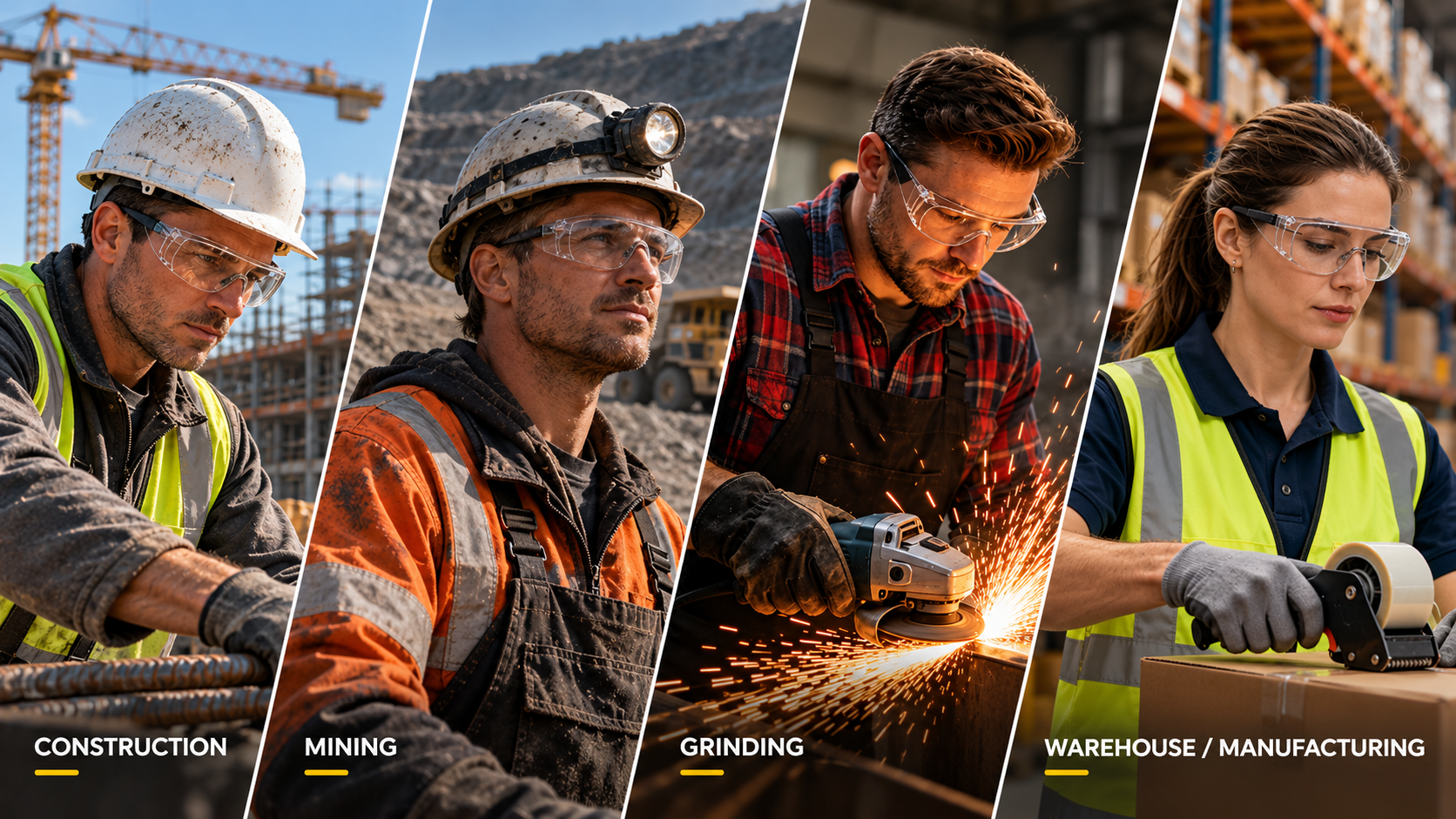
Construction workers may be exposed to flying concrete fragments, drilling particles, cutting debris, dust and hazards entering from the side. Outdoor work and changing weather can also increase the risk of lens fogging.
The main priorities are:
Impact Protection + Side Coverage + Anti-Fog + Secure Fit
Wraparound or extended-side designs can provide broader coverage than standard open-frame safety glasses where particles may approach from different angles. Safetoe’s Wrapova™ Extended Side Protection supports wider side coverage, while Veratopium™ Anti-Fog Technology helps maintain clearer vision during active work and changing environmental conditions.
For general or lightweight construction activities, SG003 may provide a practical option. For dustier environments requiring a closer fit, the foam-lined SG037 anti-fog safety glasses can offer additional coverage.
The final choice should always reflect the actual construction task and worksite risk assessment.
Safety Glasses for Mining
Mining environments often involve airborne dust, rock or mineral particles, flying debris, harsh outdoor conditions and extended wearing periods.
Compared with general construction, dust coverage and fit stability may require greater attention.
The main priorities are:
Dust Coverage + Impact Protection + Stable Fit + Lens Durability
Standard open safety glasses may not always provide sufficient coverage in high-dust areas. Depending on the risk assessment, workers may require closer-fitting foam-lined safety glasses or safety goggles with greater enclosure.
Lens durability is also important where eyewear is regularly exposed to mineral dust and abrasive particles. Korvion™ Scratch-Resistant Lens Technology is designed to support lens durability, while extended side coverage can help reduce exposure from particles approaching at an angle.
Models such as SG002and SG037 may be considered according to the required coverage level, fit and environmental conditions.
Mining does not automatically require one universal eyewear type. The correct configuration depends on dust concentration, impact risk and the individual work area.
Safety Glasses for Grinding
Grinding is one of the more demanding environments covered in this guide. Workers may be exposed to high-speed particles, metal fragments, sparks, dust and debris approaching from the side.
The main priorities are:
Impact Protection + Coverage + Stable Fit + Lens Durability
The required coverage level may increase with the task:
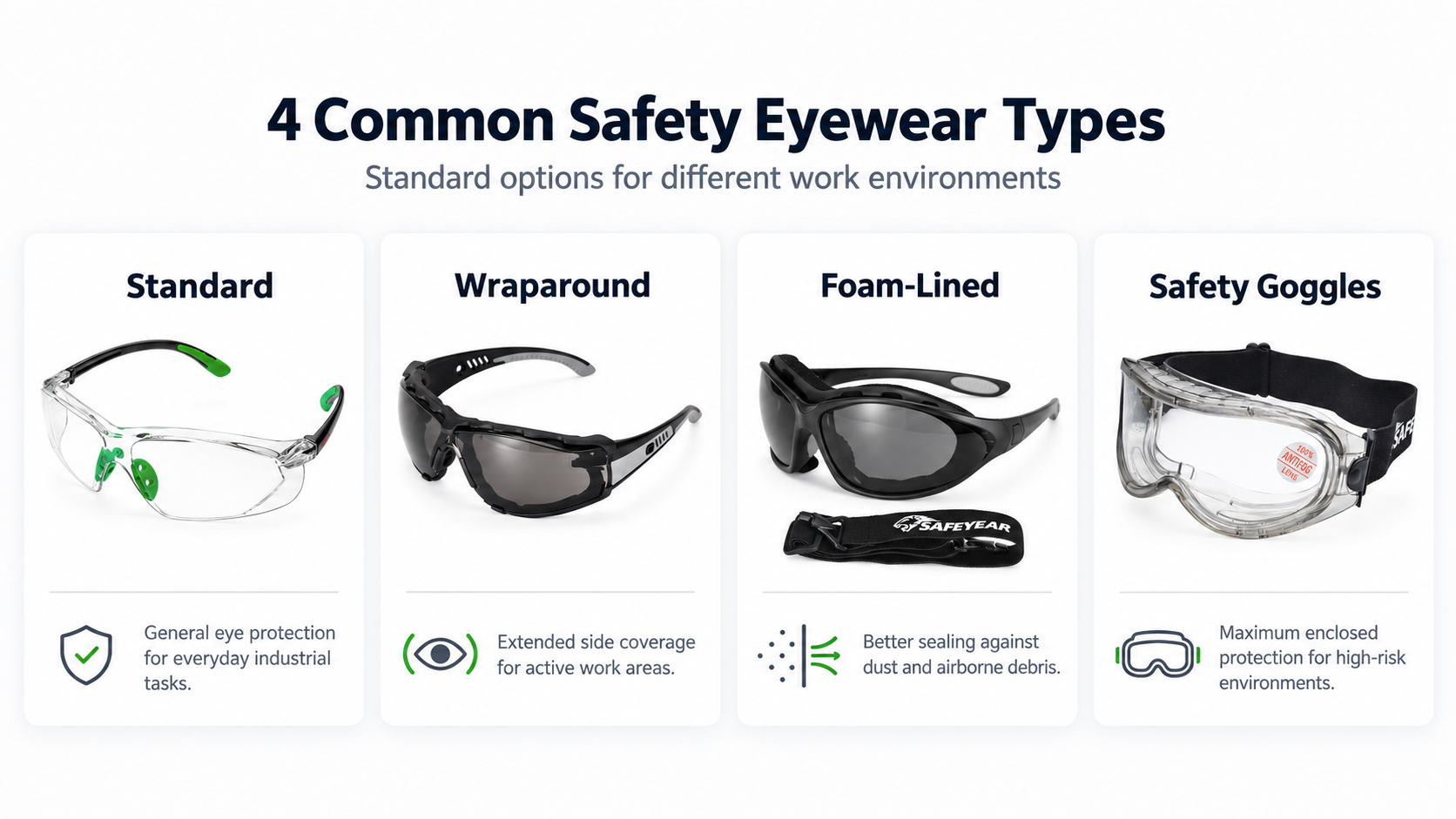
Standard Safety Glasses
Suitable for lower-exposure industrial tasks requiring basic impact protection.
Foam-Lined Safety Glasses
Provide a closer fit and additional protection against dust and side-entry debris.
Safety Goggles
Provide greater enclosure where the worksite risk assessment identifies a higher exposure level.
Products such as SG002, SG037 and SG007 represent different eyewear configurations that can be evaluated according to the grinding process and required coverage.
Buyers can also review Safetoe’s Grinding Safety Glasses Solution for grinding-specific hazards and protection priorities.
The objective is not to choose the most enclosed design for every task, but to match impact performance, coverage and fit to the actual grinding risk.
Safety Glasses for Warehousing and Logistics
Warehousing and logistics operations usually require a different balance from grinding or mining.
Workers may encounter dust, packaging debris, cutting tasks, loading activities and frequent movement between indoor spaces, loading docks, outdoor areas or refrigerated zones. Because eyewear may be worn throughout a full shift, comfort and clear vision are especially important.
The main priorities are:
Lightweight Design + Comfort + Anti-Fog + Everyday Impact Protection
Maximum enclosure is not always necessary. A better objective is:
Enough Protection + Low Weight + Clear Vision + Long-Shift Comfort
Temperature and humidity changes can cause lenses to fog when workers move between normal-temperature areas, refrigerated storage and outdoor loading zones. Anti-fog performance therefore has direct practical value in warehouse operations.
Long wearing hours can also create nose pressure, temple pressure, slipping and repeated adjustment. Flexentra™ Comfort System is designed around pressure reduction, fit stability and extended wear.
For warehousing, the best eyewear is often the model workers can wear comfortably and consistently throughout the shift while still meeting the required impact and coverage level.
Safety Glasses for Manufacturing
Manufacturing does not have one universal eyewear configuration because hazards vary by workstation.
A single factory may include assembly, inspection, machining, cutting, maintenance and dusty production processes. Each area can require a different balance of impact protection, coverage, comfort and enclosure.
A practical workstation-based approach is:
Assembly and Inspection
Lightweight safety glasses may be suitable where hazards are limited and extended comfort is important.
Machining and Cutting
Higher impact protection and wider coverage may be required around machine-generated particles and cutting debris.
Dusty Processes
Foam-lined safety glasses can provide a closer fit where fine particles are present.
Higher-Enclosure Applications
Safety goggles may be considered where the risk assessment identifies a need for greater eye-area coverage.
The key purchasing principle is:
One Factory Does Not Mean One Eyewear Type.
Manufacturing buyers should map each workstation to its specific hazards before standardizing eyewear across an entire facility.
Quick Comparison: Safety Glasses by Work Environment
| Work Environment | Common Eye Hazards | Main Eyewear Priorities | Typical Eyewear Type |
| Construction | Dust, flying debris, drilling particles | Impact + Side Coverage + Anti-Fog | Wraparound / Foam-Lined |
| Mining | Dust, rock particles, harsh conditions | Dust Coverage + Impact + Stable Fit | Foam-Lined / Goggles |
| Grinding | High-speed particles, metal debris, sparks | Impact + Coverage + Stability | Foam-Lined / Goggles |
| Warehouse | Dust, packaging debris, temperature changes | Lightweight + Comfort + Anti-Fog | Lightweight Safety Glasses |
| Manufacturing | Machine debris, cutting and assembly hazards | Depends on workstation risk | Safety Glasses / Foam-Lined / Goggles |
This comparison is a starting point rather than a substitute for a workplace risk assessment. The same industry may contain several tasks with different protection requirements.
What If Workers Wear Prescription Glasses?
Ordinary prescription glasses are not a substitute for certified industrial eye protection.
Workers who need to keep their personal prescription glasses on during work can consider OTG safety eyewear. OTG designs provide additional internal space to fit over conventional prescription frames while maintaining workplace eye protection.
Safetoe SG009 is an OTG-style option intended for workers who require additional internal space. Buyers should still confirm compatibility with the worker’s prescription frame, the required safety standard and the hazards of the job.
Explore OTG Safety Glasses for prescription-compatible industrial eye-protection options.
Safety Standards Still Depend on the Market and Application
Choosing the correct eyewear type is only part of the selection process.
PPE buyers should also confirm:
The applicable market and safety standard
The workplace risk assessment
The required impact or performance level
Product and lens markings
Certification and test documentation
Relevant standards may include EN ISO 16321 and ANSI/ISEA Z87.1.
The applicable standard and performance level should be verified against local regulations, employer requirements and project specifications before purchasing.
Match the Eyewear to the Hazard, Not Just the Industry
The best safety eyewear is not determined by industry name alone. It should match the specific hazards, working conditions and wearing requirements of each job.
Construction: impact protection and side coverage
Mining: dust coverage and stable fit
Grinding: impact protection and greater enclosure
Warehousing: lightweight comfort and anti-fog performance
Manufacturing: workstation-specific protection
A risk-based approach helps buyers avoid selecting one eyewear configuration for every employee, while also supporting comfort, compliance and appropriate protection.
Explore Safety Eyewear Solutions →
View Industrial Safety Glasses and Safety Goggles →

 English


