EN 352-1, EN 352-2 and EN 352-3 apply to different types of hearing protection. EN 352-1 covers earmuffs, EN 352-2 covers earplugs, and EN 352-3 covers earmuffs attached to head and/or face protection devices. The main difference is therefore the type of hearing protector each standard covers.
For PPE buyers, safety managers and distributors, understanding this distinction helps identify which standard should be reviewed for a particular product—and what additional information still needs to be checked before purchase or approval.
What Is EN 352?
EN 352 is a European standards series covering hearing protection products. It is used within the broader European PPE compliance framework, but it should not be confused with CE marking itself or treated as a certification body.
CE marking relates to conformity with applicable EU legislation, including PPE Regulation (EU) 2016/425 where relevant. EN 352 provides product-specific technical standards that can support conformity assessment.
The EN 352 series also contains additional parts addressing hearing protectors with other functions or configurations. This guide focuses on EN 352-1, EN 352-2 and EN 352-3 because they cover the three common hearing protection types discussed here: earmuffs, earplugs and attached earmuffs.
EN 352-1 vs EN 352-2 vs EN 352-3: Quick Comparison
| Standard | Hearing Protector Type | Typical Product |
| EN 352-1:2020 | Earmuffs | Over-the-head safety earmuffs |
| EN 352-2:2020+A1:2024 | Earplugs | Foam, corded or uncorded earplugs |
| EN 352-3:2020 | Attached earmuffs | Earmuffs attached to compatible head or face protection |
The simplest difference is that EN 352-1 applies to earmuffs, EN 352-2 to earplugs, and EN 352-3 to earmuffs attached to head or face protection devices.
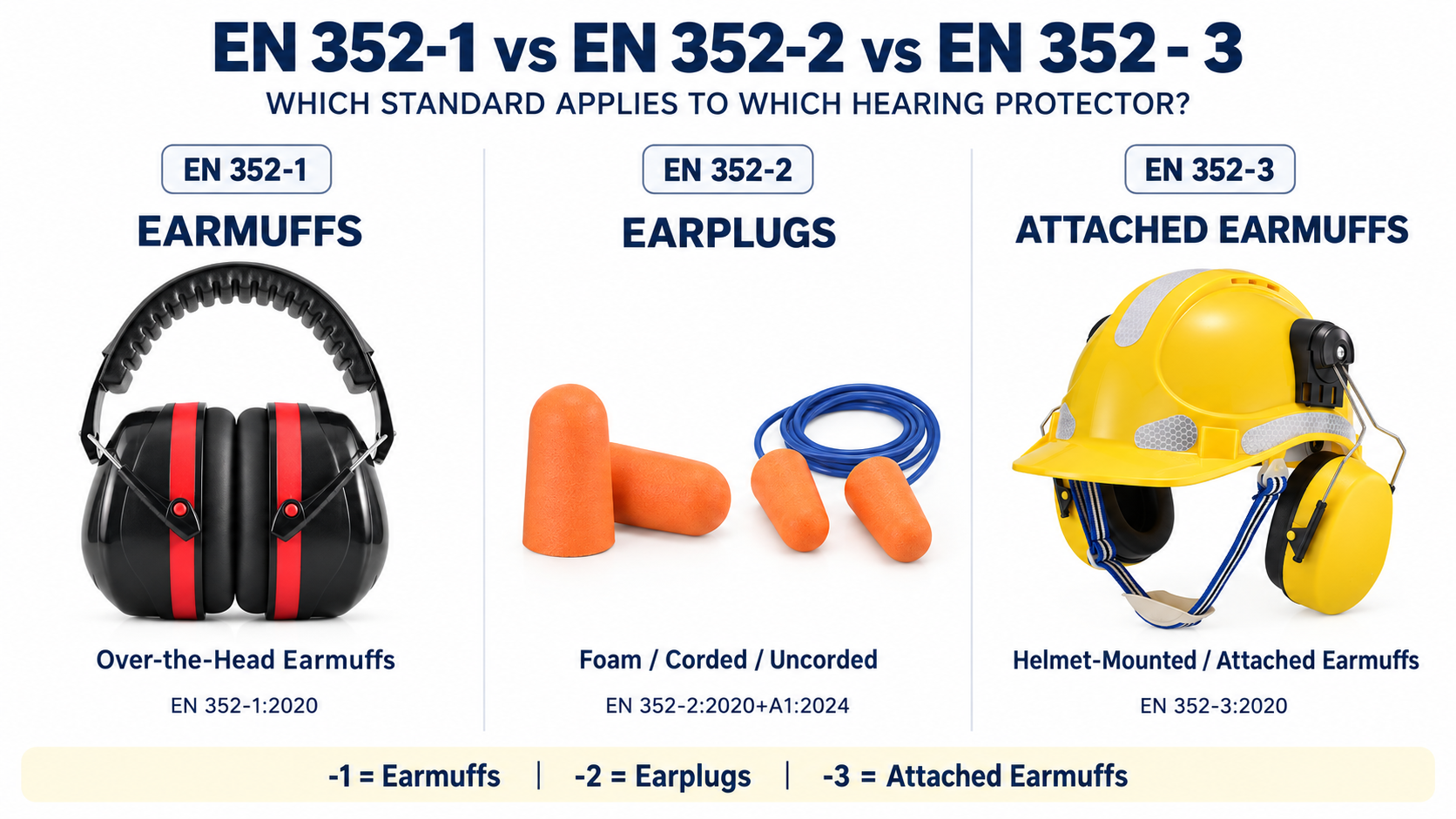
EN 352-1, EN 352-2 and EN 352-3 Hearing Protection Standards
For a broader overview of the European hearing-protection framework, see EN 352 Hearing Protection Standards
What Is EN 352-1?
EN 352-1:2020 applies to earmuffs.
These products typically use two ear cups connected by a headband. Important design and performance elements include the ear cups, cushions, headband, attenuation performance and how the earmuffs fit the wearer.
EN 352-1 does not represent one fixed attenuation level. Different earmuffs meeting the same standard can have different performance data.
Safeyear product examples include:
EM-5002 Professional Safety Earmuffs — SNR 33 dB
FM-1B Lightweight Safety Earmuffs — SNR 31 dB
EM-5003 Essential Safety Earmuffs — SNR 29 dB
These examples help illustrate what an EN 352-1 product may look like; they should not be read as a ranking of protection.
Related resources: Safety Earmuffs and EN 352 Hearing Protection Standards
What Is EN 352-2?
EN 352-2 covers earplugs, including products such as foam earplugs, corded earplugs and uncorded earplugs.
An important point for buyers in 2026 is the exact standard edition shown in current documentation. The current European standards framework includes EN 352-2:2020+A1:2024. However, this does not automatically change or upgrade the certification version shown on an existing product certificate.
The standard framework and the certification status of an individual product are separate issues.
For example, Safeyear hearing-protection products may include:
When reviewing these or other products, check the exact standard edition stated in the relevant certificate or test documentation rather than assuming the newest listed edition applies automatically.
What Is EN 352-3?
EN 352-3:2020 applies to earmuffs attached to head protection and/or face protection devices.
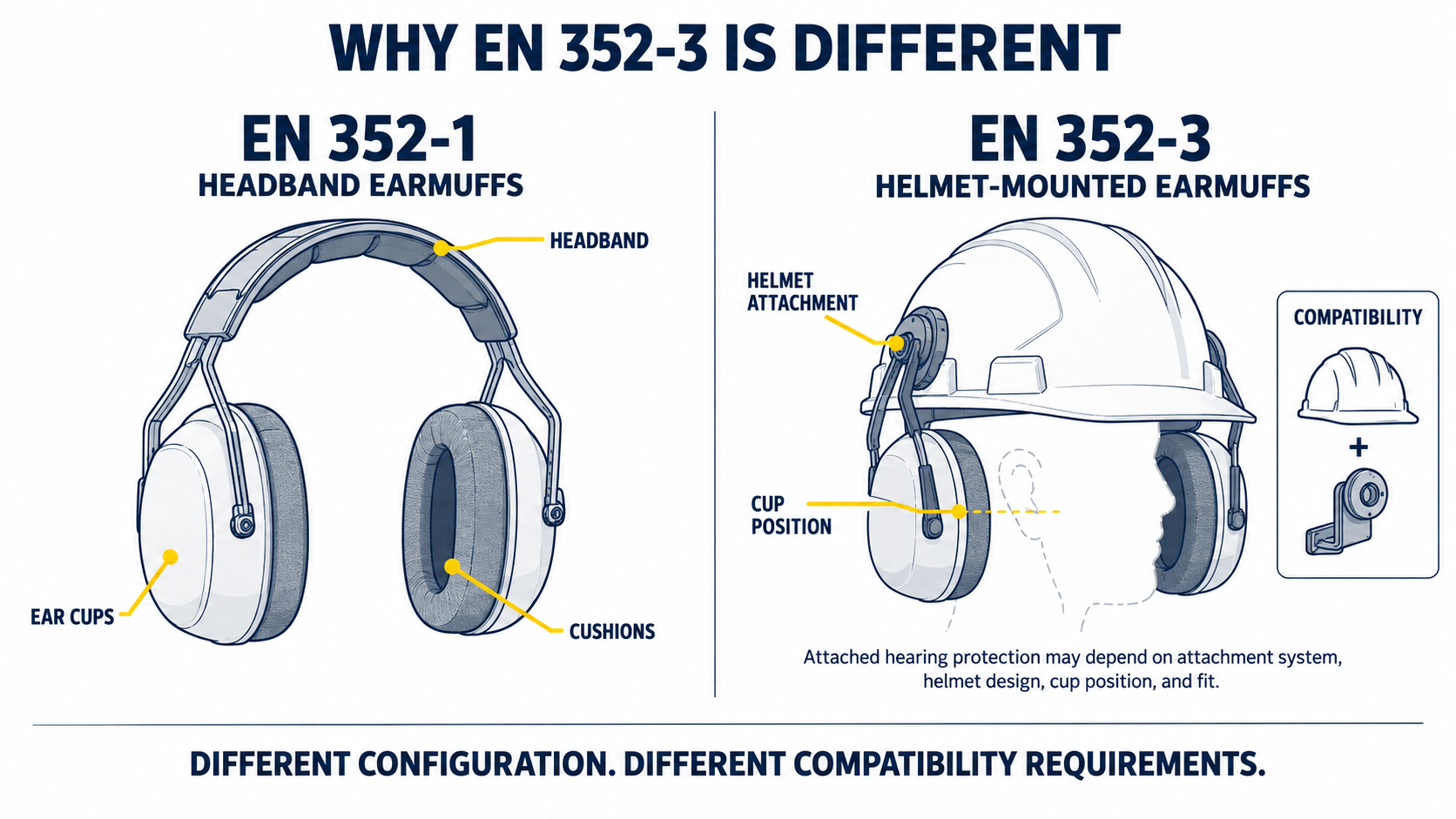
This category should not be understood simply as a conventional earmuff with an added clip. The attached configuration matters because the hearing protector works as part of a broader PPE setup.
Compatibility Matters
Several factors can influence an attached earmuff configuration, including:
attachment system
helmet design
cup positioning
fit
Safeyear's E-2008D Helmet-Mounted Safety Earmuffs can be used as a practical example. Where certification or testing refers to a specific combination, that combination should be stated accurately. For Safeyear E-2008D, the current product documentation identifies E-2008D + W-018 as the tested/certified combination. This should not be generalized to compatibility with all safety helmets.
Does EN 352 Tell You the Noise Reduction Level?
No—not by the standard number alone.
Seeing EN 352-1 on a product does not tell a buyer the product’s exact SNR or attenuation performance. Different earmuffs covered by the same standard can have different acoustic performance.
For procurement or safety evaluation, buyers should continue checking:
SNR
H/M/L attenuation data
exact product model
certificate
test documentation
The standard number identifies the relevant type of hearing protector and technical framework, but product-specific attenuation data is still essential.
This distinction is especially important when comparing several products that all reference the same EN 352 part.
The EU harmonised-standard listing also notes that these EN 352 parts do not themselves require the noise attenuation level to be labelled on the product, reinforcing the need to review product-specific attenuation data and documentation. ([EUR-Lex][2])
EN 352 vs NRR: Are They the Same?
No.
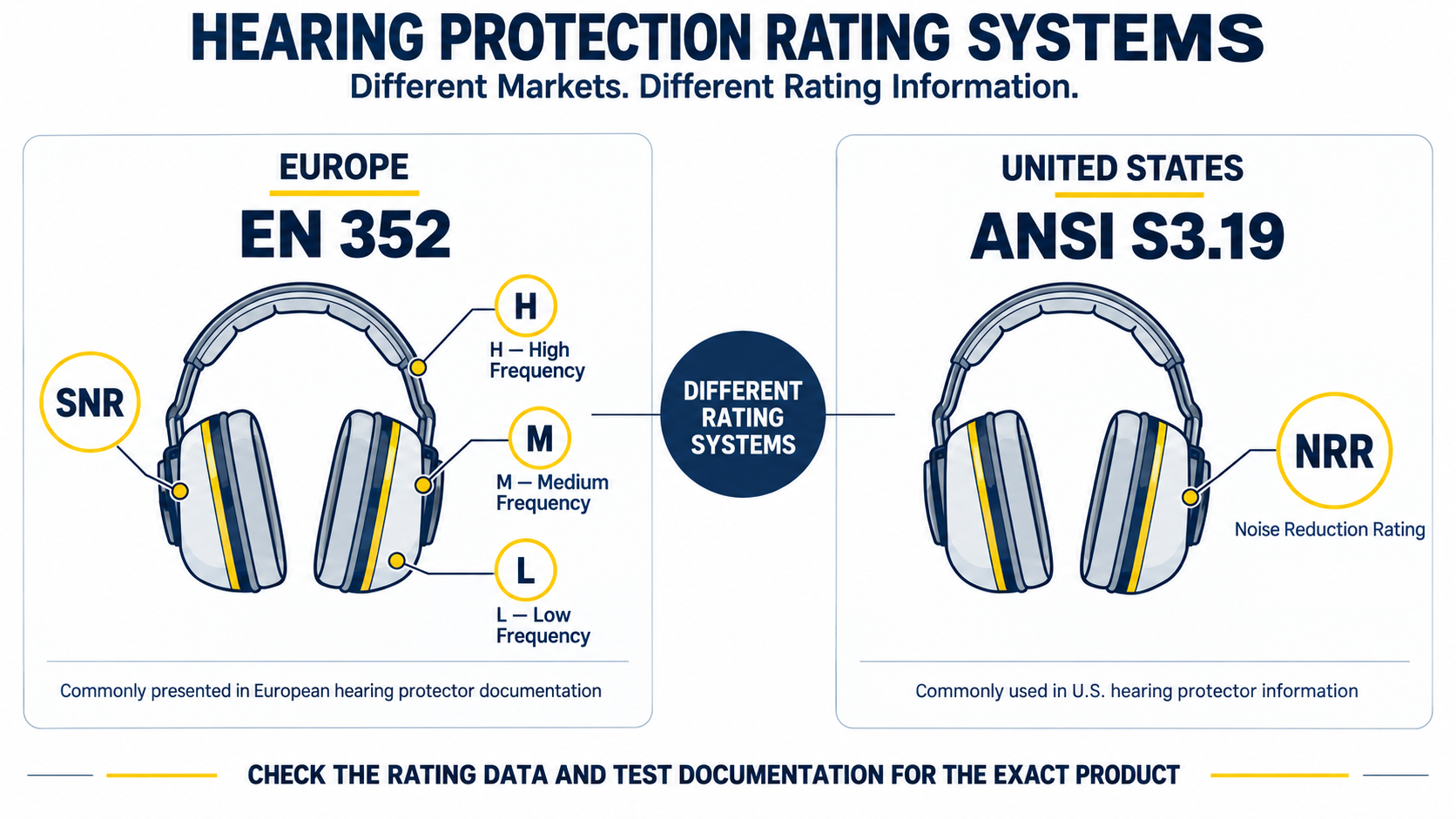
EN 352 is part of the European hearing-protection standards framework, while NRR is a noise-reduction rating commonly presented in U.S. hearing-protector information.
European hearing protector documentation commonly presents SNR and H/M/L attenuation data, while U.S. hearing protector information commonly uses NRR.
These should not be treated as identical rating systems or converted using a simple universal formula.
For more U.S.-market information, see U.S. NRR and ANSI S3.19 Reference
Which EN 352 Standard Should Buyers Check?
A simple starting point is to match the standard part to the hearing-protector type.
Buying earmuffs?
→ Check EN 352-1
Buying earplugs?
→ Check EN 352-2
Buying helmet-mounted or attached earmuffs?
→ Check EN 352-3 and the applicable compatible PPE configuration
Then verify:
The standard number is only one part of a complete product review.
FAQ
What Is the Difference Between EN 352-1, EN 352-2 and EN 352-3?
EN 352-1 covers earmuffs, EN 352-2 covers earplugs, and EN 352-3 covers earmuffs attached to head protection and/or face protection devices.
Is EN 352 the Same as CE Certification?
No. EN 352 is a European standards series for hearing-protection products. CE marking relates to conformity with applicable EU legislation, including PPE Regulation (EU) 2016/425 where relevant. A product’s standard reference and its broader conformity documentation should therefore be reviewed separately.
Does a Higher SNR Mean a Hearing Protector Is Always Better?
No. Appropriate hearing protection depends on actual noise exposure, fit, comfort, wearing time, communication needs and compatibility with other PPE. Excessive attenuation can also reduce communication and environmental awareness in some workplaces, so selecting the highest available SNR is not automatically the right approach.
Conclusion: Match the EN 352 Standard to the Hearing Protector
The key distinction is straightforward: EN 352-1 applies to earmuffs, EN 352-2 to earplugs, and EN 352-3 to attached earmuffs.
However, PPE buyers should not stop at the standard number. Always review the exact product, standard edition, attenuation data, certificate or test documentation and compatibility requirements where applicable.
For a broader overview of the European hearing-protection framework, visit EN 352 Hearing Protection Standards

 English


