Common Eye Hazards On Construction Sites

Construction eyewear 1

Flying Debris

Cutting, drilling and grinding can generate airborne particles.

Construction eyewear 4

Dust Exposure

Construction dust may reduce visibility and irritate eyes.

Construction eyewear 2

Impact Hazards

Unexpected objects and materials can strike the eye area.

Construction eyewear 3

Outdoor Conditions

Sunlight, wind and changing weather create additional challenges.

Recommended Safety Technologies

Technology-03

Veratopium™

Wash-Resistant Anti-Fog Technology

Technology-06

Korvion™

Scratch-Resistant Lens Technology

Anti-static

Flexentra™

Comfort Cushioning System

Technology-08

Wrapova™

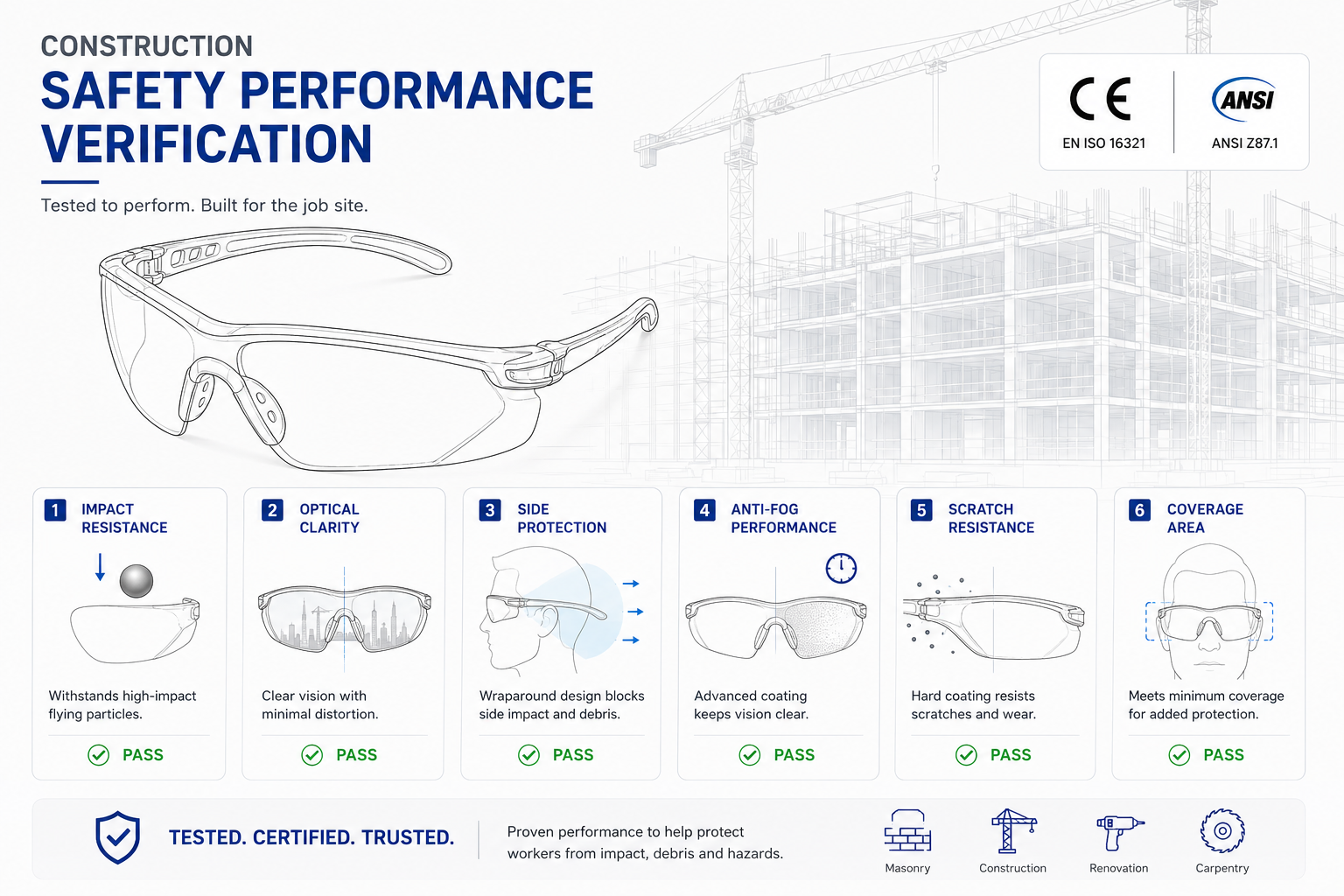
Extended Side Protection Design

Recommended Products

Related Videos & Blogs
Why and how to maintain work boots

Why and how to maintain work boots

This article explains why regular work boot maintenance is important for protection, comfort, foot health, and long-term performance. It covers key maintenance methods such as cleaning dirt from the sole, avoiding solvent-based cleaners, storing boots in a cool and ventilated place, using protective spray, removing laces before cleaning, applying leather care lotion, and avoiding waxy or oily products that may damage breathability. The article helps workers understand how proper care can extend the service life of work boots and maintain their protective performance.
Read More
How Heavy Are Oilfield Labor Insurance safety shoes?

How Heavy Are Oilfield Labor Insurance safety shoes?

This article explains whether the weight of oilfield safety shoes should be considered when purchasing work footwear. It points out that oilfield safety shoes are often heavier because they include multiple protective functions, with many conventional models weighing around 1000 grams per shoe, and even more when insulation or cotton lining is added. However, the article emphasizes that the suitable weight depends on the worker’s job content, working hours, walking distance, and department responsibilities. Since oilfield companies include drilling, exploration, transportation, machinery, refineries, and management roles, one type of safety shoe cannot meet all needs. The article recommends choosing oilfield safety shoes based on different workplace demands and highlights the importance of comfort, protection, and department-based procurement or customization.
Read More
Many Workers Solved The Problem by Switching To H-9437 Oil-Shield Pro Safety Boots

Many Workers Solved The Problem by Switching To H-9437 Oil-Shield Pro Safety Boots

This article introduces SAFETOE H-9437 Oil-Shield Pro Safety Boots, designed for oily and wet work environments. Featuring an oil-resistant nitrile rubber outsole, DESMA slip-resistant technology, steel toe protection, puncture resistance, waterproof leather, and S3 certification, H-9437 provides reliable safety, stability, and comfort for oil & gas, construction, mining, and industrial workers.
Read More
How to Choose Safety Boots for the Oil & Gas Industry? 3 Recommended S3 Work Boots for Middle East Projects

How to Choose Safety Boots for the Oil & Gas Industry? 3 Recommended S3 Work Boots for Middle East Projects

This article explains how to choose the right safety boots for oil & gas worksites, especially for Middle East project conditions. It introduces common jobsite risks such as oily floors, slippery metal platforms, sharp debris, falling tools, high-temperature work zones, long shifts, and static-related hazards. The article recommends matching each risk with the right boot function, including oil-resistant nitrile rubber outsoles, slip-resistant tread design, puncture-resistant midsoles, 200J toe protection, high-cut ankle support, shock absorption, waterproof breathable construction, and anti-fatigue comfort. It also recommends three Safetoe S3 work boots: M-8552 Tank for all-round oil & gas protection, H-9437 OilShield for oil-resistant high-cut ankle support, and H-9552 PolarGuard for cold conditions and night shifts. Finally, the article provides a quick checklist and FAQ to help buyers, contractors, and distributors choose suitable oil & gas safety boots.
Read More

FAQ

What Safety Glasses Should Construction Workers Wear?

Construction workers should wear safety glasses that meet ANSI Z87.1 or EN ISO 16321 standards and are appropriate for the hazards present on the jobsite. Typical construction risks include flying debris, concrete dust, wood chips, metal fragments, UV exposure, and side impacts from moving materials. Wraparound designs with side protection, impact-resistant polycarbonate lenses, anti-fog coatings, and scratch-resistant surfaces help provide reliable protection throughout the workday. Choosing certified safety eyewear that fits comfortably encourages continuous wear and improves workplace safety. Safeyear construction safety glasses combine Veratopium™, Korvion™, Flexentra™, and Wrapova™ technologies to deliver professional eye protection for demanding construction environments.

Why Are Wraparound Safety Glasses Recommended for Construction Sites?

Do Construction Safety Glasses Need Anti-Fog and Scratch-Resistant Lenses?

How Can Comfortable Safety Glasses Improve Productivity on Construction Sites?

Are Prescription Glasses Enough for Construction Work?

Why Choose Safeyear Construction Safety Glasses?

Protect Vision On Every Jobsite.

Discover safety eyewear designed for construction and general industry applications.

Ready to work with safetoe ?
Get pricing, samples, and distributor support from SAFETOE team.
Worldwide Leading Safety Protection Products Supplier.
 

Contact Us

Shanghai Langfeng Industrial Co., Ltd. (Safetoe)
Add: Room 905, Building A, No.2, Jibei Road 117, Shanghai, China (Mainland)
Tel : +86-021-5212 7320
Fax : +86-021-5212 1031
Wechat: +86-181 1626 8656
WhatsApp: +86-18116268656
E-mail: jay@safetoe.net
 
Copyright © 2021 Safetoe. All Rights Reserved. SItemap  Support By Leadong.