In industrial project procurement, many buyers ask:
What’s the difference between FFP2, FFP3, KN95, and N95? Can they replace each other?
This is especially common in cross-border projects (Europe / Middle East / Africa / North America), where tender documents, site-entry requirements, and compliance files often specify a certain standard. If you choose the wrong standard, you may face:
● Certificates not accepted
● Project inspection failure
● PPE entry rejection on site
● Delivery delays that affect project schedules
This article compares the three most widely used respirator standards—EN149, GB2626, and NIOSH—to help you choose the right grade among FFP2 / FFP3 / KN95 / KN100 / N95 for industrial dust, airborne particles, and workplace protection.
Why Can’t Different National Standards Be Used Interchangeably?
From the outside, FFP2, KN95, and N95 all look like common particulate respirator masks. However, from a procurement and compliance perspective, they cannot simply be treated as the same product.
Standards Determine Procurement Compliance
In B2B projects, standards usually determine whether you are allowed to use the product, not just whether it “works well.” For example:
● European projects may require EN149 (FFP2/FFP3)
● North American projects may require NIOSH (N95)
● Some overseas projects accept GB2626 (KN95/KN100)
Differences in Testing Methods (Brief Overview)
Even if the protection level looks similar, different standards have different:
● Test methods
● Labeling rules
● Certification systems
● Pass/fail evaluation criteria
That’s why these standards are often considered comparable, but not identical.
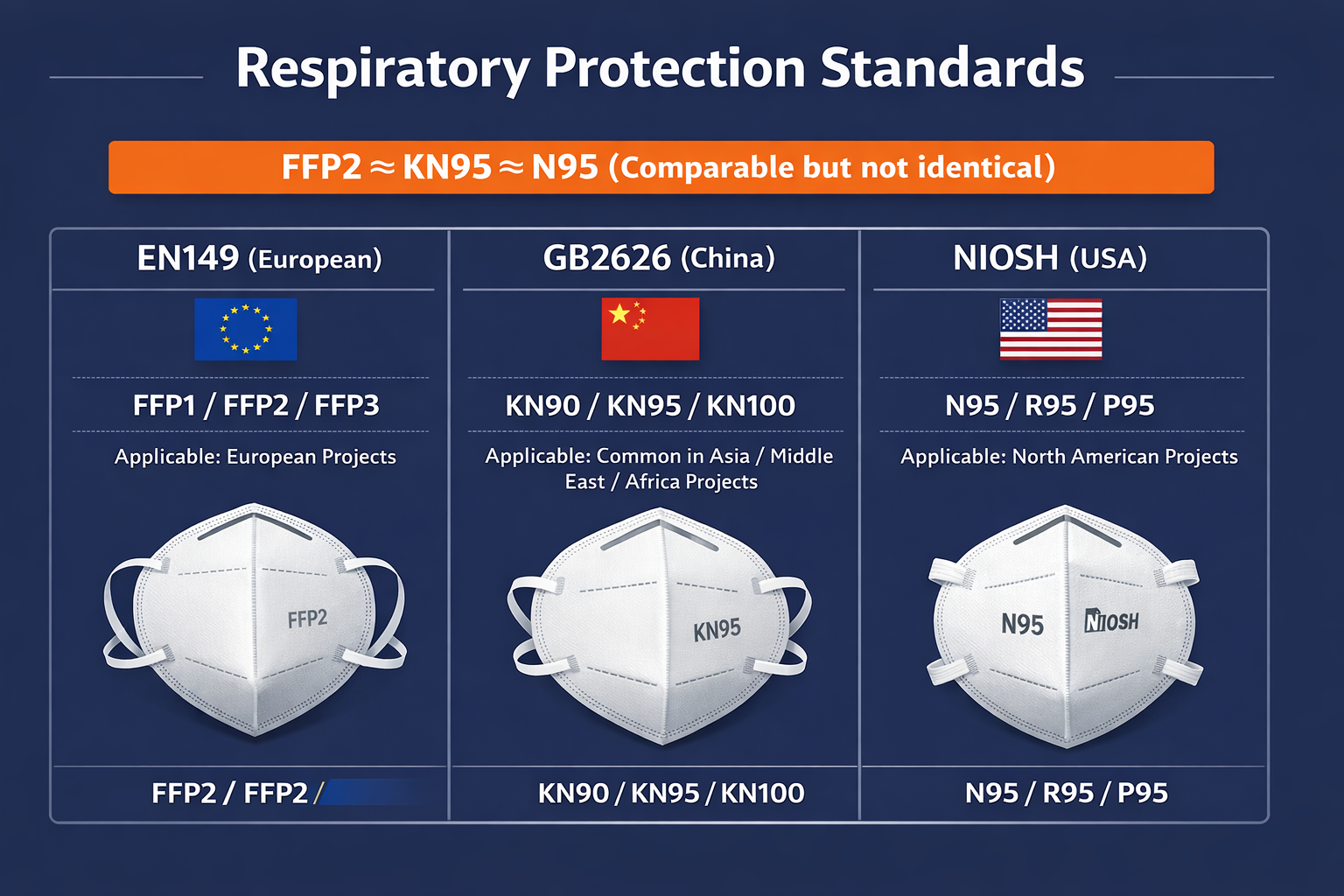
What Is EN149 (EU Standard)? Which Industries Use It?
EN149 is a widely used European standard for industrial particulate respiratory protection. Common grades include:
● FFP1 / FFP2 / FFP3
It is commonly applied in industrial environments such as:
● Construction, demolition, grinding, and cutting
● Cement dust, mining dust, woodworking dust
● Metal processing and welding fumes
● Factories, workshops, and dusty warehouse environments
FFP2 vs FFP3: What’s the Difference?
Simply put: FFP3 provides a higher protection level than FFP2, and is suitable for harsher dust conditions or projects with stricter PPE requirements.
● FFP2: A common general-purpose option, widely accepted with better overall cost efficiency
● FFP3: Higher grade, suitable for heavier dust exposure or stricter workplace rules
Valved vs Non-Valved Respirators
Buyers often ask how to choose between valved vs non-valved respirators:
● Valved respirators: Easier exhalation, better for high-intensity work and hot environments
● Non-valved respirators: More general-purpose, suitable for sites with standardized wearing rules
Reminder: Some job sites may have specific rules on whether exhalation valves are allowed. Always follow on-site PPE requirements.
What Is GB2626 (China Standard)? How to Understand KN95 / KN100?
GB2626 is a commonly used Chinese standard for respiratory protection. Typical grades include:
● KN90 / KN95 / KN100
● KP90 / KP95 / KP100
Among them, KN95 is extremely common in global B2B markets, especially in Asia, Africa, and the Middle East due to stable supply and wide adoption.
KN vs KP (Non-Oil vs Oil-Based Particles)
Here’s a simple way to understand it:
● KN series: Designed for non-oily particles (dust, mining particles, airborne solids, etc.)
● KP series: Designed for both oily and non-oily particles (broader application)
If your worksite mainly involves construction dust or industrial particles, the KN series is usually the more common choice.
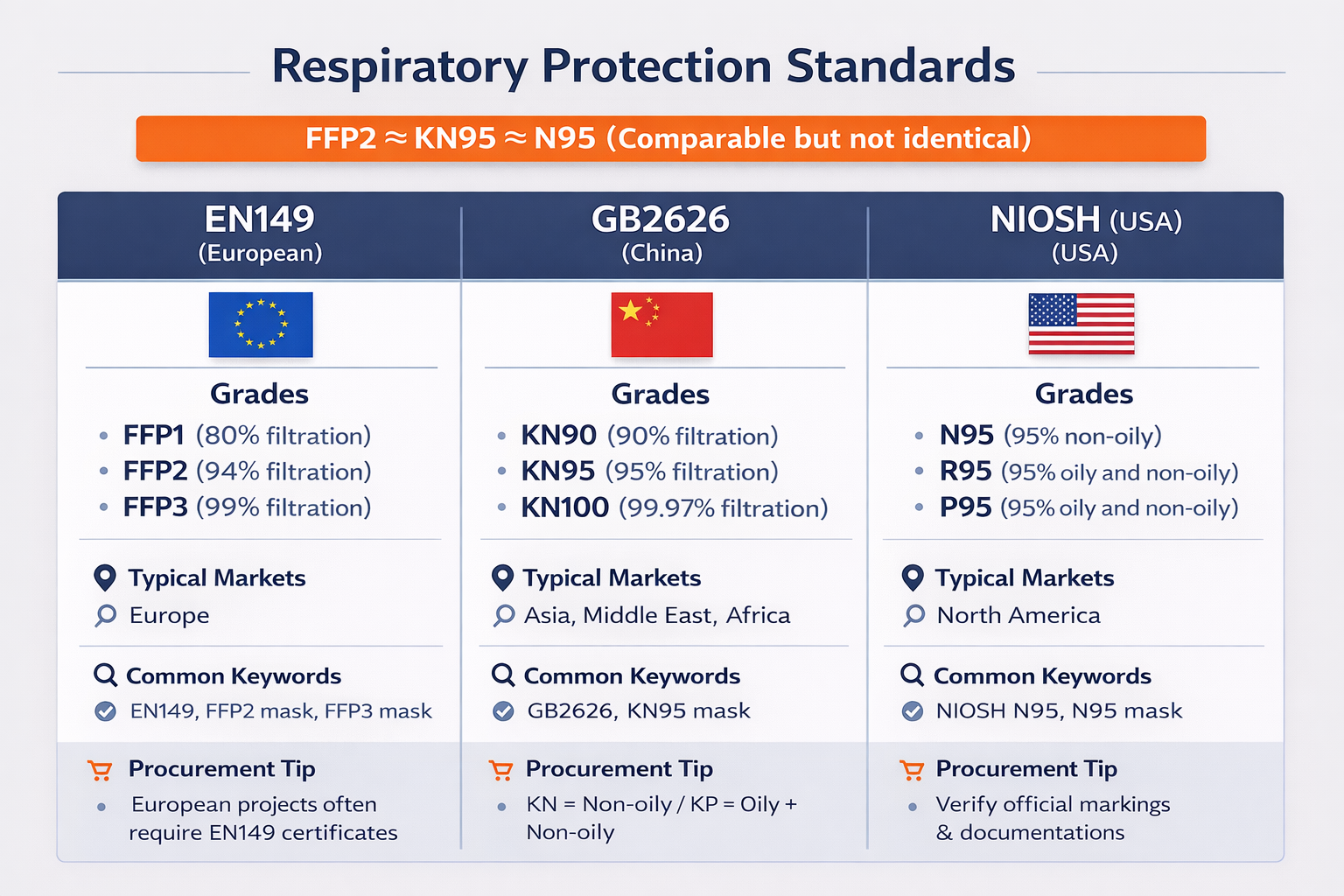
Market Usage in Asia / Africa / Middle East
From a procurement point of view:
● KN95: High demand, cost-effective, ideal for standard project distribution
● KN100: Higher grade, suitable for heavier dust environments or higher protection expectations
For export projects, it’s also recommended to confirm whether you need:
✅ Packing list / carton marks
✅ Technical documents
✅ Certificates and compliance files
What Is NIOSH (US Standard)? Key Identifiers for N95
NIOSH is one of the most widely used respiratory protection certification systems in North American industrial projects. One of the most common grades is N95.
What Do N / R / P Series Mean? (Basic Explanation)
Here’s a quick guide:
● N series: For non-oily particles (most common)
● R series: Limited resistance to oily particles (more restricted applications)
● P series: Suitable for oily particle environments (stronger applicability)
In project procurement, NIOSH N95 remains the most frequently requested option.
How to Identify Genuine NIOSH Marking (Avoid Counterfeits)
To reduce procurement risk, always check:
● Whether NIOSH is clearly printed on the product
● Whether the N95 grade is clearly marked
● Whether the product, packaging, and documents match consistently
● Whether certificates / technical data sheets (TDS) can be provided upon request
Comparison Table: FFP2 ≈ KN95 ≈ N95 (Comparable, Not Identical)
Many buyers ask:
Can FFP2, KN95, and N95 replace each other?
A common industry shortcut is:
FFP2 ≈ KN95 ≈ N95
But the more accurate statement is:
✅ Comparable
⚠️ Not identical
This table is useful for RFQ discussions and quick selection:
Standard System | Common Grades | Common RFQ Keywords | Procurement Notes |
EN149 (EU) | FFP2 / FFP3 | EN149, FFP2 mask, FFP3 mask | Often required in EU tenders |
GB2626 (China) | KN95 / KN100 / KP95 | GB2626, KN95 mask | KN = non-oil, KP = oil & non-oil |
NIOSH (USA) | N95 / R95 / P95 | NIOSH N95, N95 respirator | Verify marking & documents |
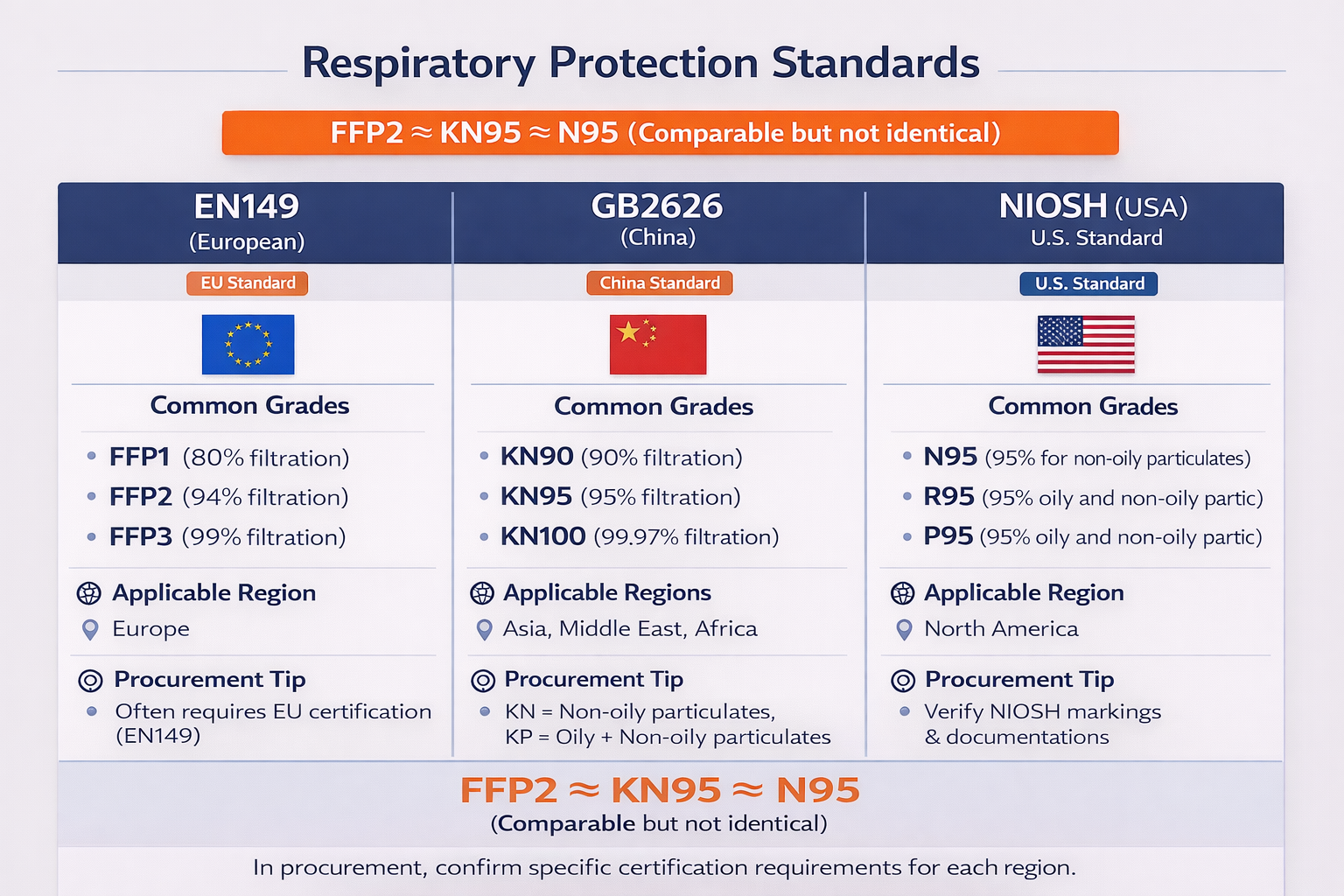
B2B Purchasing Tips: How to Choose Efficiently?
If you are a project buyer, contractor, or distributor, here’s the recommended selection process:
1) Confirm the Required Standard First
● EU / Europe projects: prioritize EN149 (FFP2/FFP3)
● North America projects: prioritize NIOSH (N95)
● Multi-country projects / general supply: GB2626 (KN95/KN100) is often a stable option
2) Choose the Grade Based on Worksite Conditions
● General dust environments: FFP2 / KN95 / N95
● Heavier dust exposure or higher requirements: FFP3 / KN100 (match your project needs)
3) Confirm Valved or Non-Valved
● High-intensity work / hot environments: valved models may be preferred
● Standard distribution / unified management: non-valved models are more common
Common RFQ Questions: Quantity, Lead Time, Certificates, OEM
To speed up quotation and production confirmation, prepare:
● Required order quantity
● Target lead time
● Needed certificates / technical documents
● OEM/ODM requirements (branding, packaging, carton printing)
● Destination country and special packaging rules (if any)
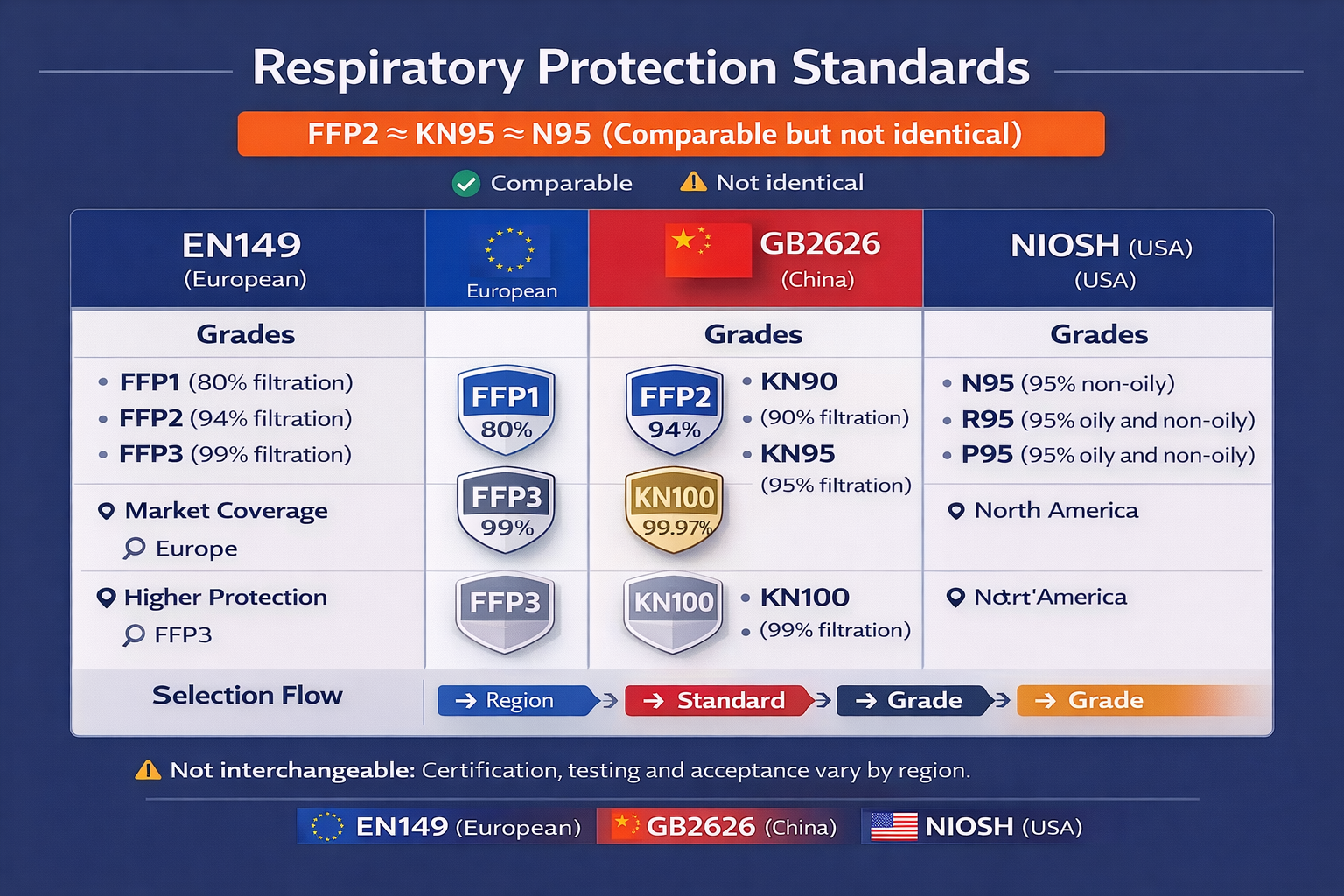
CTA
Need industrial dust respirators for your project?
Safeyear provides FFP2 / FFP3 / KN95 / NIOSH N95 industrial respiratory protection products for B2B supply, supporting OEM/ODM customization, with certificates and technical documents available upon request.
Contact us to get pricing and lead time details.
Contact & Links
Shop now: https://safetoework.com/
Wholesale: https://safetoe.net/
WhatsApp: +8615375354433
YouTube: @SAFETOE


 English


